What Is DeFi? Decentralized Finance Explained
On this page
What is DeFi?
DeFi (decentralized finance) is financial services, such as trading, lending, borrowing and saving, that run as smart contracts on public blockchains instead of through banks, brokers or exchanges. Anyone with a crypto wallet can use them, transactions settle on-chain around the clock, and you keep custody of your assets unless you deposit them into a contract.
The Financial Stability Board describes DeFi as services that aim to replicate some functions of traditional finance while seemingly removing the intermediaries; in practice, most DeFi activity still involves crypto assets rather than the wider economy.
In short: in traditional finance a company holds your money and runs the rules; in DeFi, open-source code holds the money and runs the rules. For a quick plain-English version, see what DeFi means in crypto. This hub goes deeper and links to everything DeFipedia has on the topic.
How DeFi works
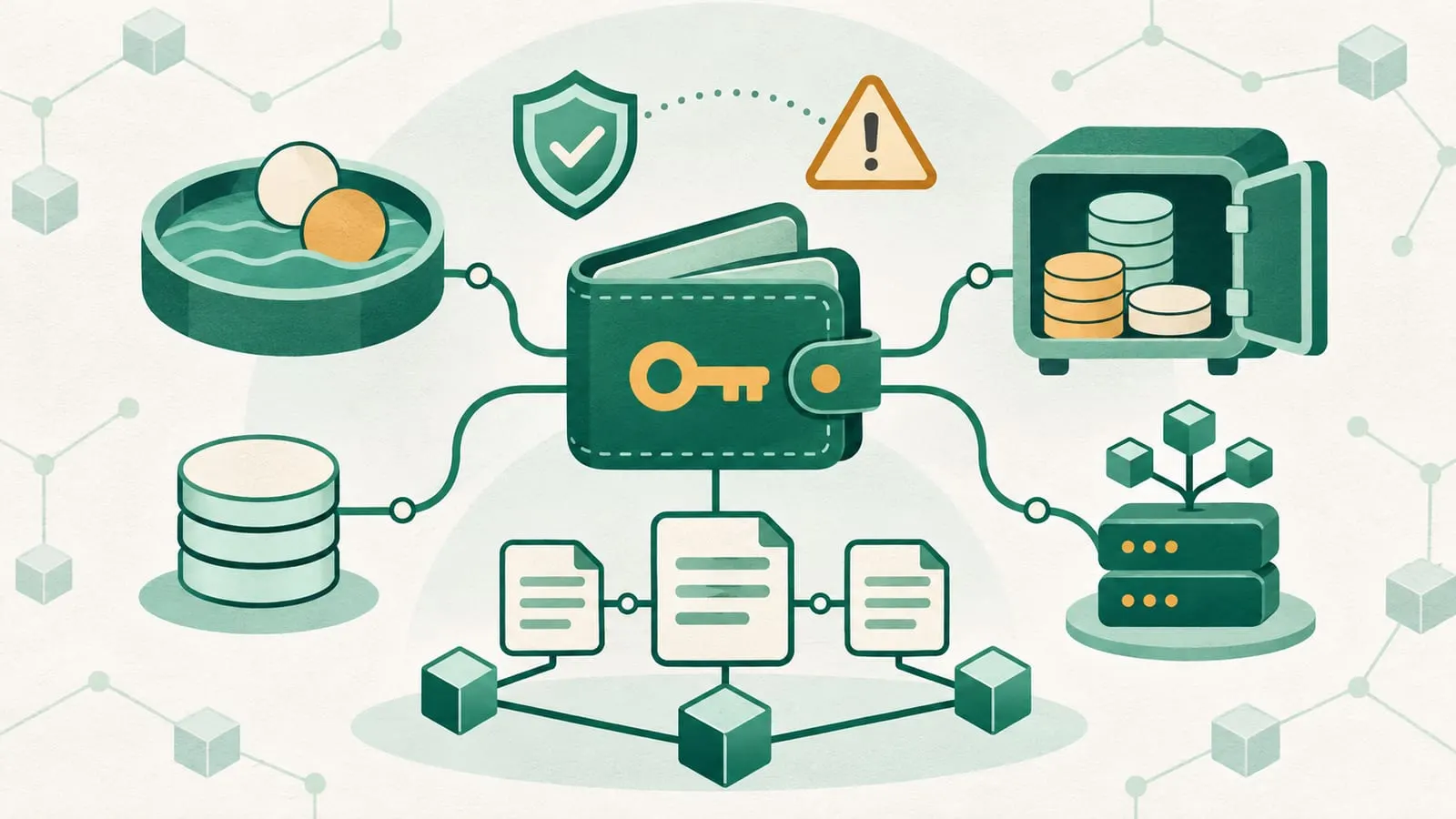
DeFi is built in layers, each relying on the one below:
| Layer | What it is | Examples |
|---|---|---|
| Blockchain | Records transactions and runs contracts | Ethereum, its layer 2s (Arbitrum, Base), Solana, BNB Chain |
| Assets | The tokens that move through DeFi | ETH, stablecoins like USDC and USDT, wrapped BTC, DeFi tokens |
| Protocols | Smart contracts that provide a service | Exchanges, lending markets, staking, derivatives |
| Applications | Websites and apps that make protocols easy to use | Protocol front ends, aggregators, wallets |
| Wallet | Your keys and the way you sign transactions | Browser and mobile DeFi wallets |
A typical interaction looks like this: you open a protocol’s website, connect your wallet, and sign a transaction, for example “supply 500 USDC”. The transaction goes to the blockchain, the protocol’s contract checks it and updates balances, and the result is public for anyone to verify. There is no application form and no one who can approve or decline you, though some websites block certain countries.
Because every protocol is open code on the same chain, they can plug into each other. A token you receive from one can be used immediately in another. This composability is why DeFi is often described as “money Legos”.
What can you do with DeFi?
| Activity | How it works | Example protocols |
|---|---|---|
| Swap tokens | A decentralized exchange (DEX) prices trades from liquidity pools | Uniswap, Curve, PancakeSwap |
| Lend and borrow | Lenders earn interest; borrowers post more collateral than they borrow | Aave, Morpho, Compound |
| Hold dollar tokens | Stablecoins track a currency such as the US dollar | USDC, USDT, DAI and USDS |
| Stake | Lock ETH or other coins to help secure a network and receive a liquid token | Lido, ether.fi |
| Earn yield | Supply liquidity or deposit into vaults for fees and rewards | Curve pools, yield vaults |
| Trade derivatives | Perpetual futures and options settled on-chain | Hyperliquid, GMX, dYdX |
| Bet on outcomes | Prediction markets trade on real-world events | Polymarket |
You can read more about each in our hubs on DeFi lending, yield farming and liquidity pools. If you want to understand the services behind the apps, start with what DeFi protocols are.
How big is DeFi in 2026?
The usual yardstick is total value locked (TVL), the value of assets deposited in DeFi contracts. As of November 16, 2026, DefiLlama put total DeFi TVL at about $71 billion. That compares with:
- a peak of nearly $178 billion in November 2021,
- about $115 billion at the start of 2025,
- a 2025 high of about $168 billion in early October 2025, before a sharp fall to about $112 billion by the start of 2026 and lower since.
TVL rises and falls with crypto prices as much as with deposits, so it is a rough gauge. Stablecoins, which most DeFi activity runs on, had a combined supply of about $287 billion on the same date.
Excluding bridges and wrapped-token custodians, which we treat as a separate category (the LayerZero V2 bridge alone held about $17 billion), the biggest DeFi protocols by deposits in mid-November 2026 were Lido (liquid staking, about $18 billion), Aave V3 (lending, about $14 billion) and Morpho (lending, about $10 billion). Decentralized exchanges hold far less TVL, but Uniswap remains the largest DEX by trading volume, with about $63 billion across its versions in the 30 days to November 16, 2026, per DefiLlama. Check DefiLlama for live figures.
DeFi vs CeFi vs TradFi
| DeFi | CeFi (crypto companies) | TradFi (banks, brokers) | |
|---|---|---|---|
| Who holds your assets | You, or a smart contract | The company | The institution |
| Access | Any wallet, no KYC at protocol level | Account and KYC | Account and KYC |
| Transparency | Fully on-chain | Limited, company reports | Limited, regulated reporting |
| Reversibility | Transactions generally final | Company can freeze or reverse | Disputes and recalls possible |
| Protections | None by default | Varies; usually no deposit insurance | Deposit insurance, regulation |
CeFi means centralized crypto platforms such as exchanges and lenders. The 2022 collapses of crypto lenders like Celsius and BlockFi were CeFi failures, not DeFi ones, but they show why custody matters. For more, see TradFi vs DeFi.
Is DeFi really decentralized?
Not always. Many protocols started with, and some still have, admin keys or multisig wallets that can upgrade or pause contracts. Governance votes are often dominated by a few large token holders. Most DeFi depends on centralized stablecoins like USDC and USDT, whose issuers can freeze addresses, and on price oracles run by a small number of providers. The Bank for International Settlements calls this the “decentralisation illusion”. Decentralization is a spectrum, so check each protocol’s controls rather than taking the label on trust. The key features of DeFi explain the ideals; this section explains the reality.
A short history of DeFi
- 2009: Bitcoin shows that value can move peer to peer without a bank. ethereum.org calls it, in many ways, the first DeFi application.
- 2015: Ethereum launches with general-purpose smart contracts.
- 2017-2018: Early protocols appear, including MakerDAO’s DAI stablecoin and the first version of Uniswap.
- 2020: “DeFi summer”: token rewards for using protocols (liquidity mining) cause TVL to soar.
- 2021-2022: TVL peaks in November 2021, then falls with the Terra collapse and the 2022 bear market.
- 2023-2026: Growth of layer 2s, liquid staking, restaking and tokenized real-world assets, alongside new regulation such as the EU’s MiCA and the US GENIUS Act for stablecoins.
How to get started with DeFi
- Learn the basics of wallets, gas fees and how a seed phrase works.
- Set up a self-custody wallet and back up the recovery phrase offline. Never share it.
- Fund it with a small amount from an exchange, plus a little of the network’s native coin for fees.
- Pick an established protocol and reach it through a bookmarked official link, not a search ad or social media post.
- Make a small test transaction, read what your wallet asks you to sign, and check the result on a block explorer.
- Track your positions and revoke token approvals you no longer need.
For lending specifically, see how to lend your crypto on DeFi. For the long-form beginner’s guide, see DeFi explained for beginners.
Risks of DeFi
- Smart contract risk: bugs can be exploited and funds drained. A rounding-error exploit cost Balancer V2 about $128 million in November 2025, according to DefiLlama; Balancer’s own post-mortem put the theft of user funds at about $94.8 million. Read about smart contract vulnerabilities.
- Collateral and bridge risk: a failure in one asset can spread. In April 2026, unbacked rsETH from an exploited bridge route was used as collateral to borrow from Aave V3; Aave’s incident report first modeled potential bad debt of roughly $124–230 million depending on the scenario, revised on April 22 to about $62–162 million; no final figure had been published on Aave’s forum by mid-November 2026.
- Liquidation: if your collateral falls in value, your loan can be closed at a penalty. See forced liquidation.
- Stablecoin depegs: a stablecoin can lose its dollar value if its backing fails.
- Scams and phishing: fake websites, malicious approvals and rug pulls cause large losses. See our scams hub.
- No safety net: DeFi deposits are not bank deposits and have no government insurance. Some users buy cover from decentralized insurance protocols, which covers only part of the market.
- Regulatory and tax risk: rules differ by country and are changing, and most DeFi transactions can be taxable events.
For a fuller treatment of yield strategies, see the risks of yield farming. Explore the DeFi basics pillar for more guides. This page explains how DeFi works and is not financial advice.
Frequently asked questions
What does DeFi stand for?
DeFi stands for decentralized finance. It refers to financial applications built on blockchains, mostly Ethereum and other smart contract networks, that work without a bank or broker in the middle.
Is DeFi the same as crypto?
No. Crypto is the broad category of blockchain-based assets. DeFi is the subset of applications that provide financial services, such as exchanges and lending markets, using those assets.
Is DeFi legal?
Using DeFi is legal in most countries, but rules vary and are evolving. Some front ends block certain regions, and regulators apply securities, tax and anti-money-laundering rules to many activities. Check the rules where you live.
How do I start using DeFi?
You need a self-custody wallet, some of the network's native coin to pay transaction fees, and the assets you want to use. Start with small amounts on a well-established protocol, and bookmark its official site.
Can you lose money in DeFi?
Yes. Token prices can fall, positions can be liquidated, smart contracts can be hacked and stablecoins can lose their peg. There is no government insurance on DeFi deposits.
Is DeFi really decentralized?
It varies. Many protocols have admin keys, small governance groups or centralized front ends, and depend on centralized stablecoins and price oracles. Check who controls upgrades before trusting a protocol with funds.
Sources
- Balancer: Nov 3 exploit post-mortem (November 2025)
- Aave governance forum: LlamaRisk update to the rsETH incident report (April 22, 2026)
- ethereum.org: Decentralized finance (DeFi)
- DefiLlama: DeFi total value locked
- DefiLlama API: historical TVL across chains
- DefiLlama API: stablecoin supply
- Financial Stability Board: The financial stability risks of decentralised finance (Feb 2023)
- BIS Quarterly Review: DeFi risks and the decentralisation illusion (Dec 2021)
- Aave governance forum: rsETH Incident Report (April 20, 2026)
- ESMA: Markets in Crypto-Assets Regulation (MiCA)
Educational content, not financial advice. DeFi carries risk, including total loss of funds.
Guides about Defi
- DexGuru Review—Ease of Use, Fees, Wallets, and More
DexGuru is a legit and modern trading platform for beginners and experienced traders alike. Here's a lowdown on all that you need to know about DexuGuru.
- Understanding Arbitrage in DeFi: Opportunities, Strategies, and Risks
Arbitrage opportunities exist in nearly every market, especially in DeFi. Understanding DeFi arbitrage opportunities can make you an easy risk-free profit.
- Brief Timeline History of Ethereum Blockchain
A look at Ethereum's journey over the years. The brief timeline history of Ethereum covers all major milestones of network development, forks, and upgrades.
- Alpha Homora—Ease of Use, Fees, Wallets, and More
Learn more about Alpha Homora—why the platform is a big player in DeFi, what it offers, and why you should consider investing in it.
- How to Mint an NFT: A Beginner’s Guide
Turning your digital artwork into valuable blockchain-based assets doesn't require coding skills. Here is how you should go along with minting your first NFT.
- Decentraland Review—Ease of Use, Fees, Profitability, and More
Read to learn everything about Decentraland—what the platform does, how it works, and why it's one of the biggest players in the virtual reality space.
- Risks of Yield Farming
The risks of yield farming include impermant loss, smart contract exploits, unfariness, liquidation, and more.
- Margin Trading on dYdX Explained for Beginners
What is margin trading, what is dYdX, how to trade margin on dYdX, how to borrow assets on dYdX, what is dYdX margin and borrowing collateralization?
- How to Make a dApp
DApps have a normal frontend and a backend that exits on the blockchain. Knowing the steps and how much it cost to build a dApp is crucial at the moment.
- What Is TradFi
TradFi or traditional finance refers to the mainstream financial system that consists of banks, fintech companies, and other financial institutions.
- Smart Contracts in Blockchain: What They Are and How They Work
What are smart contracts in blockchain and how do they work? Learn more about smart contracts, including their benefits and applications.
- Decentralized Hedge Funds: What Are They and How Do They Work?
A decentralized hedge fund is a community-based investment pool, where the members/community select allocation funds instead of a hedge fund manager.
- Alpaca Finance—Ease of Use, Fees, and More
Learn more about Alpaca Finance—what the platform has to offer and why it will be a big player in the DeFi space
- Aragon DAO—Ease of Use, Fees, Tokens, and More
Aragon is a decentralized autonomous organization that enables developers to create DAO projects using the Aragon smart contracts seamlessly.
- A Guide to the Best NFT Marketplaces
There are many NFT marketplaces avilable online, this post highlights some of the best NFT marketplaces to buy, sell, and trade NFTs.
- 1inch Exchange Review—Ease of Use, Fees, Wallets, and More
This review aims to answer some of the most common questions asked about 1inch, the pros, and cons, the exchange fees, and its key features.
- Using the Benefits of Augur to Make Money
Learn about the benefits of Augur, how it works, its features, and how to buy and store it.
- Pros and Cons of Decentralized Exchange (DEX)
Decentralized exchanges (DEXs) provide a range of advantages and disadvantages when compared to traditional finance.
- How to Invest in the Ampleforth Stablecoin
Ampleforth is an algorithmic stablecoin protocol on the Ethereum blockchain that is censorship resistant and based on a rebase mechanism.
- DeFi Pulse Index: Intro, Pros & Cons, and How to Buy
Explaining the DeFi Pulse Index (DPI)—how it works, what it does, and why you should consider buying it.
- Best dApps for Making Money
In this article, we take a look at some of the best dApps in the market and how you can make money using them. Read on to learn more.
- Akropolis Explained: Features, Pros & Cons, and More
This piece explores Akropolis project - how holders of AKRO can hold tokens and earn interest, and the pros and cons of the Akropolis project
- MakerDAO: The History and Role of the Building Block of DeFi
MakerDAO allows users to take create debts and take DAI, a neutral stablecoin using volatile cryptocrrencies voted by the MakerDAO community as collateral.
- How to Interact With dApps
What are dApps? Explore how decentralized applications work, why they're useful, and how to access them yourself.
- Limitations of Bitcoin: Scalability, Smart Contracts, and More
Learn about Bitcoin, its scalability, use in smart contracts, limitations and disadvantages, and more.
- TradFi vs DeFi: Differences and Similarities
What is TradFi and DeFi, similarities, differences, and what the future holds for these two finance systems
- Differences Between Lending in DeFi and TradFi
What is the difference between DeFi and TradFi? What are the advantages and disadvantages of both finance systems? Can DeFi outperform TradFi in the future?
- An Intro to the Arbitrum Ecosystem
what is Arbitrum, what are Arbitrum ecosystems,, what are the top Arbitrum coins, what are the advantages and disadvantages of Arbitrum?
- DEX vs. CEX: Which Is Better?
What are DEXs, how do they work, what are CEXs, how do they work, what are the differences between DEX and CEX, what makes a DEX better than a CEX?
- Benefits of Asset Management Protocols for DeFi & DeFi 2.0
DeFi protocols are a significant element of the decentralized finance space. Learn about the benefits of asset management protocols here.
- How NFTs Are Used in DeFi
The use cases of NFTs in DeFi are numerous. From simple tokens, security, and ticketing to fun experiences in degenerate multiverses, NFTs are DeFi gems.
- How Can I Find New DAO Projects?
DAOs, or decentralized autonomous organizations, refer to member-owned communities that function without centralized leadership. Read on to learn more.
- NFTs in the Metaverse: A Brief Introduction
Explaining NFTs - non-fungible tokens; why they have gained so much popularity, as well as how to buy an NFT yourself.
- Key Features of DeFi Explained
Explaining decentralized finance (DeFi)—how it differs from traditional finance solutions, and why it has become a popular finance option.
- Brief History of Bitcoin: The Beginning of DeFi
The history of Bitcoin, why was it created, price action over the years, what affects the price of bitcoin, what the future holds for Bitcoin
- Mapping the DeFi Ecosystem in 2022
Blockchain technology is revolutionizing the financial sector thanks to DeFi. Discover the ecosystem of the DeFi space in this article.
- A Guide to $Magic Tokens: What They Are and How to Buy Them
what is magic trading, what are MTK tokens, how to buy MTK tokens, what are the advantages and disadvantages of MTK tokens?
- What Is DeFi: Beginner’s Guide to Decentralized Finance
DeFi, short for decentralized finance, is an umbrella term for the emerging peer-to-peer financial services that run on blockchains technology.
- What Are the Risks of Defi 2.0 and How Can You Avoid Them?
Although an improvement on DeFi 1.0, DeFi 2.0 still contains risks, many of which can be avoided via due dilligence and planning.
- Automated Market Makers: What They Are and How They Work
Simply put, AMMs are self-governing trading techniques that eradicate the need for centralized marketplaces and related market-making methods.
- How Ethereum is Changing the Crypto Narrative
What is Ethereum and Ethereum gas fees? What is the energy consumption of Bitcoin and ETH? Lean how Ethereum is overtaking Bitcoin and more in this article.
- DeFi Loans Explained for Beginners
What is DeFi lending, how does it work, what are this risks of DeFi lending, are DeFi loans worth it?
- Top 6 Revolutionary Use Cases of DeFi
What are the top revolutionary use cases of DeFi? What is the purpose of DeFi? What is the future of DeFi?
- Everything There Is to Know About Decentralized Stock Exchanges
Learn about decentralized stock exchanges with examples, how they work, and their advantages and disadvantages.
- Understanding the Scalability Trilemma
Scalability, decentralization, and security - how can we fix this trilemma?
- Are NFTs a Good Investment?
What are NFTs, how do they work, what are the pros and cons of investing in NFTs, what are the best NFTs to invest in?
- 3 Best DeFi Projects to Watch Out for in 2022
A brief overview of decentralized finance (DeFi) - how to invest in DeFi, and the best DeFi project to invest in 2022
- Key Insights to Maximizing Staking With Lido
Lido is an Ethereum-based DeFi staking platform that is on a mission to reduce the barriers to entry for staking by allowing users to stake any amount of Ether (ETH).
- Options Trading Strategies: Everything You Need to Know
Options allow holders the right and not the obligation to buy or sell specific assets like Bitcoin or Ethereum in DeFi or TradFi at a defined price and date.
- Step-By-Step Guide: How to Start a DAO
This step-by-step guide explains exactly what you'll need to to start a DAO successfully.
- The Harmful Impact of NFTS on the Environment and What to Do About It
Learn about the harmful impact of NFTs on the environment, their carbon footprint, and what to do about it.
Answers about Defi
- What Is a Flash Loan in dYdX?
Unlike regular loans, flash loans do not require borrowers to provide collateral or proof of income. Open this link to learn more.
- Swap vs. DEX: What's the Difference?
A DEX is a peer-to-peer crypto marketplace, whereas a swap is the exchange of one crypto for another. Here is a quick overview of both.
- DEX vs. Dapp: What’s the Difference?
Explaining the differences between decentralized exchanges and decentralized apps - where their similarities end and differences meet.
- DeFi Pulse Index: What It Is and How to Buy It
What is DeFi Pulse Index (DPI), where to buy DPI, how to buy DPI?
- What Does APY Mean in Crypto?
APY or annual percentage yield is the rate of return on an investment in a year, factoring in the compounding interest. Find out what it means in crypto.
- Can You Stake With Akropolis?
What is Akropolis, what is AKRO used for, how to stake AKRO?
- Why Is DeFi Based on Ethereum Network?
Despite the scalability and high gas fee glitches, Ethereum is still the gold standard of DeFi. Open this link to learn more.
- Are Smart Contracts Legally Binding?
Explaining the legality of smart contracts - how they work, and whether or not they are legally binding under a jurisdiction.
- Is Augur a Good Investment?
Augur is a prediction market and betting protocol on Ethreum. Although an old name, predictions show that it may hit the top of the charts soon.
- Prediction Markets: What They Are and How They Are Utilized
Explaining prediction markets, how they work, and what are their use cases
Community questions about Defi
- What are the best node projects to invest in for passive income?
Crypto nodes have been a really popular & trending way to earn passive income in recent years. Having a crypto node is quite easy and it can be rewarding…
- Is stablecoin yield farming a good investment?
While you can make more profits by yield farming with standard crypto like Bitcoin , you are faced with the risk of impermanent loss . This is every yield…
- Can you make money from stable coins?
Yes, you can definitely make money from stable coins. As you probably already know, stablecoins are cryptocurrencies that are pegged to the value of a…
- How does lending work on Aave?
Aave is a DeFi platform that allows users to lend and borrow assets without the services of an intermediary. As an Aave lender, you deposit the assets you…
- What are the most popular tokenization platforms?
Here are the five most popular tokenization platforms you should check out: Polymath – primarily deals with the development, issuance, and management of…
- How does impermanent loss work with a stablecoin?
If the stablecoin is truly stable, then you'll have minimal impermanent loss, or none at all. However, if the stablecoin isn't backed by real cash, you…
- How did the Ethereum Yellow Paper differ from the White Paper?
A whitepaper predominantly describes a business idea, while a yellow paper outlines the project’s technical documentation. When you compare the Ethereum…
- How do liquidity pool fees work?
The fee you'll get depends on the percentage of your deposit in relation to the pool. In simpler words, if the pool has $900, and you deposited $100…
- How can I build a DeFi lending protocol?
The complexity of the protocol you are building depends on the kind of platform and the number of functionalities you want your platform to have. The…
- Do yield farming bots exist and are they safe?
It is in fact possible to create any kind of bot to do anything, especially with crypto and in trading. Most of the platforms known as yield aggregators…
- What does DeFi mean in crypto?
DeFi is an acronym for decentralized finance . It refers to the collections of applications and websites that offer services formerly provided by banks…
- What is TradFi and DeFi?
Traditional Finance, often abbreviated as TradFi, is the conventional financial system, like banks, hedge funds, brokerages, etc. It’s characterized by a…
- How was your trading experience with TradFi vs. DeFi?
I prefer DeFi to TredFi anytime because of the potential it holds. Driven by its growth in market capitalization and transaction volume, DeFi has taken…
- What is forced liquidation in margin trading?
Forced liquidation is the involuntary sale of assets held in a margin account by a brokerage company, normally after the account owner fails to meet…
- Is Nexo a great platform to earn a passive income on?
Nexo has been around since the early days of crypto. I think it is right to call Nexo a legit and reputable platform to invest your money. They are a bit…
- How do I convert Bitcoin to Ethereum on a DEX?
Let’s demonstrate this point using Uniswap as our DeFi exchange. First, visit the Uniswap website. Press the “Use Uniswap” tab on the upper right-hand…
- How do deflationary tokens work?
Unlike inflationary assets (like the US Dollar, for example) deflationary assets have a limited (finite) supply that cannot be surpassed under any…
- What are stablecoins in cryptocurrency?
Stablecoins are cryptocurrencies pegged to “stable” physical assets, like commodities and fiat money. They are the solution to the needs of cryptocurrency…
- What is the difference between bear and bull markets?
The metaphor behind the bull and bear market comes from the actual animals themselves and their mode of attack. Bears often claw downwards when fighting…
- What's the difference between DeFi 2.0 vs 1.0?
DeFi 2.0 and DeFi 1.0 differ in terms of liquidity ownership. Protocols that adopt DeFi 2.0 own the liquidity of the protocol, but in DeFi 1.0 the…
- What is the difference between node and masternode projects?
A Masternode resembles a node – a computer whose data is linked to other computers – on a blockchain but with extra functions. Generally, you require…
- What are the major lending risks in DeFi?
There are three major lending risks of DeFi: Impermanent Loss - When you lock your tokens in a DeFi protocol , you risk impermanent loss. Basically, this…
- What is a blockchain?
Blockchain is a shared, immutable, and transparent ledger of transactions that are secure, yet accessible to everyone at any time. You can think about…
- How do DeFi lending protocols work?
DeFi lending protocols enable users to lend and borrow cryptocurrencies in a permissionless, immutable, interoperable, and transparent way. A traditional…
- Are there DeFi platforms that allow instant access to staked coins?
You'll have a hard time finding a DeFi platform that allows such a feature. Even if you do find such a platform, they'll probably be an unreliable one…
- What are the costs involved in running node projects?
You require 125 gigabytes of free disk space, 2 gigabytes of memory, a broadband internet connection with a minimum upload speed of 400 kilobits per…
- What is collateral in DeFi lending?
In DeFi lending, a collateral is a digital asset that a lender accepts as security for offering a loan. The collateral mitigates financial background…
- Which platform is best for yield farming stablecoins?
Curve is the best platform for stablecoin yield farming. It’s an Automated Market Marker (AMM) platform that resembles Uniswap and Balancer. However, it…
- Why are smart contract transactions irreversible?
Generally, smart contracts are irreversible since there is no third party to verify transactions. But because they are accessible, traceable, and…
- What is multichain bridging?
A multichain bridge is a website that allows you to move your crypto across several blockchains and convert to different assets in a few clicks. Doing…
- What are the security risks of DeFi lending platforms?
There are three main security risks of DeFi lending platforms: Rug Pulls This is an exit scam where project owners issue a new coin, pair it to major…
- What is cross-chain in DeFi?
A blockchain is an entire ecosystem that consists of a base layer and a programmable layer often supports the development of other applications. The base…
- Which cryptocurrencies use smart contracts?
Smart contracts are programs that define rules of agreement between platforms and their users, such that if a user fulfills condition A, the smart…
- What is the interest rate on margin trading?
Margin trading is a form of secured lending. In other words, when you apply for a loan from a brokerage firm to buy assets on margin, your loan is secured…
- Will I earn a high interest rate on stable coins?
Depending on the platform where you're investing your stable coins, you can definitely earn a high interest rate on them. Specifically, many platforms…
- DeFi vs crypto: What's the difference?
Decentralized finance or DeFi is a collective name for financial services platforms that use blockchain technology to provide services that were normally…
- How do DeFi loans work?
DeFi loans are simple, and if you are someone who loves the privacy and the permissionless nature of the blockchain, DeFi loans can be yet another…
- What are the advantages of deflationary crypto assets?
There are multiple benefits investors and developers get from deflationary tokens . Above all, deflationary cryptocurrencies strive to solve the…
- Cryptocurrencies with the smartest contracts?
Ethereum remains the biggest smart contract platform in the crypto space. However, it is facing stiff competition from blockchain protocols like Solana…
- Where do I see my P2P transactions history with DeFI?
It is easy to view transaction history on centralized exchanges and platforms because these platform store your data and sometimes require KYC to comply…
- What's the difference between TradFi and DeFi?
In DeFi, decentralized ledgers act as the source of trust, controlling all activities in the financial space. Contrary, public governance (laws and…
- How many DeFi protocols are there?
There are hundreds of DeFi protocols out there running on various blockchains. Some are pretty popular, while others are mostly unknown. DeFi prime…
- What are DeFi lending protocols?
DeFi lending platforms like Aave , Compound, and Oasis are protocols where you can lend and borrow crypto. For example, if you deposit some ETH at Aave…
- Which DeFi lending platforms are recommended?
If you're interested in getting started with DeFi lending as a beginner, I'd highly recommend going with reputable lending platforms. Ignore all platforms…
- How do I use stablecoins?
You can use stablecoins to facilitate trades on cryptocurrency marketplaces. Instead of purchasing crypto using fiat money directly, you can convert your…
- How does DeFi lending compare with traditional lending?
The technology behind DeFi lending is blockchain; DeFi leverages its unique features to emerge a step UP over the traditional lending methods. First, DeFi…
- What is LP in decentralized finance?
LP can refer to liquidity pools or liquidity providers and liquidity providers are the makers of the market. Some websites use LP providers to refer to…
- Where can I see my transactions on a blockchain?
Since the blockchain is public, every address, every transaction, and every block is traceable, as it's permanently written on the blockchain. Sure…
- How can I convert tokens to coins in a DeFi money market?
To convert your tokens to coins in a DeFi money market: Withdraw your tokens a DeFi protocol to a web3 wallet, like MetaMaskVisit a DEX platform like…
- What platforms can I buy stable coins from?
You can buy stablecoins from almost every centralized and decentralized exchange there is. This includes Binance , Coinbase, KuCoin, Nexo, and many…
- Why should I use DeFi over other cryptocurrencies?
It depends on the type of investor you want to be. Buying cryptos as an investment is speculative. You're hoping the price goes up, but it could go down…
- Can NFT's be used in DeFi?
NFTs or nonfungible tokens were created on Ethereum as an asset class of assets of their own. They only overlapped with DeFi as the use cases of NFTs…
- What are some popular use cases of DeFi?
DeFi is an alternative finance system that leverages blockchain to offer financial services and products of all sorts. These are the top 10 use cases of…
- What is the most popular DeFi lending platform?
Aave is the most popular DeFi lending protocol. Established in 2017 as ETHLend and initially Ethereum -based, Aave has expanded to enable DeFi lending and…
- Which are the best yielding strategies on Polygon?
The best yield farming strategy on Polygon can allow you to earn up to $100 daily. You can earn this by borrowing stablecoins on your staked Matic, and…
- What is DeFi lending?
DeFi lending is a decentralized setup that works like traditional financial markets. Lenders deposit their money in a smart contract, and are issued some…
- Which cryptocurrency has the least amount of volatility?
The most volatile cryptocurrencies are low market cap coins. You can determine the market cap by multiplying the current price of a coin by its…
- How does the Sifu scandal affect Wonderland in Crypto?
The Daniele and Sifu saga created a breach of trust in the TIME Wonderland ecosystem, causing mass panic and a mass sell-off, tanking the price of the…
- Do all DeFi lending protocols leave out centralized intermediaries?
DeFi lending protocols leave out centralized intermediaries by facilitating cryptocurrency loans in a trustless way – without third parties and letting…
- What risks come with DeFi lending?
Like every other investments, DeFi lending has its risks. The biggest of them all is the smart contract risk. There is also the risk of high fees or…
- What did Buterin write about in the original Ethereum White Paper?
The Ethereum yellow paper was published by Vitalik Buterin in 2014 alongside Dr. Gavin Wood, who now manages Parity Technologies, the parent company of…
- What do off-chain transactions mean in cryptocurrency?
Off-chain transactions are transactions running on a crypto network that transfers the value externally. Because of their cost-effectiveness, instant…
- Are NFTs Cryptocurrency?
Cryptos and NFTs stem from the same technology and encoding process via blockchain, but their difference lies in fungibility. Cryptocurrencies are digital…
- How do we work with crypto volatility in DeFi?
You can manage and safeguard against a volatile crypto market in DeFi by: Using automated smart contracts to minimize losses during a bear market and…
- Are there any risks in staking deflationary tokens?
Even investing in the most stable assets can be risky. History has proven time and again that investing always bears risks, no matter how slight the risk…
- Can I get high yields from stable coins?
Yes! You can definitely earn high yields from stable coins. In fact, in the vast majority of cases, stable coins offer the highest possible yields of any…
- Help! My fUSTD just disappeared.
Running different DeFi transactions can be confusing sometimes. Several things might be responsible for your fUSDT disappearing. You may have been hacked…
- How do you increase scalability in blockchain?
There are four factors that affect blockchain scalability: limitations, gas fees , block size, and response time. These issues can be solved through…
- Are there any risks to the DeFi borrower?
As a DeFi borrower, you are exposed to risks such as: Software risk DeFi platforms use smart contracts /software codes running on the internet. Like other…
- How sustainable are NaaS projects?
Now nodes as a service project are quite popular now in crypto. They reward you for buying some sort of space that allows you to earn passively but the…
- What can a DeFi loan be used for?
Margin trading is the biggest if not the only reason why people take DeFi loans . It allows you to open positions beyond the current value of your assets…
- How is stablecoin different from other cryptocurrencies?
A stablecoin is a cryptocurrency whose value is tied to a stable reserve asset like the US dollar or a commodity like Gold. Stablecoins offer an…
- Do deflationary tokens increase in value?
Deflationary tokens aim to minimize their market supply, and increase scarcity and demand. This directly implies that their value rises with time…
- Why is scalability important in blockchain?
Scalability is the capacity of a blockchain to handle large transaction throughput. Whether a user wants to join a blockchain network, use decentralized…
- How can I use reduce volatility in cryptocurrency?
Aside from building a balanced portfolio, the only other detail to hedge against potential cryptocurrency volatility is through short selling, futures …
- Do you think DeFi will replace TradFi?
Even though DeFi has been touted as a replacement for traditional finance for a long time, both sections of the industry will eventually co-exist and they…
- What is meant by hedging?
I've been reading on ways to reduce risk and the one word that popped up a lot was hedging. What does this mean?
- What advantages does DeFi have over TradFi?
DeFi is on a mission of revolutionizing TradFi by eliminating the financial bureaucracy plaguing mainstream financial systems like banks. The application…
- What are the steps to create a FaaS pool?
FaaS platforms allow project owners to create their liquidity pools via a straightforward, self-service interface with few clicks. FaaS enables project…
- Are there threats to banks in DeFi lending?
Currently, DeFi lending does not pose any serious threat to banks. However, this is bound to change with the elimination of barriers like over-…
- What assets can be tokenized?
Asset tokenization is the process of converting ownership rights of real-world assets into blockchain-based tokens. The possibilities of tokenization are…
- What are the risks of depositing Defi vs. Blockfi?
DeFi depositing/lending is an intensive approach to earning passive income from idle assets. But it is also essential to consider the various DeFi…
- What are smart contracts?
Smart contracts are computer codes built on a blockchain network that are self-executing when the agreed terms between two parties are met. Basically…
- What does impermanent loss mean?
Impermanent loss is the price difference between holding an asset on a centralized exchange or wallet and adding it as liquidity on Uniswap or other…
- Are there apps for DeFi lending?
Yes, there are several DeFi lending apps where you can learn about and get into DeFi lending. These apps offer loans for business purposes and allow users…
- How important is interoperability in DeFi?
Initially, the Ethereum blockchain and several other networks competed to own the greatest market share of the DeFi sector. Thus, most DeFi projects were…
- Is DeFi better than than TradFi?
DeFi is better than TradFi as its underlying technology – blockchain – offers an easier, near-instant, and more efficient way of executing secure…
- Can someone share advice on bear strategies?
The best way to earn passive income from crypto in a bear market is to have crypto that can keep earning you interest. You can also earn in a bear market…
- Can anyone make an NFT?
Yes, anyone can create an NFT as long as they have a crypto wallet (usually either Ethereum or Solana). NFTs don't have inherent value - instead, their…
- Is it a good idea to invest in DeFi staking?
Yes, it's a good idea to invest in DeFi staking as it has numerous benefits over Proof-of-Work (PoW) mining: It is cheaper: In PoW, you must purchase…
- Is TradFi or DeFi the future of crypto?
TradFi or traditional finance refers to current brick and mortar commercial banks and their entire structure. It included the slow payment settlement…
- Is DeFi completely anonymous?
Anonymity in crypto is a hard question to discuss. While crypto is anonymous a lot of things may be possible in the realm of hacking. For example, the IP…
- Are stablecoins better than bitcoin?
Stablecoins are better than bitcoin when you want to channel your bitcoin profits to a reliable store of value without necessarily converting them to fiat…
- How much time do I need to create FaaS pools?
It will take you less than one hour to create a FaaS pool. To create a pool on Value DeFi: Visit the Value DeFi websiteConnect your preferred web3…
- How do futures provided by centralized exchanges influence the price of the underlying assets?
Bitcoin futures does not have a direct correlation to the price of Bitcoin. However, futures may hold some temporary influence over price swings and may…
- Are there any DOA toolkits that can assist in rapid decentralized decision-making?
There are many decentralized autonomous organizations on several cryptocurrency projects that help to make decisions faster. The problem lately is that of…
- Can I stop crypto exchange hackers?
The best way to store your funds to protect you from hackers is to use an external hardware wallet or cold storage device that allows you to store funds…
- What are the parameters required to create FaaS pools?
FaaS is the fastest and most straightforward approach for startups to jump-start their token liquidity without any advance payment or expense. Value DeFi…
- How is DeFi currency different from other cryptocurrencies?
DeFi is a sub-niche within the cryptocurrency space that aims to cut out middlemen in finance by replacing them with smart contracts . DeFi specific…
- Which is the more profitable strategy: yield farming or staking?
Yield farming is usually more profitable than staking, but it's also a bit unreliable. It's widely regarded as a less safe option than staking…
- What does it cost to create FaaS pools?
It costs nothing to create a FaaS pool. There is absolutely no fee charged for creating a pool apart from the regular gas fees of executing a blockchain…
- Is decentralized insurance the next big DeFi trend?
Decentralized insurance is the next big DeFi trend since insecurity is a significant DeFi threat. DeFi insurance protocols provide insurance products and…
- Will NFT's last forever?
At its core, an NFT is simply a digital certificate of ownership. Against this backdrop, it is easy to see NFTs still used several decades into the…
- What does it mean to tokenize an asset in blockchain?
Asset tokenization is the process of transferring ownership rights of a tangible or intangible asset into blockchain tokens. For instance, you can issue…
- Can you get insurance for defi?
Insuring your DeFi assets is one way to hedge against volatility, crashes, theft, and hacks. Technical crashes and hacks are common in DeFi, and…
- Why did the Ethereum community split into Ethereum and Ethereum Classic?
Ethereum Classic (ETC) was created out of a philosophical and ethical disagreement in the Ethereum community that aggravates controversy till today. In…
- Is DeFi safe?
Try not to confuse DeFi with cryptocurrencies, as cryptocurrency is a broader term used to talk about assets of value issued by platforms which could be…
- What are the benefits of holding onto deflationary coins for yield pool value?
There are definitely benefits of holding onto deflationary coins. Unlike inflationary assets (like the US Dollar), deflationary ones do not lose value…
- Best DeFi Staking Platforms in 2022
Proof-of-stake (PoS) networks are particular to cryptocurrency staking. It operates similarly to a standard equity account. When consumers lock up their…
- Will DeFi dApps surpass most of the BSC or some ETH swaps?
In the future, DeFi dApps will surpass their centralized counterparts like BSC and ETH swaps. This opinion is shaped by the fact that decentralization is…
- Are stablecoins worthwhile investing in the long term?
Stablecoins can be quite profitable, so yes, you can regard them as profitable long-term assets to grow your investment. Namely, there are 3 ways you can…
- Is Ethereum still worth investing in?
If you advocate sustainable energy generation and use and want to be ahead of the curve, you should consider investing in Ethereum. Unlike Bitcoin , which…
- Is yield farming stablecoins safe?
While you can make more profits by yield farming with standard crypto like Bitcoin , you are faced with the risk of impermanent loss . This is every yield…
- Where can I yield farm stablecoins?
Here are the top three platforms where you can yield farm stablecoins: Aave – this is a popular stablecoin yield farming platform. With more than $14…
- Will I still be liable for the network fee on a congested DeFi network?
DeFi congestion happens when the demand for DeFi transactions surpasses the underlying blockchain capacity. Each blockchain has a block limit on the…
- Do L2 protocols pose less risk for generating higher returns for yield farmers?
Layer-2 protocols are designed to be faster and more efficient than their layer-1 counterparts. To be this fast and efficient, L2 protocols must sacrifice…
- How do I compare DeFi/CeFi's yield rates?
It's great to compare yield rates to know which platform has better profit viability. However, CeFi generally has a lower yield than DeFi, so it may be…