How Do DeFi Lending Protocols Work? Pools, Interest Rates, Collateral and Liquidations
On this page
I hear a lot about asset management in crypto and DeFi. How do DeFi lending protocols work when it comes to asset management?
The short answer
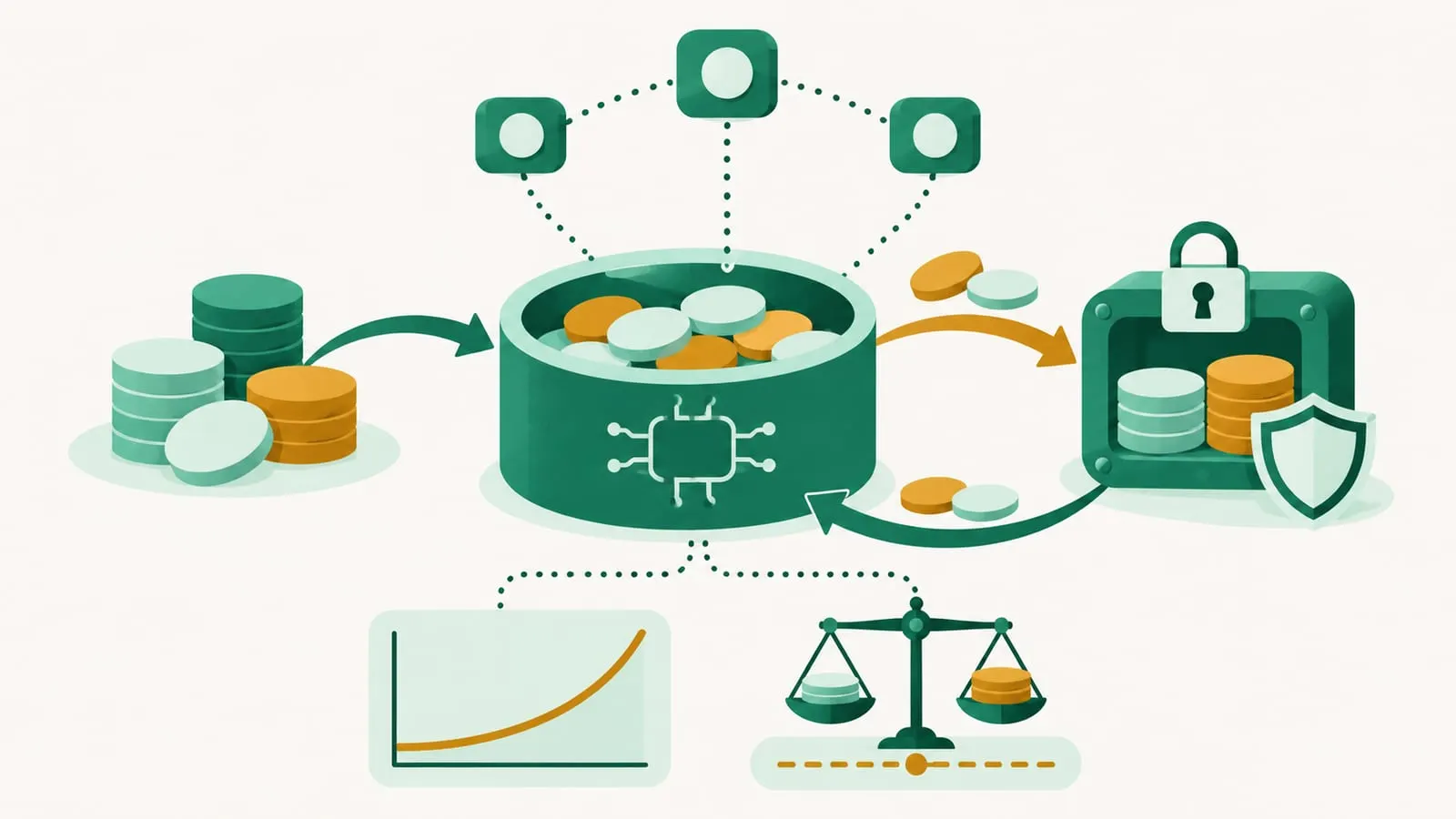
A DeFi lending protocol is a set of smart contracts that runs a money market on a blockchain. Lenders deposit crypto into a shared pool and earn interest. Borrowers post collateral worth more than their loan and borrow from that pool. A formula sets the interest rate from how much of the pool is borrowed, and if a loan becomes unsafe, outside “liquidators” repay it and take the borrower’s collateral at a discount. There is no bank, credit check or loan officer: the code holds the funds and enforces the rules.
This page explains the general mechanics. For a single protocol in detail, see how lending works on Aave, and for a practical walkthrough, our guide on how to lend your crypto on DeFi.
The three roles
Every lending protocol has three kinds of participants:
- Lenders (suppliers) deposit assets such as USDC or ETH into a lending pool and receive a token or balance that represents their share, such as Aave’s aTokens. That claim grows as interest is paid.
- Borrowers deposit collateral, then borrow other assets from the pool up to a limit set by the collateral’s value.
- Liquidators are usually automated bots. They watch for unsafe loans and repay part of the debt in exchange for collateral plus a bonus, which keeps the pool solvent.
Behind them sit governance (token holders who vote on which assets are listed and on risk settings), risk managers who propose parameter changes, and price oracles that feed market prices into the contracts.
Step by step: what happens to your money
- You supply. You send, say, 10,000 USDC from your wallet to the protocol. The contract records your deposit and gives you a receipt token or position.
- Borrowers draw from the pool. Someone who deposited ETH as collateral borrows 6,000 of that USDC. The pool’s utilization is now 60%.
- Interest accrues. The borrower’s debt grows every block or second at the borrow rate. Your balance grows at the lower supply rate.
- You withdraw. You can take your USDC back whenever enough of the pool is unborrowed. If utilization reaches 100%, you wait until borrowers repay or new lenders arrive.
- The borrower repays or is liquidated. Repaying unlocks their collateral. If ETH falls far enough first, liquidators repay part of the loan and take ETH, so lenders stay whole.
How interest rates are set
Rates aren’t negotiated. Each asset has an interest-rate curve based on utilization, the share of the pool that is lent out:
- At low utilization, borrowing is cheap and lenders earn little, because most of their money sits idle.
- As utilization rises, both rates rise.
- Above an optimal utilization point (the “kink”), the borrow rate rises steeply. That pulls in new lenders and pushes borrowers to repay, so the pool doesn’t run out of cash.
Lenders earn less than borrowers pay, for two reasons: not all deposits are lent out, and the protocol keeps a share of interest (the reserve factor). As of mid-November 2026, DefiLlama showed the largest Ethereum USDC and USDT markets on Aave V3 and Compound III paying suppliers roughly 3–4.5% base APY, while lending ETH earned under 2%. These numbers change constantly; check DefiLlama for live rates. For the full mechanics, see what determines interest rates on crypto lending platforms.
Collateral and liquidation
Because the protocol doesn’t know who you are, every loan is over-collateralized. Each collateral asset has a maximum loan-to-value (how much you can borrow against it) and a higher liquidation threshold. If your collateral’s value falls until your loan crosses that threshold (on Aave, a health factor below 1), your position can be liquidated.
On Aave V3, a liquidator can repay up to 50% of the debt in one go while the health factor is above 0.95, and up to 100% at 0.95 or below, or when the borrower’s balance of the specific collateral or debt asset being liquidated is worth less than $2,000 (a per-asset test, not the whole position). They receive collateral worth the debt they repaid plus a liquidation bonus, which is the borrower’s cost. Compound III works differently: the protocol absorbs the underwater account and sells the collateral at a discount. Read more in what is collateral in DeFi lending and forced liquidation.
Pooled vs isolated designs
Not every lending protocol pools risk the same way:
| Design | Example | What it means for lenders |
|---|---|---|
| Shared multi-asset pool | Aave V3 | Many assets in one pool; a problem with one collateral asset can affect lenders across that pool |
| One borrowable asset per market | Compound III | Each market lends a single base asset (such as USDC) against a set of collateral assets, so risks are separated by market |
| Isolated markets with curated vaults | Morpho | Each market pairs one collateral with one loan asset; vault curators choose which markets your deposit funds |
Aave’s newer V4, live since March 2026, uses a hub-and-spoke model that shares liquidity but caps each market’s exposure. Our Aave vs Compound comparison explains these designs in more depth.
DeFi lending vs a bank or CeFi lender
A bank checks your credit and keeps your deposits on its balance sheet, backed in many countries by deposit insurance. A centralized crypto lender takes custody of your coins and lends them on its own terms; several, including Celsius and BlockFi, collapsed in 2022 (see BlockFi vs Compound). A DeFi protocol has neither credit checks nor custodian: the rules, loans and collateral are public on-chain, and you keep control from your own wallet. Our page on DeFi vs traditional lending goes further.
There are also narrow forms of lending without collateral, such as flash loans that must be repaid within one transaction. See crypto loans without collateral.
Risks
- Smart-contract risk: bugs or exploits can drain funds, even in audited code.
- Collateral and bad-debt risk: if a listed collateral asset collapses or is minted without backing, borrowers’ debts may exceed their collateral, and lenders absorb the shortfall.
- Oracle risk: a wrong price can cause unfair liquidations or let attackers borrow too much.
- Liquidity risk: at 100% utilization, withdrawals wait.
- Governance and front-end risk: votes can change parameters, and phishing sites copy official apps.
See DeFi lending risks for more. If you’re a developer, our technical overview on how to build a DeFi lending protocol covers these mechanisms from the builder’s side. This page explains how lending protocols work and is not financial advice.
Frequently asked questions
What are DeFi lending protocols?
They are applications built from smart contracts that let people lend and borrow crypto directly from a shared pool. Well-known examples include Aave, Compound, Morpho, Spark and Kamino. Anyone with a compatible wallet can use them without an account or credit check.
Is DeFi lending peer-to-peer?
Mostly not. Most protocols are peer-to-pool: lenders deposit into a pool and borrowers draw from it, so a lender has no individual borrower. Some designs match lenders and borrowers more directly, but the pooled model dominates.
Where does the interest come from?
From borrowers, who pay a variable rate on what they borrow. The protocol passes most of that interest to lenders and keeps a share, called the reserve factor, for its treasury. Some markets also add token rewards on top.
Why would anyone borrow less than their collateral is worth?
To get cash or stablecoins without selling an asset they want to keep, to take leverage, to short an asset, or to move between strategies. Over-collateralization is what lets the protocol lend without knowing who you are.
Can I lose money lending on DeFi?
Yes. Smart-contract exploits, collateral that collapses in value, oracle failures and governance mistakes can create losses for lenders, and withdrawals can be delayed when a market is fully borrowed. Lending is not a savings account with deposit protection.
Sources
- Aave V3 source code (aave-dao/aave-v3-origin): LiquidationLogic.sol
- Aave documentation: Aave V3 overview
- Aave documentation: Interest rate strategy
- Aave Help Center: Liquidations and health factor
- Compound III documentation: Interest rates
- Compound III documentation: Liquidation
- DefiLlama Yields API (live pool rates)
Educational content, not financial advice. DeFi carries risk, including total loss of funds.