How Does Lending Work on Aave? Supplying, aTokens, Interest and Liquidations Explained
On this page
My dad and I want to explore our options with DeFi lending. I have heard of Aave as a DeFi lending protocol. How does lending work on Aave?
The short answer
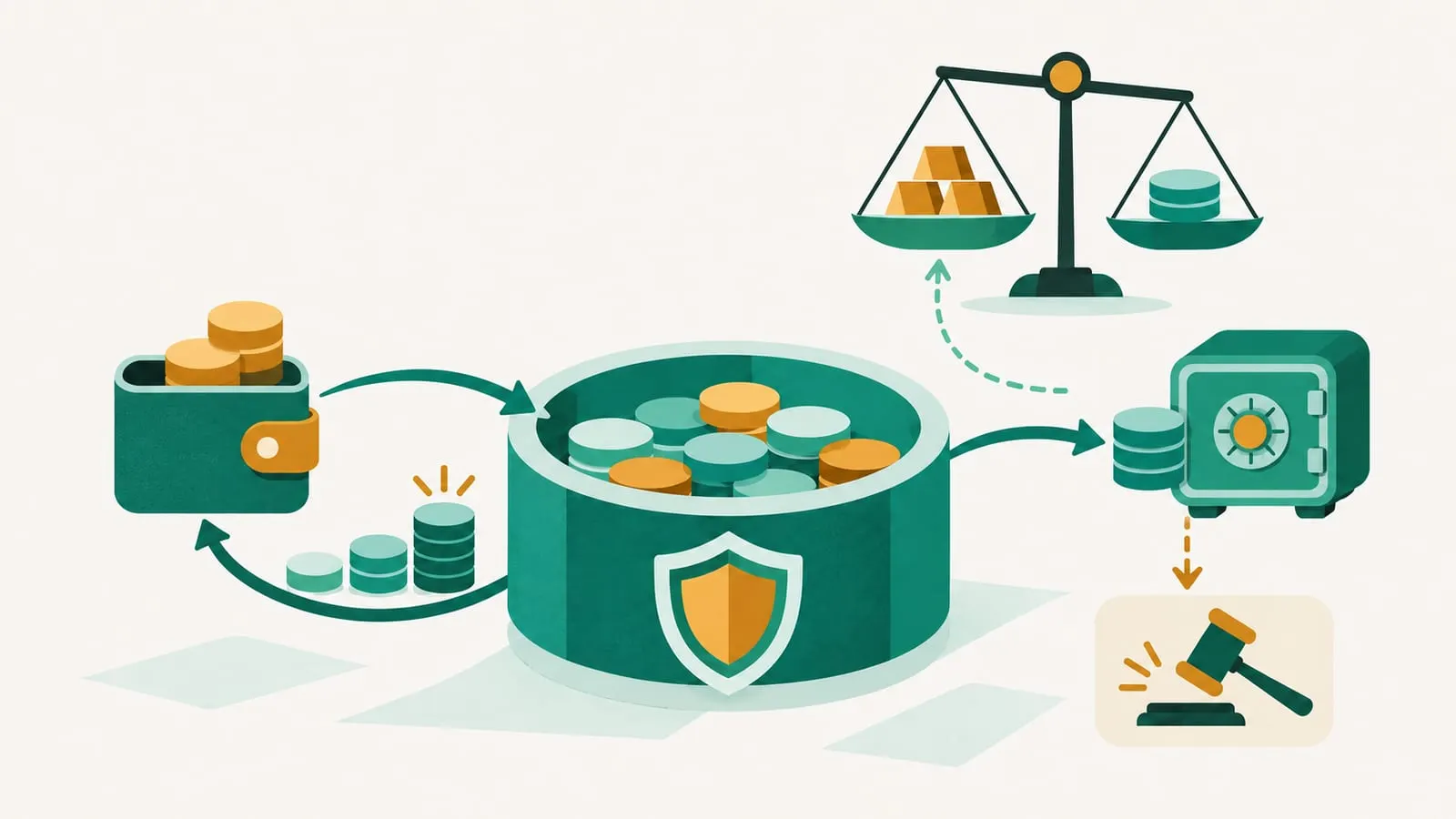
Lending on Aave works through shared pools rather than one-to-one loans. You supply a crypto asset such as USDC or ETH to Aave’s smart contracts, receive aTokens that represent your deposit, and earn interest paid by people who borrow from the same pool against collateral. Nobody negotiates a rate: an algorithm sets it from moment to moment based on how much of the pool is borrowed.
As of mid-November 2026, DefiLlama showed Aave V3’s main Ethereum USDC market paying about 4.4% base APY to suppliers and USDT about 3.1%, with rates changing constantly. Aave is one of the largest DeFi lending protocols, with roughly $14 billion of TVL in Aave V3 alone on DefiLlama (deposits not currently lent out; about $10.6 billion more was out on loan). This page explains each step and the risks. It is not financial advice.
Step by step: what happens when you lend on Aave
- You connect a self-custody wallet (such as a browser or hardware wallet) to the Aave app on a supported network. Aave does not hold your keys or ask for an account.
- You supply an asset. Your first deposit of a token usually needs an approval transaction, then the supply transaction itself. The asset joins that market’s lending pool.
- You receive aTokens. Supply 1,000 USDC and you receive about 1,000 aUSDC. aTokens are ordinary tokens whose balance increases over time as interest accrues, so your earnings show up as a growing balance.
- Borrowers draw from the pool. Other users who have supplied collateral borrow from the pool and pay a variable interest rate.
- You withdraw when you like. Withdrawing burns your aTokens and returns the underlying asset plus interest, as long as the pool has enough unborrowed liquidity.
Your deposit is not lent to a specific person, and you are not exposed to any one borrower’s creditworthiness. You are exposed to the pool as a whole: its collateral, its parameters and Aave’s code. For a protocol-agnostic walkthrough, see how to lend your crypto on DeFi.
Where the interest comes from
Suppliers are paid from the interest borrowers pay, minus a cut for Aave’s treasury called the reserve factor. The rate depends on utilization: the share of the pool that is currently borrowed.
Aave V3 uses a two-slope rate curve for each asset. Below an optimal utilization point, borrow rates rise gently. Above it, they rise steeply, to pull in new deposits and push borrowers to repay so lenders can always exit. For example, Aave’s Core Ethereum market used a 94% optimal point for USDC and USDT, per a September 2026 risk steward update, and these parameters are adjusted by Aave’s risk managers and governance over time.
A rough rule of thumb is:
Supply rate ≈ borrow rate × utilization × (1 − reserve factor)
On November 16, 2026, DefiLlama showed Aave V3 Ethereum USDC at about 94% utilization, a borrow APY of about 5.2% and a supply APY of about 4.4%. Because not every dollar is borrowed and the protocol keeps a slice, suppliers always earn less than borrowers pay. Our guide to what determines interest rates on crypto lending platforms explains the curve in more detail, and Convert interest rate to APY covers how APR and APY relate.
Typical Aave V3 supply rates (November 2026)
| Market (Ethereum, Aave V3 Core) | Base supply APY | What drives it |
|---|---|---|
| USDC | ~4.4% | Heavy stablecoin borrowing, ~94% utilization |
| USDT | ~3.1% | ~85% utilization |
| WETH | ~1.4% | Borrowing for staking loops and leverage |
| WBTC, cbBTC, wstETH | ~0% | Mainly supplied as collateral, rarely borrowed |
Figures are base APY from DefiLlama’s yields API on November 16, 2026 and change daily. Some markets add separate token rewards; treat those as temporary.
How borrowing works (and why it protects lenders)
Aave loans are over-collateralized. To borrow $1,000 of USDC you might need to supply $1,300 or more of ETH, depending on that asset’s loan-to-value (LTV) ratio. Each collateral asset has:
- a maximum LTV, which caps how much you can borrow against it, and
- a liquidation threshold, slightly higher, at which the position becomes unsafe.
Aave tracks every borrower with a health factor:
Health factor = (collateral value × weighted average liquidation threshold) ÷ total debt
If it falls below 1, the position can be liquidated. A liquidator repays part of the debt and receives the same value of collateral plus a liquidation bonus. On Aave V3, up to 50% of the total debt can be repaid in one go while the health factor is above 0.95. Up to 100% of the debt in the asset being repaid can be liquidated when the health factor is 0.95 or lower, or when the borrower’s balance of the specific collateral or debt asset being liquidated is worth less than $2,000 (a per-asset test, not the whole position). A partial liquidation must also leave at least $1,000 of that collateral and debt, otherwise it has to be cleared in full, to avoid unliquidatable dust.
Liquidations are what keep lenders whole: they let the protocol recover funds before collateral is worth less than the debt. When they fail, for example because collateral collapses too fast or an oracle misprices it, the shortfall becomes bad debt that the protocol or lenders must absorb. More on collateral in DeFi lending and the risks to the DeFi borrower.
Features you’ll see in the Aave app
- E-Mode (efficiency mode): higher borrowing power when collateral and debt are correlated, such as stablecoin against stablecoin or ETH against liquid-staked ETH. Since V3.7 (2026), E-Mode categories can be isolated, which replaced the older Isolation Mode and Siloed Borrowing features.
- Variable rates only: Aave V3.2 removed the legacy stable-rate option, so all V3 borrowing is variable. See fixed vs variable APR for what that means for you.
- Flash loans: developers can borrow without collateral if they repay within the same transaction, for a fee that Aave’s docs say is 0.05% at deployment and changeable by governance (still 0.05% on the main Ethereum market in November 2026). Since V3.4 the code sends the whole fee to the Aave DAO treasury rather than sharing it with suppliers; some older docs pages still describe a split. Our guide to crypto loans without collateral covers these.
- GHO: Aave’s own overcollateralized stablecoin, minted by borrowers. Savings GHO (sGHO) earns a separate savings rate that Aave’s governance stewards set directly (an August 2026 steward update proposed raising it from 4.25% to 4.50%; check the Aave app for the rate currently in force), rather than a utilization-based rate.
- Umbrella: a safety module, live since June 2025, where you can stake aTokens such as aUSDC, aUSDT or aWETH (or GHO) for an extra reward, in exchange for having that stake slashed to cover bad debt in that asset’s market if it occurs. In mid-November 2026 DefiLlama showed Umbrella rewards of roughly 1.7–1.8% on top of the base rate for USDC and USDT.
- Supply and borrow caps: each market has limits set by governance. When a cap is reached, the app won’t accept new deposits of that asset until room opens up.
Aave V3 vs Aave V4
Aave V4 launched on Ethereum on March 30, 2026. It reorganizes liquidity into hubs (shared pools of an asset) and spokes (markets that borrow from those hubs with their own collateral rules), and has since expanded to Avalanche, Arc and Base. Aave V3 is still being upgraded (V3.7 rolled out in April–May 2026) and holds far more deposits. For a lender, the core loop is the same in both: supply, earn a utilization-based rate, withdraw when liquidity allows. For how Aave stacks up against its oldest rival, see Aave vs Compound.
Risks of lending on Aave
Aave is not a savings account with deposit protection. Before you supply, understand:
- Smart contract risk. Audits and a long track record reduce the chance of a bug but don’t remove it.
- Bad-debt risk from collateral. In April 2026 an attacker exploited a Kelp rsETH bridge route, minted unbacked rsETH and used it on Aave V3 to borrow roughly 82,650 WETH; Aave’s incident report first modeled bad debt of roughly $124–230 million, revised on April 22 to about $62–162 million (no final figure had been published on Aave’s forum by mid-November 2026). Aave’s contracts were not compromised, but WETH lenders in affected markets were exposed. A risky collateral asset can hurt lenders of a different asset.
- Oracle risk. In March 2026 a misconfigured price cap undervalued wstETH and triggered about $26 million of liquidations.
- Liquidity risk. At very high utilization you may have to wait to withdraw.
- Stablecoin and asset risk. If the asset you supply depegs or collapses, aTokens track it down.
- Front-end and phishing risk. Bookmark the official app and read every wallet prompt.
- Gas costs. On Ethereum mainnet, fees can eat a large share of the yield on small deposits; Layer 2 networks are cheaper.
For a broader view, see DeFi lending risks and the Lending & Borrowing hub.
Frequently asked questions
How does Aave pay interest to lenders?
When you supply, you receive aTokens (for example aUSDC) that track your deposit one-to-one with the underlying asset. Their balance grows continuously as borrowers pay interest, so you see interest accrue directly in your wallet balance.
Do I need to borrow to earn on Aave?
No. You can simply supply an asset and earn the supply rate. Borrowing is optional; your supplied assets only act as collateral if you borrow against them.
Can I withdraw from Aave at any time?
You can withdraw whenever there is enough unborrowed liquidity in the pool. If a market is close to 100% utilization, withdrawals can be delayed until borrowers repay or new deposits arrive, although rates rise sharply to encourage both.
Does Aave require KYC?
The core Aave markets are permissionless and do not require KYC. Some specialized markets, such as Aave's Horizon real-world-asset market, restrict who can supply certain collateral, and front ends may block some regions or addresses.
What fees does Aave charge lenders?
There is no deposit or withdrawal fee from Aave itself; you pay network gas. Aave keeps a share of the interest borrowers pay (the reserve factor) for its treasury, which is why the supply rate is lower than the borrow rate.
Is stable-rate borrowing still available on Aave?
No. Aave V3.2 (October 2024) removed the legacy stable-rate logic, so borrowing on Aave V3 is at variable rates.
Sources
- Aave governance forum: LlamaRisk update to the rsETH incident report (April 22, 2026)
- Aave governance forum: [GHO Stewards] August 2026 GHO Borrow Rate and Aave Savings Rate Update
- Aave V3 source code (aave-dao/aave-v3-origin): FlashLoanLogic.sol
- Aave V3 source code (aave-dao/aave-v3-origin): LiquidationLogic.sol
- Aave documentation: Aave V3 overview
- Aave Help Center: Liquidations and health factor
- Aave documentation: Changelog (V3.2 to V3.7, V4)
- Aave documentation: Flash loans
- Aave governance forum: Risk Stewards stablecoin IRM changes on Aave V3 (September 2, 2026)
- DefiLlama: Aave V3 protocol data
- DefiLlama Yields API (live pool rates)
Educational content, not financial advice. DeFi carries risk, including total loss of funds.