What Is a DeFi Token? Types, How They Work and How to Evaluate Them
On this page
What a DeFi token is
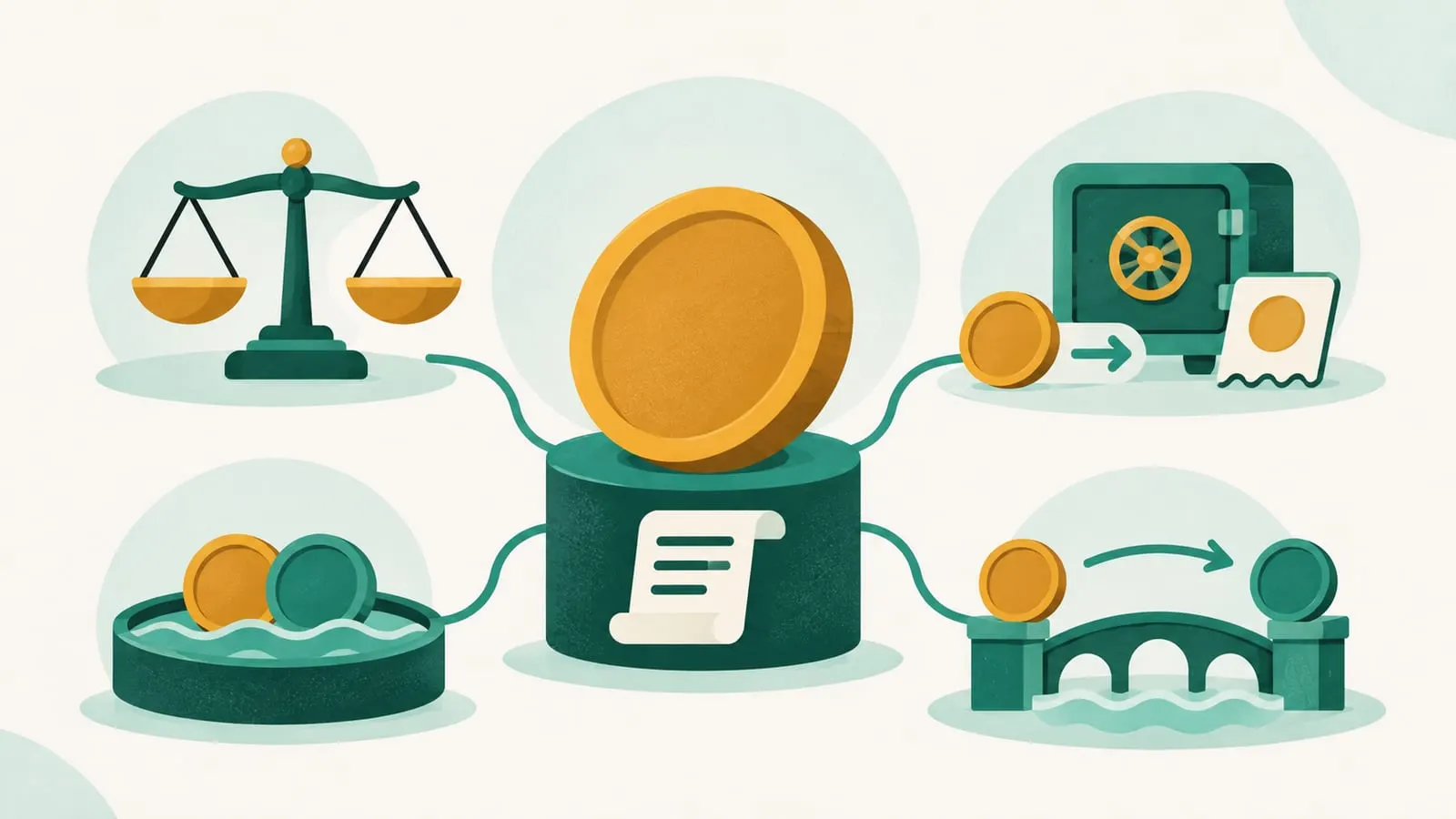
A DeFi token is a crypto token that is issued by, or used inside, a decentralized finance protocol. It might give you a vote on how a lending market is run, represent your deposit in a pool, act as a dollar inside a trading app, or stand in for an asset from another chain. Almost all DeFi tokens are smart contracts on an existing blockchain; on Ethereum and compatible chains they follow the ERC-20 token standard, which is why wallets and exchanges can handle thousands of them in the same way.
“DeFi token” is an umbrella term. A governance token like UNI, a stablecoin like DAI and a receipt token like stETH are all DeFi tokens, but they behave very differently and carry different risks. Knowing which kind you are looking at is the first step in understanding it.
DeFi coins vs DeFi tokens
People use the words interchangeably, but there is a technical difference:
| Coin | Token | |
|---|---|---|
| What it is | Native asset of its own blockchain | Created by a smart contract on an existing blockchain |
| Examples | ETH (Ethereum), SOL (Solana), BNB (BNB Chain) | UNI, AAVE, LDO, DAI, USDC on Ethereum |
| Used to pay gas? | Yes | Usually not |
| Who controls the rules | The chain’s protocol and validators | The token’s contract and, often, its governance |
So “DeFi coins” in casual speech usually means DeFi tokens, plus the native coins of chains that host a lot of DeFi. For a broader primer, see what tokens are in cryptocurrency and the tokens hub.
The main types of DeFi token
| Type | What it does | Examples |
|---|---|---|
| Governance token | Votes on protocol changes, fees and treasury spending; sometimes receives value from fees | UNI (Uniswap), AAVE (Aave), LDO (Lido), SKY (Sky, formerly MKR), CRV (Curve) |
| Stablecoin | A token designed to hold a steady price, usually $1 | DAI and USDS (DeFi-native), USDC and USDT (company-issued) |
| Receipt or yield-bearing token | Proves you deposited assets and accrues interest or rewards | aTokens (Aave), stETH (Lido), sUSDS (Sky) |
| LP token | Represents your share of a liquidity pool on a DEX | Uniswap v2 LP tokens, Curve LP tokens (Uniswap v3 and v4 use NFTs) |
| Wrapped or bridged token | Represents an asset from elsewhere so it can be used in DeFi | WETH, WBTC, bridged USDC.e |
| Index or basket token | Tracks a basket of other tokens | DeFi Pulse Index |
Governance tokens
Governance tokens are what most people mean by “DeFi tokens”. Holders can propose and vote on changes, such as which assets a lending market accepts or how fees are set. In practice, voting power is often concentrated among founders, early investors and a few large holders, and turnout is frequently low. See decentralized governance for how this works.
Receipt and yield-bearing tokens
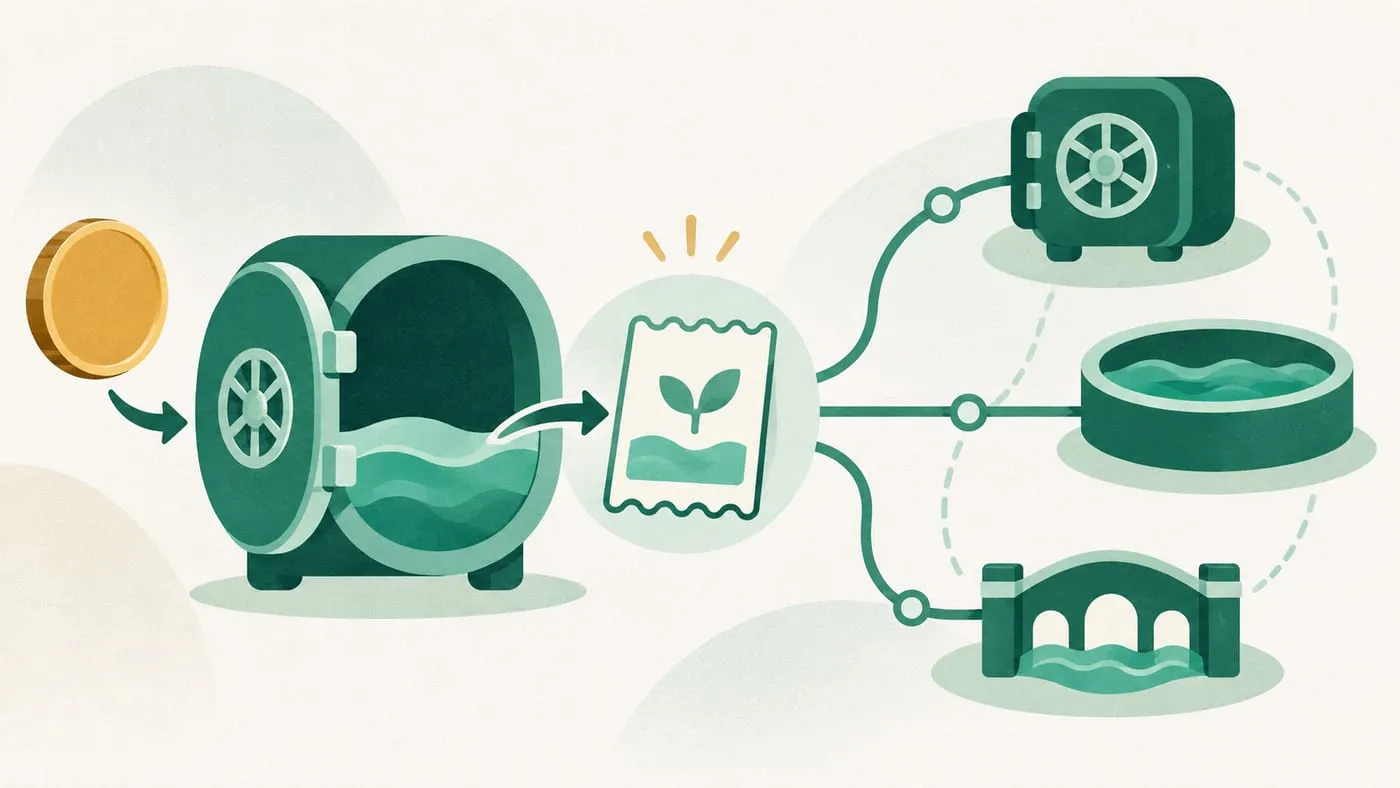
When you deposit into a DeFi protocol, you usually get a token back. On Aave you receive an aToken whose balance grows as interest accrues. When you stake ETH with Lido you receive stETH, a liquid staking token. These tokens can often be used elsewhere in DeFi, which is the “money lego” idea, but each extra layer adds the risks of every protocol underneath.
LP tokens
Providing liquidity to a DEX pool gives you a token or NFT representing your share of the pool and its fees. Its value depends on the pool’s assets and is exposed to impermanent loss. Projects sometimes lock their LP tokens to reassure buyers; see how locked liquidity works.
How do DeFi tokens get value?
A token’s price is set by supply and demand, but demand usually rests on one or more of these:
- Fee sharing, buybacks and burns. Some protocols send part of their revenue to token holders or use it to buy and burn tokens. Uniswap is a notable example: its UNIfication proposal, published in November 2025 and approved by UNI holders on December 25, 2025, switched on protocol fees on selected pools and directs them to burning UNI. It also burned 100 million UNI from the treasury on December 27, 2025 (UTC), as a one-off estimate of the fees that could have been burned since launch.
- Staking rewards. Holders may stake tokens to secure a protocol or earn rewards. If rewards are paid in newly minted tokens, they dilute everyone else.
- Utility. A token may be needed to use a product, get fee discounts or boost rewards.
- Governance rights. The right to control a large treasury or fee settings can be valuable, though it is hard to price.
- Speculation. Much of the price action in DeFi tokens reflects market sentiment rather than protocol fundamentals.
A common mistake is to assume a busy protocol means a valuable token. A protocol can process billions of dollars of activity while its token receives nothing, and a token’s market cap can be large relative to the deposits its protocol holds. See how total value locked relates to market cap and price.
The DeFi token market in 2026
As of mid-November 2026, DefiLlama shows about $71 billion locked across DeFi protocols on all chains, well below the roughly $177 billion peak of November 2021. CoinGecko’s DeFi category, which includes some liquid-staking and exchange tokens, puts the combined market cap at around $60 billion. Both figures move daily, so check the live dashboards in the sources below.
Rather than a “best DeFi tokens” list, which goes stale quickly and would amount to a recommendation, use the checklist below to judge any token yourself.
How to evaluate a DeFi token
- What does the token actually do? Voting only, fee share, burns, staking, collateral or access? Read the protocol’s own docs, not just marketing.
- Does the protocol earn real revenue? Look at fees paid by users and how much of that, if any, reaches token holders. DefiLlama tracks fees, revenue and holder revenue for many protocols.
- Who holds the supply? Check what share belongs to the team, investors and treasury, and how concentrated voting power is.
- What unlocks are coming? Large unlocks for investors and team members add supply. See what a lock-up period is and track schedules on a site like Tokenomist.
- How mature and secure is the protocol? Audits, time in production, past exploits and bug bounties all matter.
- Liquidity. Thinly traded tokens can be hard to sell without moving the price; see slippage.
- Is it the real contract? Copy the contract address from the project’s official site or docs.
How to buy DeFi tokens
- Choose where to buy. Larger tokens trade on centralized exchanges, which require identity checks. Almost every DeFi token also trades on decentralized exchanges.
- Set up a wallet. For a DEX, you need a self-custody DeFi wallet and to keep your seed phrase offline and private.
- Fund it with the chain’s native coin (for example ETH) to pay gas, plus the asset you want to swap.
- Verify the token contract, then swap on a reputable DEX, checking slippage settings and the quoted price. Our guide to buying crypto on a decentralized exchange walks through it.
- Revoke unneeded approvals afterwards, since token approvals are a common route for wallet drains.
Risks of DeFi tokens
- Price volatility. DeFi tokens can lose most of their value in a downturn, and many trade far below their past highs.
- Smart-contract risk. Bugs or exploits in the token or protocol contracts can wipe out value; see smart-contract vulnerabilities.
- Governance risk. Large holders can push through changes that harm smaller ones, and governance attacks have happened.
- Dilution. Emissions and token unlocks increase supply.
- Regulatory risk. Rules on tokens and DeFi are still developing in many countries.
- Scams. Fake tokens with real names, honeypot contracts and pump-and-dump launches are common. Read up on common crypto scams before buying anything new.
Nothing here is a recommendation to buy any token. For more guides, browse the Tokens and NFTs section.
Frequently asked questions
What is the difference between a DeFi coin and a DeFi token?
A coin is the native asset of its own blockchain, like ETH on Ethereum, and is used to pay network fees. A token is issued by a smart contract on an existing blockchain, like UNI or AAVE on Ethereum. People often say 'DeFi coins' loosely for both.
Are DeFi tokens a good investment?
There is no general answer, and this page is not investment advice. DeFi tokens are highly volatile, many have fallen sharply from their peaks, and a token's price can diverge widely from how much its protocol is used. Evaluate each one on its design, revenue, supply schedule and risks.
How do DeFi tokens make money for holders?
Only if the design lets them. Some tokens receive a share of protocol fees, are bought back or burned with revenue, or can be staked for rewards. Others only grant voting rights. Rewards paid in newly minted tokens dilute other holders.
Where can I buy DeFi tokens?
Larger DeFi tokens trade on centralized exchanges, and almost all trade on decentralized exchanges such as Uniswap. On a DEX you need a self-custody wallet holding the chain's native coin for gas, and you should confirm the token's official contract address to avoid copycat tokens.
Is a stablecoin a DeFi token?
Stablecoins are tokens and are the most used assets in DeFi, but only some are DeFi-native. DAI and USDS are created by a DeFi protocol, while USDC and USDT are issued by companies and simply used in DeFi.
Sources
- ethereum.org: ERC-20 token standard
- Uniswap Labs: UNIfication proposal (Nov 10, 2025)
- The Block: Uniswap governance passes UNIfication proposal (Dec 2025)
- Etherscan: 100 million UNI burn from the Uniswap timelock (December 27, 2025, 20:33 UTC)
- DefiLlama: Uniswap fees and holders revenue
- DefiLlama: Total value locked across all chains
- CoinGecko: Decentralized Finance (DeFi) category
- Tokenomist: Token unlock schedules
Educational content, not financial advice. DeFi carries risk, including total loss of funds.
Guides about Defi token
- What Are Tokens in Cryptocurrency: A Complete Introduction
This article will give you a complete introduction to tokens in cryptocurrency, how they work, and how they differ from coins.
- How NFTs Are Used in DeFi
The use cases of NFTs in DeFi are numerous. From simple tokens, security, and ticketing to fun experiences in degenerate multiverses, NFTs are DeFi gems.
- A Guide to $Magic Tokens: What They Are and How to Buy Them
what is magic trading, what are MTK tokens, how to buy MTK tokens, what are the advantages and disadvantages of MTK tokens?
- What Are the Risks of Defi 2.0 and How Can You Avoid Them?
Although an improvement on DeFi 1.0, DeFi 2.0 still contains risks, many of which can be avoided via due dilligence and planning.
- Introducing DeFi 2.0: The Second Generation of DeFi
Understanding DeFi 2.0 - how it differs from DeFi 1.0, and what it will improve on
Answers about Defi token
- DeFi Pulse Index: What It Is and How to Buy It
What is DeFi Pulse Index (DPI), where to buy DPI, how to buy DPI?
- Can You Stake With Akropolis?
What is Akropolis, what is AKRO used for, how to stake AKRO?
- Can You Get Lido DAO Tokens?
Lido DAO token is available for purchase on Uniswap, SushiSwap, 1inch, DeversiFi, Hoo, Hotbit, and Bilaxy. It is the governance token of Lido.
- What Are Ampleforth Automatic Supply Changes?
Ampleforth is an Ethereum-based protocol that adjusts the supply of its native token AMPL in response to market demand.
Community questions about Defi token
- How do deflationary tokens work?
Unlike inflationary assets (like the US Dollar, for example) deflationary assets have a limited (finite) supply that cannot be surpassed under any…
- What are the advantages of deflationary crypto assets?
There are multiple benefits investors and developers get from deflationary tokens . Above all, deflationary cryptocurrencies strive to solve the…
- How can I convert tokens to coins in a DeFi money market?
To convert your tokens to coins in a DeFi money market: Withdraw your tokens a DeFi protocol to a web3 wallet, like MetaMaskVisit a DEX platform like…
- Are there any risks in staking deflationary tokens?
Even investing in the most stable assets can be risky. History has proven time and again that investing always bears risks, no matter how slight the risk…
- Do deflationary tokens increase in value?
Deflationary tokens aim to minimize their market supply, and increase scarcity and demand. This directly implies that their value rises with time…
- What assets can be tokenized?
Asset tokenization is the process of converting ownership rights of real-world assets into blockchain-based tokens. The possibilities of tokenization are…
- How do tokenized money markets work?
A tokenized money/fund is also known as a digital fund or a blockchain-traded fund. Here, the shares in the fund are digitally represented and are traded…
- What are the benefits of holding onto deflationary coins for yield pool value?
There are definitely benefits of holding onto deflationary coins. Unlike inflationary assets (like the US Dollar), deflationary ones do not lose value…