Aragon Review (2026): Status, Ease of Use, Fees and What Happened to ANT
On this page
Aragon at a glance (November 2026)
Aragon is one of the oldest DAO-building projects on Ethereum, and it looks very different from when this review was first written. The Aragon Association, the Swiss non-profit that held the treasury, dissolved in November 2023. Holders of its ANT token could redeem them for ETH at a fixed rate until 2 November 2024, and ANT no longer has any role in the project.
What remains is a product and services business: Aragon OSx, an open-source framework for building DAOs as smart contracts; the Aragon App, a no-code interface for launching and running one; and paid security, deployment and advisory work for larger protocols. The project is now stewarded by the Aragon Foundation.
| Details | |
|---|---|
| What it is | DAO framework (OSx), no-code DAO app, governance services |
| Launched | 2017 |
| Token | None in use. ANT was redeemed and retired (window closed 2 Nov 2024) |
| Cost to create a DAO | Network gas; no published app fee |
| Networks | OSx is configured for Ethereum mainnet and other EVM networks including Polygon, Base, Arbitrum, Optimism, Avalanche, BNB Chain and Linea (per Aragon’s osx-commons network config); the App’s create wizard may offer only a subset |
| Governance options | Token voting, multisig, admin, staged proposals, lock-to-vote |
| Status | Active; legacy Court, Govern and Voice front ends ended 1 Dec 2024 |
What happened to the Aragon Association and ANT
- November 2023: dissolution. On 2 November 2023 the Aragon Association announced a full liquidation and dissolution. It moved 86,343 ETH into a redemption contract so ANT holders could swap at a fixed 0.0025376 ETH per ANT, and set aside $11 million in a separate Swiss foundation, the Aragon Shield Foundation, to cover obligations left after the dissolution. Development continued under a new product-focused structure built around the OSx team.
- Disputes. The wind-down was contentious. On 20–21 November 2023, holders voting in the Aragon DAO approved proposals to pursue legal action against the Association and its founding team and to fund it with 300,000 USDC. The Association said the vote was unrepresentative, since many more tokens had already been redeemed than were used to pass it.
- Exchange delistings. Exchanges dropped ANT. Kraken, for example, delisted all ANT markets on 25 September 2024 and converted customers’ ANT to ETH at the same 0.0025376 ETH rate.
- November 2024: redemption closed. The window ended on 2 November 2024 at 23:59 UTC. Aragon’s final report says 87% of ANT was redeemed across 2,670 redemptions, returning 75,093.99 ETH to holders. The remaining 11,249.01 ETH went to the new Aragon Foundation, irrevocably committed to the project’s mission.
If you still hold ANT, it can no longer be redeemed through Aragon. Be wary of any site offering to “migrate” or “claim” it: that’s a common scam pattern.
What Aragon offers today
Aragon OSx
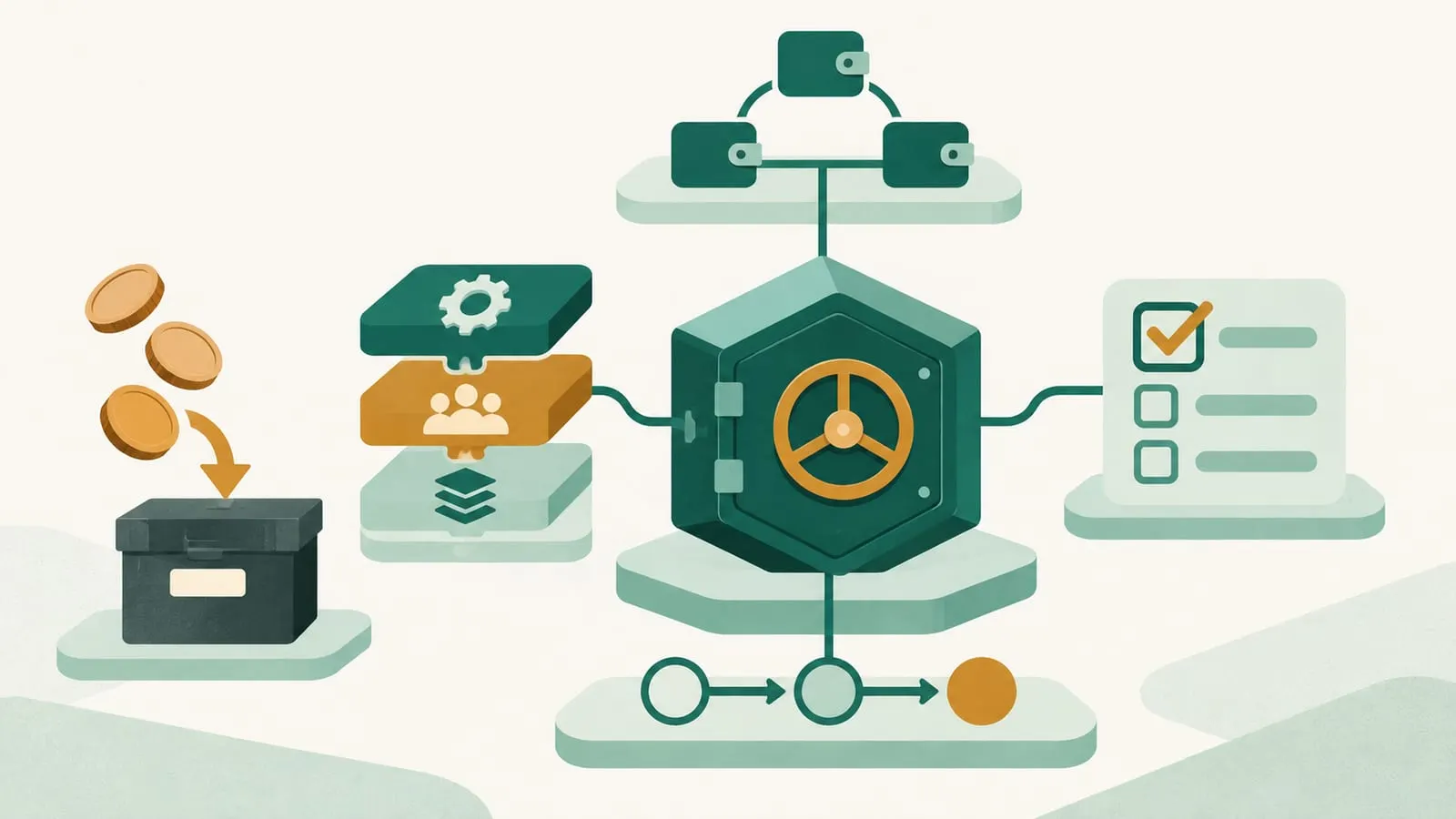
OSx is a modular, permission-based framework. A DAO is a core contract holding the treasury, and plugins define how decisions are made. Aragon’s docs list plugins for:
- Token voting: holders of a governance token vote on proposals.
- Multisig: a set list of addresses approves actions, like a multisig wallet.
- Admin: a single address controls the DAO, useful during setup.
- Staged proposals: multi-step approval, for example a council proposes and token holders can veto.
- Lock-to-vote: tokens are locked to gain voting power.
Because plugins can be swapped by a governance vote, a DAO can start as a small multisig and move to token voting later.
Aragon App
The Aragon App is the no-code front end. It offers a “Create a DAO” wizard that deploys a DAO on OSx, plus a developer path using Aragon’s governance UI kit and app template. DAOs listed in the app include Lido, Curve, Taiko and Polygon’s governance hub, mostly on Ethereum with others on Polygon, Base and smaller EVM networks.
Services
Aragon’s site now leads with paid work for protocols: security reviews, custom governance deployments and advisory. Named clients include Morpho, YieldBasis and Zama. Pricing isn’t published.
Ease of use
For a simple DAO, the app is straightforward: connect a wallet, name the DAO, choose token voting or a multisig, set voting rules (support threshold, minimum participation, duration) and sign the deployment transactions. Running it means creating proposals that bundle on-chain actions, such as a treasury transfer, which execute automatically if they pass.
Where it gets harder: designing sensible voting rules, launching a token responsibly, and anything beyond the standard plugins, which needs Solidity developers. Our step-by-step guide to starting a DAO covers the decisions you’ll face.
Fees and costs
- Aragon App: no usage fee is advertised. You pay gas to deploy the DAO’s contracts and to create and execute proposals.
- Gas: depends on the network. Ethereum mainnet costs the most; layer 2s and sidechains such as Base or Polygon usually cost a fraction of that. See gas fees and layer 2 scaling.
- Custom work: quoted privately.
- Legal costs: Aragon doesn’t provide a legal entity. If you want one, see how much it costs to set up a DAO.
The old version of this review quoted 0.2 ETH to create a DAO on Ethereum. That figure dates from the legacy Aragon Client and 2021-era gas prices and doesn’t apply to OSx.
Pros and cons
Pros
- Long track record; Aragon’s site claims a nine-year security history and over 300 projects, though those are self-reported figures.
- Open-source, modular contracts with a choice of governance models.
- No-code setup for simple DAOs.
- No platform token you need to buy.
Cons
- The Association’s dissolution and the ANT disputes damaged trust with part of the community.
- Legacy products were shut down (front-end support for Court, Govern and Voice ended on 1 December 2024), and Aragon Client DAOs are encouraged to migrate.
- Advanced setups still need developers.
- No built-in legal wrapper; members may face liability questions.
(The old review listed “prevents impermanent loss” as a pro. Aragon is governance software, not a liquidity pool, so impermanent loss doesn’t apply.)
Risks
- Smart contract risk. OSx has been audited: Aragon’s GitHub repository publishes Halborn reports (2023, and for v1.4 in January 2025, June 2026 and October 2026) and a Code4rena report (December 2023). Audits reduce but do not remove risk, and any contract can have bugs. See DAO smart contracts.
- Governance design risk. Low quorums or poorly set thresholds can let a small group take over.
- Legal risk. An unwrapped DAO may be treated as a general partnership; see the legal structure of a DAO.
Bottom line
Aragon is still a credible tool for launching an on-chain DAO, especially if you want modular, open-source contracts and the option of a no-code start. But it’s no longer the token-governed “mother of all DAOs” the old review described: ANT is gone, the Association is gone, and Aragon is now a software and services provider. For background on its original vision, see Aragon: the first decentralized digital jurisdiction, and for how DAOs function generally, how do DAOs work?.
Frequently asked questions
Is Aragon still active in 2026?
Yes, as a product and services organisation rather than a token-governed DAO. Aragon's site lists the OSx contract library, the Aragon App and services for clients such as Morpho, YieldBasis and Zama.
Can I still redeem ANT tokens for ETH?
No. The redemption window closed on 2 November 2024 at 23:59 UTC, and unclaimed ETH went to the Aragon Foundation. Major exchanges such as Kraken had already delisted ANT.
Is Aragon free to use?
The OSx contracts are open source and the no-code app doesn't advertise a usage fee, so creating a DAO mainly costs gas on the network you choose. Aragon's custom deployments, security reviews and advisory work are paid services.
Which DAOs use Aragon?
DAOs listed in the Aragon App include Lido, Curve, Taiko and the Polygon governance hub. Some of these use Aragon's older aragonOS stack rather than OSx.
Do I need a token to use Aragon?
No. You can create a DAO governed by a multisig of named addresses instead of a token, or launch a governance token for token voting.
Sources
- Aragon: A new chapter for the Aragon Project (2 November 2023)
- Aragon: ANT Redemption Initiative report (3 November 2024)
- The Block: Aragon DAO votes to fund a lawsuit against its founding team (November 2023)
- Aragon: Legacy product update (4 September 2024)
- Aragon OSx documentation
- Aragon OSx GitHub: audit reports (Halborn, Code4rena)
- Aragon osx-commons: supported networks config
- Aragon App
- Aragon (official site)
- Kraken: Delisting of Aragon (ANT)
Educational content, not financial advice. DeFi carries risk, including total loss of funds.