How Do DeFi Loans Work? Lending and Borrowing Crypto Explained
On this page
Hi, I've been thinking about lending my crypto to make some more money, but I'm not sure what this entails. How exactly do DeFi loans work?
The short answer
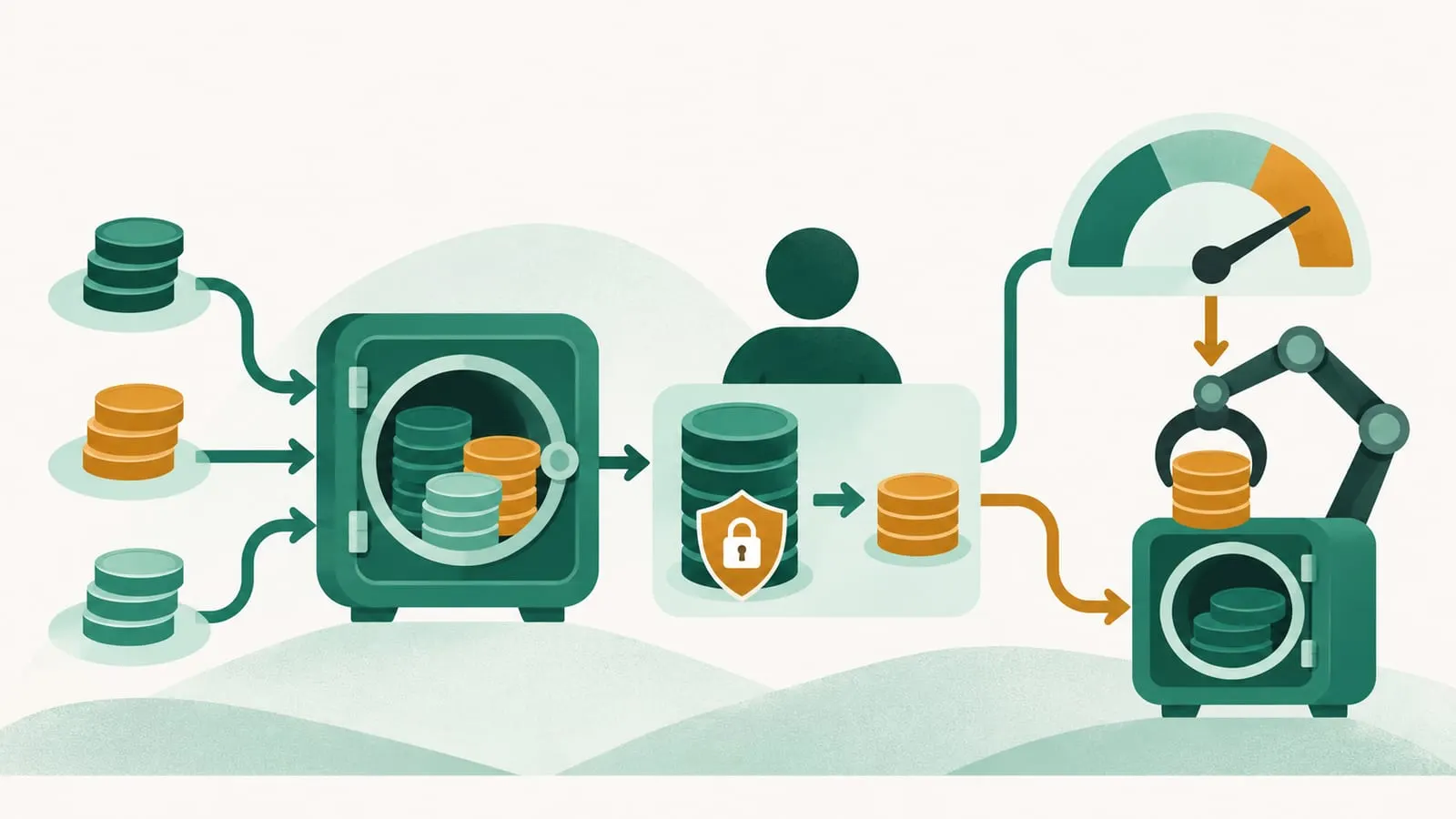
A DeFi loan is a crypto loan run by a smart contract instead of a bank. Lenders deposit tokens such as USDC or ETH into a lending protocol’s shared pool and earn interest. Borrowers lock up collateral worth more than they want to borrow, then take a loan from that pool. A formula sets the interest rate, and if a borrower’s collateral loses too much value, outside bots liquidate the loan so lenders are repaid. There is no application, credit check or loan officer.
If you’re thinking of lending your crypto to earn interest, that is the “supply” side of the same system. This page explains both sides. For the protocol mechanics in more depth, see how DeFi lending protocols work.
Lending: what happens when you supply crypto
- You deposit an asset from your own wallet into a protocol such as Aave, Compound III or Morpho.
- You get a receipt. On Aave this is an aToken (for example aUSDC) whose balance grows as interest is paid; on Compound III your balance in the market grows; Morpho vaults issue shares.
- Borrowers use the pool. You don’t lend to one person. Your deposit joins a lending pool, and borrowers draw from it.
- Interest accrues every block or second at the variable supply rate.
- You withdraw your deposit plus interest whenever the pool has enough unborrowed liquidity. If the pool is close to fully borrowed, you wait until borrowers repay or new lenders arrive.
The interest you earn comes from borrowers. The protocol keeps a slice (the reserve factor), and some markets add token rewards on top. As of mid-November 2026, DefiLlama showed the largest Ethereum USDC and USDT markets on Aave V3 and Compound III paying roughly 3–4.5% base APY, while lending ETH paid under 2% and BTC close to zero. Check live figures on DefiLlama.
For a step-by-step walkthrough, including networks, gas and wallet setup, see how to lend your crypto on DeFi.
Borrowing: how a DeFi loan is taken out
- Deposit collateral, for example ETH.
- Borrow up to the collateral’s maximum loan-to-value (LTV). Each asset has its own limit set by governance; volatile assets get lower limits.
- Interest accrues at a variable borrow rate. Aave V3 removed its stable-rate option in 2024, so most DeFi borrowing today floats.
- Repay whenever you like. There is usually no term or monthly payment. Repaying unlocks your collateral.
- Watch your safety margin. If the collateral’s value falls or the debt grows past the liquidation threshold, the loan can be liquidated.
A simple illustration: you deposit $10,000 of ETH and borrow $5,000 of USDC. If the market’s liquidation threshold for ETH is 83%, your position becomes liquidatable when your collateral is worth about $6,024 (because $6,024 × 0.83 ≈ $5,000), a fall of roughly 40%. Our page on collateral in DeFi lending walks through LTV, liquidation thresholds and the health factor in detail.
People borrow this way to get dollars without selling an asset, to take leverage, to short, or to refinance. See what a DeFi loan can be used for and why people borrow crypto.
Why DeFi loans are over-collateralized
A bank lends against your income and can take you to court. A smart contract can’t, so the collateral is its only security. That’s why you must post more value than you borrow, and why DeFi loans mainly suit people who already hold crypto. The main exception is the flash loan, which must be borrowed and repaid in a single transaction; see crypto loans without collateral.
How interest rates are set
Each asset’s pool has an interest-rate curve based on utilization, the share of deposits currently borrowed. When utilization is low, borrowing is cheap and lenders earn little. As it rises, both rates rise, and past an “optimal” point they climb steeply to pull in lenders and push borrowers to repay. Nobody negotiates a rate; it updates with every transaction. The full explanation is in what determines interest rates on crypto lending platforms.
How liquidation works
On Aave, each position has a health factor. Below 1, a liquidator can repay part of the debt and receive collateral worth that amount plus a liquidation bonus. On Aave V3, up to 50% of the debt can be repaid in one liquidation while the health factor is above 0.95, and up to 100% when it is 0.95 or lower, or when the borrower’s balance of the specific collateral or debt asset being liquidated is worth less than $2,000 (a per-asset test, not the whole position). Compound III instead “absorbs” an underwater account and sells the collateral at a discount. Either way, the borrower loses the bonus on top of the debt repaid. See forced liquidation.
A word on the old answers to this question
Earlier answers here promised up to 100% APY and suggested protocols including Anchor. Anchor, Terra’s savings app, targeted a deposit rate of about 19.5% on the UST stablecoin, topped up from a reserve because borrower interest couldn’t cover it, and collapsed with Terra in May 2022. High advertised rates usually come from temporary token rewards, risky collateral or designs that can’t last, not from borrowers. Compare any rate with the blue-chip stablecoin markets above.
Risks
- Smart-contract risk: a bug can let attackers drain a pool, even after audits.
- Bad debt: if collateral collapses faster than it can be liquidated, lenders absorb the gap. In April 2026, unbacked rsETH from an exploited Kelp DAO bridge route was used as collateral on Aave V3; Aave’s incident report first modeled bad debt of roughly $124–230 million (revised on April 22 to about $62–162 million), although Aave’s own contracts were not hacked.
- Withdrawal delays: at 100% utilization, lenders can’t withdraw until borrowers repay.
- Liquidation: borrowers can lose collateral quickly in a sharp market drop.
- Oracle and depeg risk: wrong prices or a stablecoin losing its peg hit both sides.
- Phishing: fake front ends and malicious approvals drain wallets regardless of the protocol.
DeFi lending is not a savings account with deposit protection. Read the major lending risks in DeFi before depositing, and see our crypto lending hub for related guides. This page explains how DeFi loans work and is not financial advice.
Frequently asked questions
Do DeFi loans need a credit check?
No. A lending protocol doesn't know who you are, so it relies entirely on collateral. You must lock up more value than you borrow, and the contract can sell that collateral if the loan becomes unsafe.
How much can I earn lending crypto on DeFi?
It depends on borrowing demand. As of mid-November 2026, DefiLlama showed the largest Ethereum USDC and USDT markets on Aave V3 and Compound III paying roughly 3–4.5% base APY, while ETH and BTC deposits earned far less. Rates change constantly.
Is there a repayment deadline on a DeFi loan?
Usually not. Most DeFi loans are open-ended: interest accrues continuously and you can repay any time, but the loan can be liquidated whenever your collateral no longer covers it by enough margin.
What happens if I can't repay a DeFi loan?
Nothing chases you personally. If you never repay, you simply leave your collateral locked; if its value falls far enough, liquidators repay part or all of your debt and take collateral plus a bonus, so you lose more than the amount repaid.
Can I lose money as a DeFi lender?
Yes. Smart-contract exploits, collateral that collapses in value and leaves bad debt, oracle errors and depegs can all reduce what you get back, and withdrawals can wait when a pool is fully borrowed.
Sources
- Aave V3 source code (aave-dao/aave-v3-origin): LiquidationLogic.sol
- Aave governance forum: LlamaRisk update to the rsETH incident report (April 22, 2026)
- Aave Help Center: Liquidations and health factor
- Aave documentation: Aave V3 overview
- Compound III documentation: Collateral and borrowing
- Compound III documentation: Interest rates
- Morpho documentation
- DefiLlama Yields API (live pool rates)
- Federal Reserve Bank of Richmond: Why Stablecoins Fail: An Economist's Post-Mortem on Terra (July 2022)
Educational content, not financial advice. DeFi carries risk, including total loss of funds.