How Do Liquidity Pool Fees Work? Fee Tiers, LP Earnings and Protocol Fees Explained
On this page
Hi, I've joined DEX and facilitated my first peer-to-contract trade. But I just realized that I missed a crucial part of my calculation, and those are the fees! I feel like such a fart. What protocol fees can I expect from a liquidity pool? Do the fees get split amongst the liquidity providers (which makes the most sense)?
The short answer
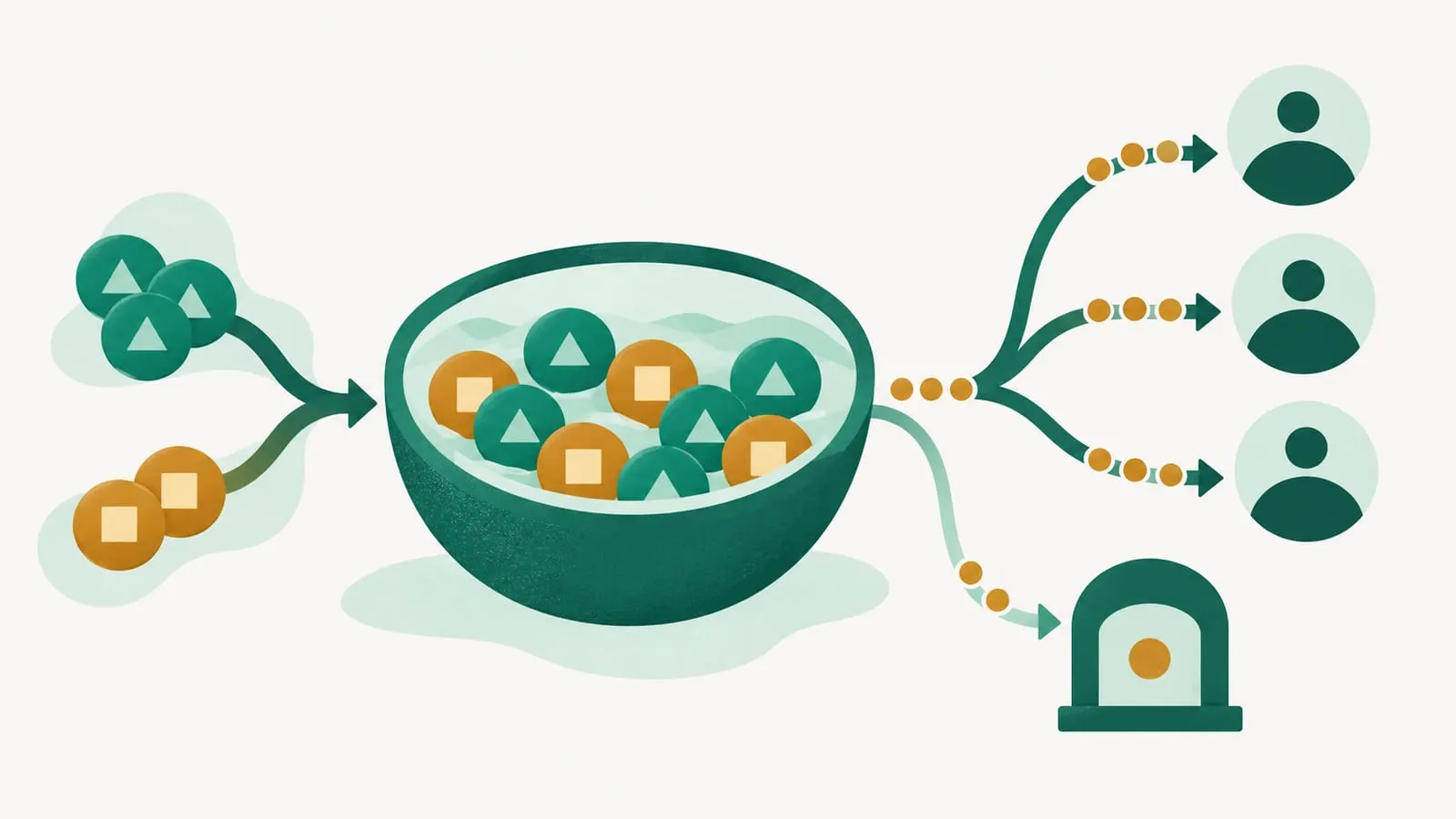
Every time someone swaps tokens through a liquidity pool, they pay a small percentage fee, usually between 0.01% and 1% of the trade. That fee stays in the pool and is shared among the liquidity providers (LPs) in proportion to how much of the pool’s liquidity they supplied. So yes, the original asker’s instinct was right: fees are split among LPs. But on many DEXs part of the fee goes to the protocol instead, and in modern concentrated-liquidity pools only liquidity near the current price earns anything.
Who pays and who earns
| Party | What they pay or receive |
|---|---|
| Trader | Pays the pool’s fee on the amount swapped, plus network gas and any front-end or wallet fee |
| Liquidity providers | Receive most or all of the pool fee, pro rata to their active liquidity |
| Protocol (where switched on) | Receives a fixed share of the pool fee, often directed to token holders, a treasury or token burns |
| Blockchain validators | Receive the network (gas) fee, not the pool fee |
The pool fee is taken from the token you’re selling, so the price you’re quoted already includes it.
Fee tiers on major DEXs
Fee levels differ by DEX and by pool:
- Uniswap v2: a flat 0.30% on every pool.
- Uniswap v3: 0.01%, 0.05%, 0.30% and 1% tiers, and the same token pair can exist at several tiers.
- Uniswap v4: no fixed tiers. A pool creator can set any fee, and pools can use dynamic fees controlled by a hook contract, for example raising fees when markets are volatile.
- PancakeSwap Infinity: fees are set when a pool is created, and pools can be static or dynamic (via hooks). PancakeSwap’s docs say the fee type can’t be changed after creation.
- Curve: stableswap pools for pegged assets typically charge low fees, and newer (Stableswap-NG) pools can use an off-peg fee multiplier that raises fees automatically as a pool becomes imbalanced.
The logic behind tiers is simple: pairs that barely move against each other (USDC/USDT) can charge very little because LPs take little price risk, while volatile or obscure tokens charge more to compensate LPs for impermanent loss.
How much goes to the protocol?
This is the part most beginners miss. A protocol fee diverts a share of each swap fee away from LPs:
| DEX and pool | Total swap fee | To LPs | To protocol |
|---|---|---|---|
| Uniswap v2 (all pools) | 0.30% | 0.25% | 0.05% |
| Uniswap v3, 0.01% tier | 0.01% | 0.0075% | 0.0025% |
| Uniswap v3, 0.05% tier | 0.05% | 0.0375% | 0.0125% |
| Uniswap v3, 0.30% tier | 0.30% | 0.25% | 0.05% |
| Uniswap v3, 1% tier | 1.00% | 0.8334% | 0.1666% |
| Curve stableswap factory pools | Varies by pool | 50% | 50% to veCRV holders |
| PancakeSwap Infinity, static-fee pools | Set by creator | The rest | 33% of the LP fee, capped at 0.4% |
Uniswap figures come from Uniswap’s fee documentation. Uniswap governance approved this protocol fee in the “UNIfication” vote in December 2025, first for v2 and a selection of high-volume v3 pools on Ethereum mainnet. A follow-up vote executed in March 2026 extended it to all mainnet v3 pools and to v2 and v3 on eight more chains, including Arbitrum, Base and OP Mainnet, and later proposals added v2 and v3 fees on BNB Chain and Polygon (executed June 2026) and Robinhood Chain (executed July 2026). The share is set by governance per fee tier and can change. For v4 pools, protocol fees can be enabled by governance separately, and hook fees can apply on top. Always check the specific pool before relying on these numbers.
How LP fee earnings are distributed
Full-range pools (Uniswap v2 style)
Your share of the fees equals your share of the pool. If the pool holds $900 and you add $100, you own 10% and earn 10% of the LP fees, as the original community answer said. The fees are added to the pool’s reserves, so your LP tokens become redeemable for slightly more over time without you claiming anything.
Concentrated liquidity (Uniswap v3/v4, PancakeSwap v3 and similar)
Here you choose a price range. Your position earns fees only while the current price is inside that range, and your share is your liquidity divided by all the liquidity active at that price. A narrow range earns more per dollar while it’s in range, but earns nothing when price moves outside it, and at that point your position is entirely in the weaker of the two tokens. Fees accrue to your position and must be collected. See our glossary entry on the automated market maker model for background.
Rewards on top of fees
Many pools also pay token incentives, sometimes called liquidity mining. Curve, for example, shows a “base vAPY” from trading fees separately from CRV rewards, which you only earn by staking LP tokens in a gauge. Treat incentives separately from fees: they depend on emissions that can end, and the reward token’s price can fall.
Estimating your fee income
A rough formula for an LP:
Daily fee income ≈ daily pool volume × LP fee rate × your share of active liquidity
Example: a pool with $10 million of liquidity trades $1 million a day at a 0.30% fee, of which 0.25% goes to LPs. LPs collectively earn $2,500 a day. A $10,000 position (0.1% of the pool) earns about $2.50 a day, roughly 9% a year before impermanent loss, gas and any rebalancing costs. If volume halves, so does the income.
Dashboards often show fee APR based on the last day or week, which can swing wildly. Our explainer on whether AMM liquidity pools are worth it and the comparison of liquidity pools vs. staking help put those numbers in context.
What traders actually pay
If you’re on the trading side, as the original asker was, add up:
- The pool fee (0.01%–1% on most DEXs).
- Network gas, which depends on the chain; see gas fees.
- Price impact and slippage, often bigger than the fee on large trades; see what slippage is in liquidity pools.
- Front-end or wallet fees. Uniswap Labs stopped charging interface fees in late December 2025, while some wallets add their own swap fee (MetaMask’s standard rate is 0.875%).
Risks for liquidity providers
- Impermanent loss can exceed fee income when prices move sharply, especially in narrow ranges. See how impermanent loss works with a stablecoin and how to avoid impermanent loss.
- Volume risk. Fee income disappears when trading moves to another pool, tier or DEX.
- Smart-contract and hook risk. A bug in the pool, a v4 hook or a liquidity manager can drain funds.
- Token risk. Pools with new tokens can be rugged or the token can go to zero; see locked liquidity.
- Protocol changes. Governance can change the protocol fee share, which changes LP income.
- MEV and toxic flow. Arbitrage bots trade against stale pool prices, a cost that falls on LPs.
For more on earning as an LP, read whether you can make revenue in yield farming as a liquidity provider, or browse the DEXs and AMMs guide.
Frequently asked questions
Do liquidity providers earn the whole trading fee?
Not always. On many DEXs part of each fee goes to the protocol, its token holders or its treasury. On Uniswap pools with the protocol fee enabled, LPs receive five sixths of the fee (v2 and v3's 0.30% and 1% tiers) or three quarters (v3's 0.01% and 0.05% tiers); on Curve's factory stableswap pools, LPs receive half and veCRV holders the other half.
How often are liquidity pool fees paid out?
Fees accrue with every swap. In Uniswap v2-style pools they are added to the pool and compound automatically into your LP tokens. In Uniswap v3 and v4 they are tracked per position and must be collected. Separate token incentives usually have to be claimed.
What is a fee tier?
It is the percentage fee a specific pool charges. Uniswap v3 offers 0.01%, 0.05%, 0.30% and 1% tiers, and the same pair can exist at several tiers. Lower tiers suit stable, heavily traded pairs; higher tiers suit volatile or exotic tokens.
How do I calculate how much I'll earn in fees?
Roughly: daily volume × LP fee rate × your share of the active liquidity. A $10,000 position that is 0.1% of a pool doing $1 million a day at a 0.25% LP fee earns about $2.50 a day before impermanent loss and costs. Volume changes daily, so treat any estimate as approximate.
Are liquidity pool fee earnings taxable?
In many countries, yes, either as income when received or when you withdraw. Rules differ by jurisdiction, so check local guidance or a tax professional.
Sources
- Uniswap developer docs: Fees (fee tiers, dynamic fees, protocol fee split)
- Uniswap developer docs: Concentrated liquidity
- Uniswap developer docs: Understanding returns (impermanent loss)
- Curve docs: Understanding rewards (base vAPY and CRV rewards)
- Curve technical docs: Factory pools (admin fee hardcoded at 50%)
- PancakeSwap docs: Infinity CLAMM and LBAMM (fees and protocol fee)
- Uniswap Labs: UNIfication proposal (November 2025)
- The Block: Uniswap governance passes UNIfication proposal (December 25, 2025)
- Uniswap governance: Protocol Fee Expansion, Vote 2 (executed March 8, 2026)
- Uniswap governance: Protocol Fee Expansion, Vote 1 (proposal 94, executed March 7, 2026)
- Uniswap governance: Protocol Fee Expansion, Vote 3 (BNB Chain, Polygon, Celo; executed June 1, 2026)
- Uniswap governance: Protocol Fee Expansion, Robinhood Chain (executed July 27, 2026)
Educational content, not financial advice. DeFi carries risk, including total loss of funds.