Is Stablecoin Yield Farming a Good Investment? Where the Yield Comes From and What Can Go Wrong
On this page
I've only heard good things from my friends who have gotten into yield farming over the past couple of years. As someone who is always interested in a good investment opportunity, I feel like I want to take part in it as well!
I've done a bit of reading on stablecoin yield farming, but I have some questions before I dive into it- Is stablecoin yield farming a good investment?
Thank you!
The short answer
Stablecoin yield farming can be a reasonable way to earn interest on dollars you already hold in crypto, but it is not a savings account and it is not insured. The yield comes from real activity, mainly borrowers paying interest and traders paying swap fees. As of November 2026, the largest, most established markets paid roughly 3–4.5% a year before token rewards. Anything well above that is paying you to take on extra risk.
Whether it is a good idea for you depends on what you would otherwise do with the money, how much of it you could afford to lose, and whether you are willing to understand and watch the protocols you use. This page explains where the yield comes from, the main approaches, the costs, the risks and how to judge an advertised rate. It is not investment advice.
Where does stablecoin yield come from?
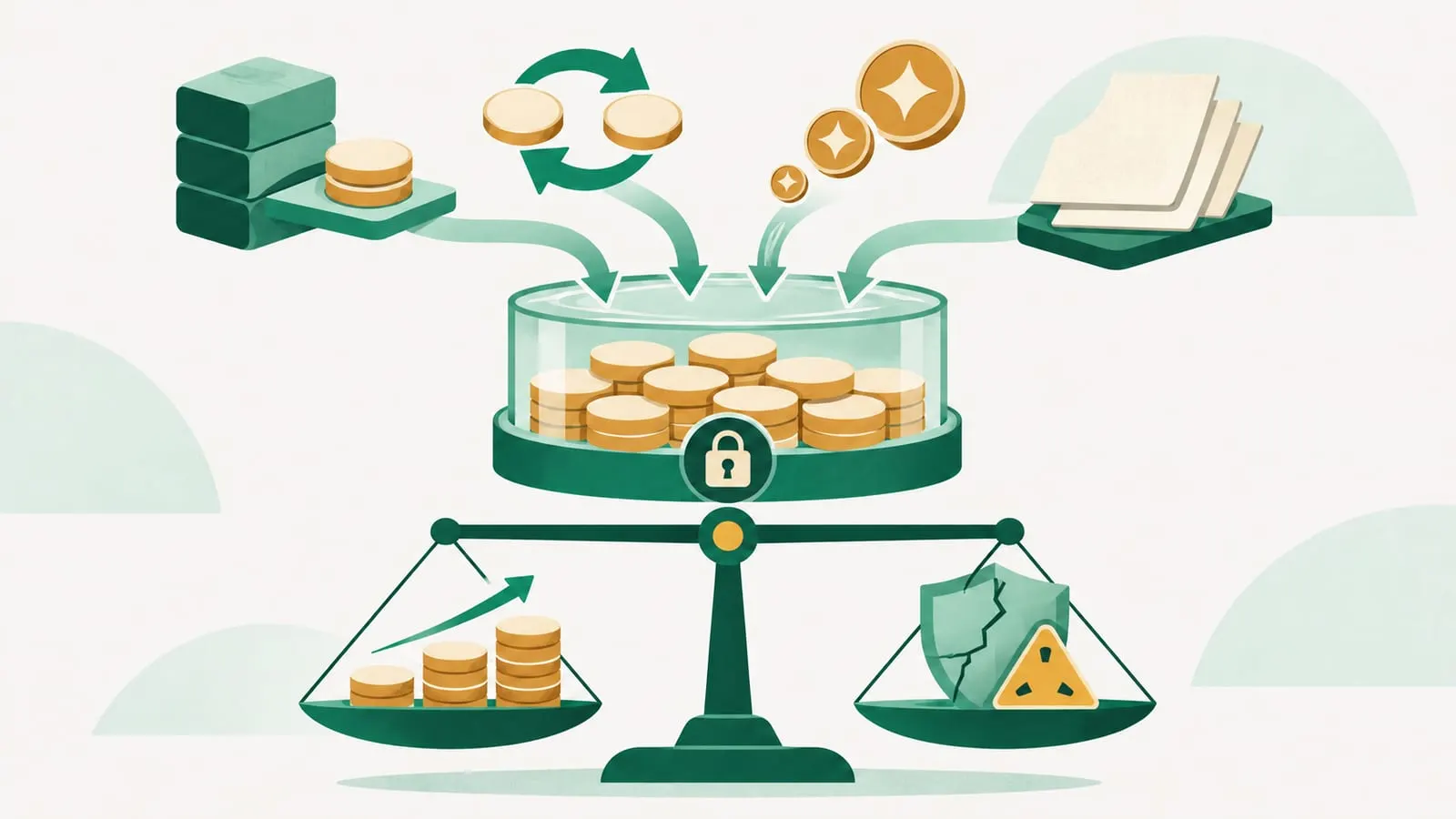
A yield is only as trustworthy as its source. There are four main ones:
- Lending demand. People borrow stablecoins, usually against crypto collateral, to trade with leverage, avoid selling assets or run strategies. They pay interest, and lenders receive most of it. This is the core of DeFi lending.
- Trading fees. Stablecoin swap pools charge a small fee on every trade, shared among liquidity providers.
- Token incentives. Protocols pay extra rewards in their own governance tokens to attract deposits. This is often the “farming” part, and it is the least durable: rewards end, and the token can lose value.
- Reserve and real-world asset income. Some stablecoin systems hold short-term government debt or other real-world assets and pass part of that income to savers. Synthetic dollars such as Ethena’s sUSDe earn mostly from funding and basis spreads on hedged derivatives positions, plus lending and reserve income.
If you cannot tell which of these is paying your yield, that is the first warning sign.
The main ways to earn yield on stablecoins
1. Lending markets (Aave, Compound)
You deposit USDC, USDT or another stablecoin into a lending pool and earn variable interest paid by borrowers.
- On Aave, depositing mints aTokens (for example aUSDC) whose balance grows as interest accrues. Rates follow utilization, the share of the pool currently borrowed: when borrowing demand rises, rates rise, sharply once utilization passes an optimal point. Aave V3 still holds most deposits; Aave V4, with a new “hub and spoke” design, went live on Ethereum on 30 March 2026 with a deliberately narrow initial set of markets. Aave also offers optional Umbrella staking of aTokens such as aUSDC for extra rewards (roughly 1.7–1.8 percentage points on USDC and USDT in mid-November 2026, per DefiLlama), but the staked deposit itself can be slashed to cover bad debt in that asset’s market, so the extra yield is payment for extra risk.
- On Compound III, each market has a single borrowable base asset (USDC on its original Ethereum market), and only suppliers of that base asset earn interest. Collateral you post does not.
Our guides on how lending works on Aave and what determines interest rates on crypto lending platforms go deeper, and Aave vs Compound compares the two.
2. Savings tokens and yield-bearing stablecoins (sUSDS, sDAI, sUSDe)
These wrap a stablecoin in a token that grows in value over time:
- sUSDS is Sky’s (formerly MakerDAO’s) savings token. You deposit USDS and receive sUSDS, which accrues the Sky Savings Rate set by Sky governance and can be redeemed back to USDS. As of November 2026, DefiLlama showed it at about 3.8% APY.
- sDAI is the older equivalent for DAI. It still exists, but its rate has been set well below sUSDS (about 1.25% on DefiLlama in November 2026).
- sUSDe is Ethena’s staked synthetic dollar. Its yield comes largely from derivatives funding and basis, so it can swing more, and it depends on exchanges, custodians and a reserve fund that is meant to absorb periods of negative revenue. Unstaking directly through Ethena involves a cooldown that Ethena’s docs describe as dynamic, between 1 and 7 days (the staking contract was set to 1 day in mid-November 2026); exiting faster means selling on the market, possibly below $1.
Savings tokens are the closest thing to “set and forget” in DeFi, but the rate is variable and can be cut at any time.
3. Stablecoin liquidity pools (Curve and other DEXs)
You deposit two or more stablecoins into a pool built for assets that should trade near $1, such as Curve’s stableswap pools. You earn a share of trading fees and, in many pools, extra token rewards.
While every coin holds its peg, impermanent loss is minimal. But if one coin depegs, traders dump it into the pool and you are left holding mostly the weak coin. See how impermanent loss works with a stablecoin for a worked example.
4. Vaults, aggregators and fixed-rate products
Many farmers do not pick markets themselves. Yield vaults and aggregators (for example curated Morpho vaults or Yearn) move deposits between lending markets and strategies for you, and yield-tokenization protocols such as Pendle let you lock in a fixed rate until a maturity date. These can be convenient, but each adds a layer: another set of smart contracts, and often a curator or manager whose choices you are trusting. In November 2025, Stream Finance’s xUSD lost most of its value after the protocol disclosed that an external fund manager had lost about $93 million, and the losses spread to lenders and other stablecoins exposed to it. Before using a vault, check what it actually holds and who can change that.
5. Leveraged and looped strategies
Some farmers borrow against their deposits and redeposit to multiply yield (“looping”). This only pays while the deposit rate stays above the borrow rate, adds liquidation risk, and can turn a small rate change into a loss. See leveraged yield farming before trying it.
Typical rates: what is “normal”?
| Approach | Where yield comes from | Typical range (Nov 2026) | Effort |
|---|---|---|---|
| Blue-chip lending (Aave V3, Compound III, USDC/USDT on Ethereum) | Borrower interest | Roughly 3–4.5% base APY, variable; some markets add 1–2% in rewards | Low |
| Savings tokens (sUSDS) | Protocol revenue and reserve income, set by governance | About 3.8% APY | Low |
| Synthetic-dollar savings (sUSDe) | Derivatives funding and basis, lending, reserves | About 5% APY, more volatile | Low to medium |
| Stablecoin LP pools | Trading fees plus incentives | Varies widely by pool | Medium |
| Leveraged or incentive-heavy farms | Leverage, new token emissions | Can be much higher, temporarily | High |
Figures are approximate snapshots from DefiLlama Yields and change daily. Dashboards usually quote APY, which assumes compounding, and some show base and reward yield separately; our explainer on what APY means in crypto covers the difference from APR.
Costs that eat into the yield
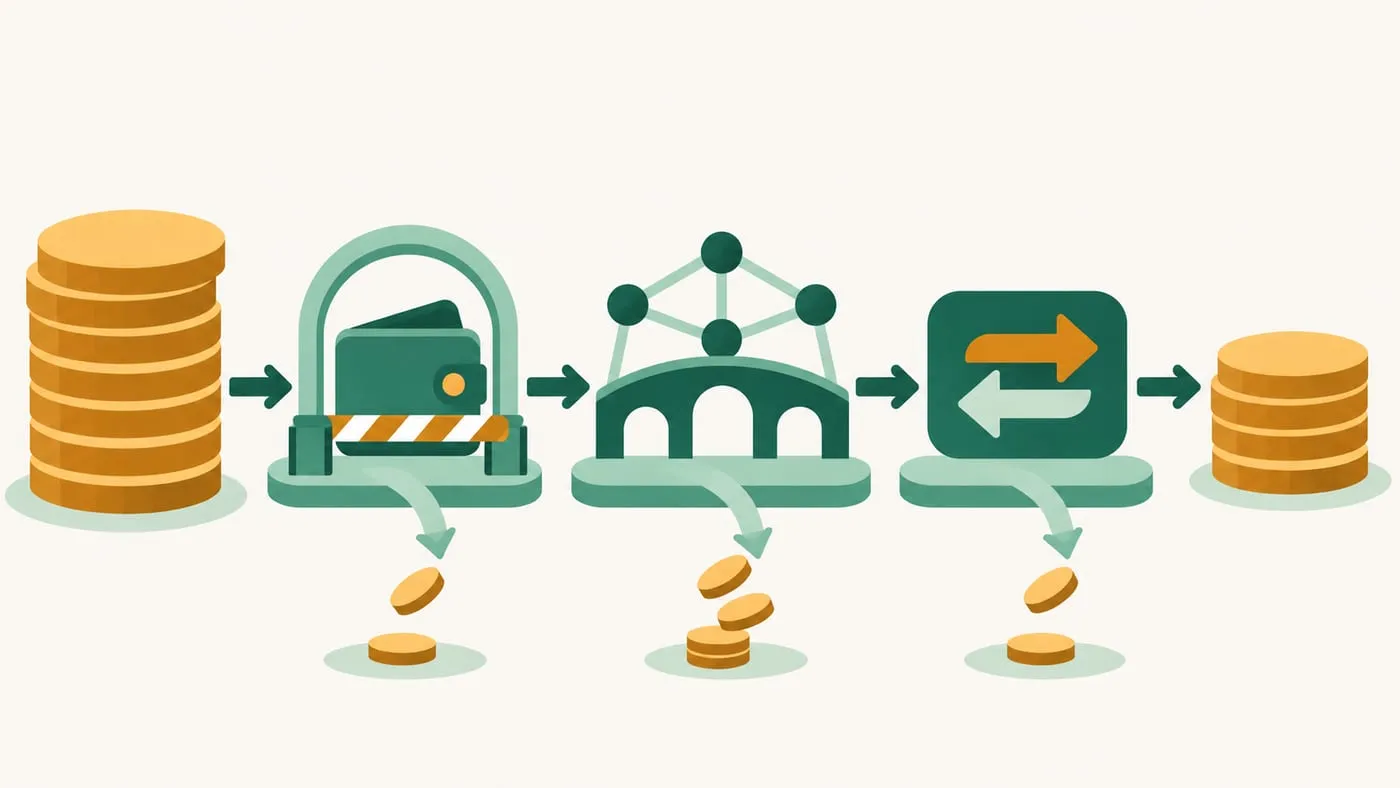
The headline rate is before costs. On Ethereum mainnet, gas fees for approving, depositing, claiming rewards and withdrawing can wipe out a year’s interest on a small balance: at 4%, $500 earns about $20 a year. Lower-fee networks make small positions more practical, but add bridging steps and often thinner liquidity (see whether layer 2s reduce fees for yield farmers). LP positions also pay slippage on the way in and out, and frequently switching to chase the best rate multiplies all of these costs.
Risks of stablecoin yield farming
| Risk | What it means | How it shows up |
|---|---|---|
| Smart contract risk | A bug or exploit drains the protocol | Partial or total loss of deposits |
| Depeg risk | The stablecoin trades below $1 | Your “stable” balance is worth less; LP pools fill with the weaker coin |
| Counterparty and custody risk | An issuer, custodian, vault manager or centralized platform fails or freezes funds | Withdrawals halted |
| Liquidity risk | A lending pool is fully borrowed, or a token has a cooldown | You cannot withdraw until borrowers repay, new deposits arrive or the cooldown ends |
| Impermanent loss | Pool composition shifts after a depeg | You exit with more of the weaker asset |
| Incentive risk | Reward tokens fall in value or emissions end | Advertised APY collapses |
| Oracle and liquidation risk | Bad price data or leverage | Forced liquidation of collateral |
| Regulatory risk | Rules on stablecoins and yield change | Products restricted or withdrawn in your country |
Stablecoins differ in how they are backed, and each type has broken before. Fiat-backed coins depend on the issuer’s reserves and banks: in March 2023, USDC briefly fell to roughly $0.87–0.88 after Circle disclosed $3.3 billion of reserves held at the failed Silicon Valley Bank, and recovered once US regulators backstopped depositors. Crypto-backed coins depend on collateral and liquidations. Algorithmic stablecoins have failed outright, most famously TerraUSD (UST) in May 2022. And newer yield-bearing “stablecoins” that are really strategy tokens, like Stream’s xUSD, can lose most of their value when the strategy behind them fails. For a fuller list, see our guide to the risks of yield farming.
On regulation: the US GENIUS Act, signed into law in July 2025, bars permitted payment stablecoin issuers from paying holders interest or yield solely for holding, using or retaining their coins. It does not directly cover DeFi lending, and it does not explicitly address rewards paid by exchanges and other third parties. Congress has fought over that gap: the Senate version of the CLARITY market-structure bill, advanced by the Senate Banking Committee in May 2026, would have barred passive yield on stablecoin balances while allowing some activity-based rewards, but a procedural vote to take it up failed 49–50 on 15 September 2026. As of November 2026, the question remains open, so the products available to you may still change.
How to evaluate a stablecoin yield
- Name the source. Borrowers, fees, reserves or token emissions? If the answer is “new deposits” or nobody can explain it, walk away.
- Compare it to the benchmark. Two benchmarks matter: the blue-chip DeFi lending rate, and what short-term Treasury bills or a money market fund pay outside crypto. If DeFi lending is around 4% and a farm offers 25%, ask exactly what extra risk explains the gap. If DeFi pays little more than Treasuries, ask whether the extra risk is worth it at all.
- Separate base yield from rewards. Look at the APY without incentive tokens; that is what remains when emissions end.
- Check the stablecoin itself. How is it backed, who can freeze it, and how has it behaved in past market stress?
- Check the protocol. Age, audits, past incidents, TVL trend, whether contracts are upgradeable by a small group, and, for vaults, who manages them and what they hold.
- Check exit conditions. Lock-ups, cooldowns, withdrawal queues, pool utilization and slippage on the way out.
- Count the costs. Gas, bridging and slippage against the expected interest for your position size.
- Size the position as if total loss were possible, and spread deposits rather than concentrating in one protocol.
Taxes are part of the real return too; see how yield farming is taxed.
So, is it right for you?
Stablecoin yield farming may make sense if you already hold stablecoins, understand that “stable” refers to price rather than safety, and are comfortable using self-custody wallets and monitoring positions. It is a poor fit if you need guaranteed access to the money, cannot afford to lose it, or are chasing the highest number on a yield dashboard.
To go further, read our stablecoin yield farming explainer, see whether you can make money from stablecoins for the wider picture, browse the stablecoins hub, or start from the yield farming and staking guide.
Frequently asked questions
How do you earn interest on stablecoins?
The common ways are supplying them to a lending market such as Aave or Compound, depositing into a savings token such as sUSDS, or providing liquidity to a stablecoin pool on a DEX like Curve. Centralized exchanges also offer stablecoin rewards, with custody risk.
What are DeFi lending rates for stablecoins right now?
As of November 2026, DefiLlama showed the main Ethereum USDC and USDT markets on Aave V3 and Compound III, and the Sky Savings Rate on sUSDS, at roughly 3–4.5% base APY, with some markets adding a percentage point or two in token rewards. Rates float with borrowing demand, so check live data before depositing.
Can you lose money yield farming stablecoins?
Yes. A stablecoin can lose its peg, a protocol can be hacked, a lending market can run short of withdrawable liquidity, and incentive tokens can fall in value. Stablecoin farming lowers price risk, not all risk.
Is there impermanent loss with stablecoin pools?
Usually very little while all coins in the pool hold their peg. If one coin depegs, the pool fills up with the weaker coin and liquidity providers end up holding more of it, which is impermanent loss in its most damaging form.
Is stablecoin yield farming worth it with a small amount?
Often not on Ethereum mainnet, where a deposit and withdrawal can cost more in gas than a few hundred dollars earns in a year. Smaller positions usually make more sense on lower-fee networks, which carry their own bridge and liquidity risks.
Is stablecoin yield taxable?
In many countries interest and rewards are taxed as income when received. Rules differ by jurisdiction, so check local guidance or a tax professional.
Sources
- Aave Umbrella source code and README (aave-dao/aave-umbrella)
- DLA Piper: Senate fails to advance the CLARITY Act (September 2026)
- Aave V3 documentation: Overview (aTokens and interest rates)
- Compound III documentation
- Sky developer docs: sUSDS (Savings USDS)
- Curve documentation
- Ethena documentation: Protocol revenue
- Etherscan: Ethena sUSDe staking contract (cooldownDuration() = 86,400 seconds on Nov 16, 2026)
- DefiLlama Yields (live stablecoin pool rates)
- GENIUS Act, Public Law 119-27, Sec. 4(a)(11) (prohibition on interest)
- Congressional Research Service: The Stablecoin Yield Debate (IF13174)
Educational content, not financial advice. DeFi carries risk, including total loss of funds.