Why Are Smart Contract Transactions Irreversible? And What to Do If You Sent the Wrong Amount
On this page
What happens if you engage in a P2P transaction and mistakenly transfer the wrong amount? The what? How are you supposed to reverse the transaction and get your money back?
The short answer
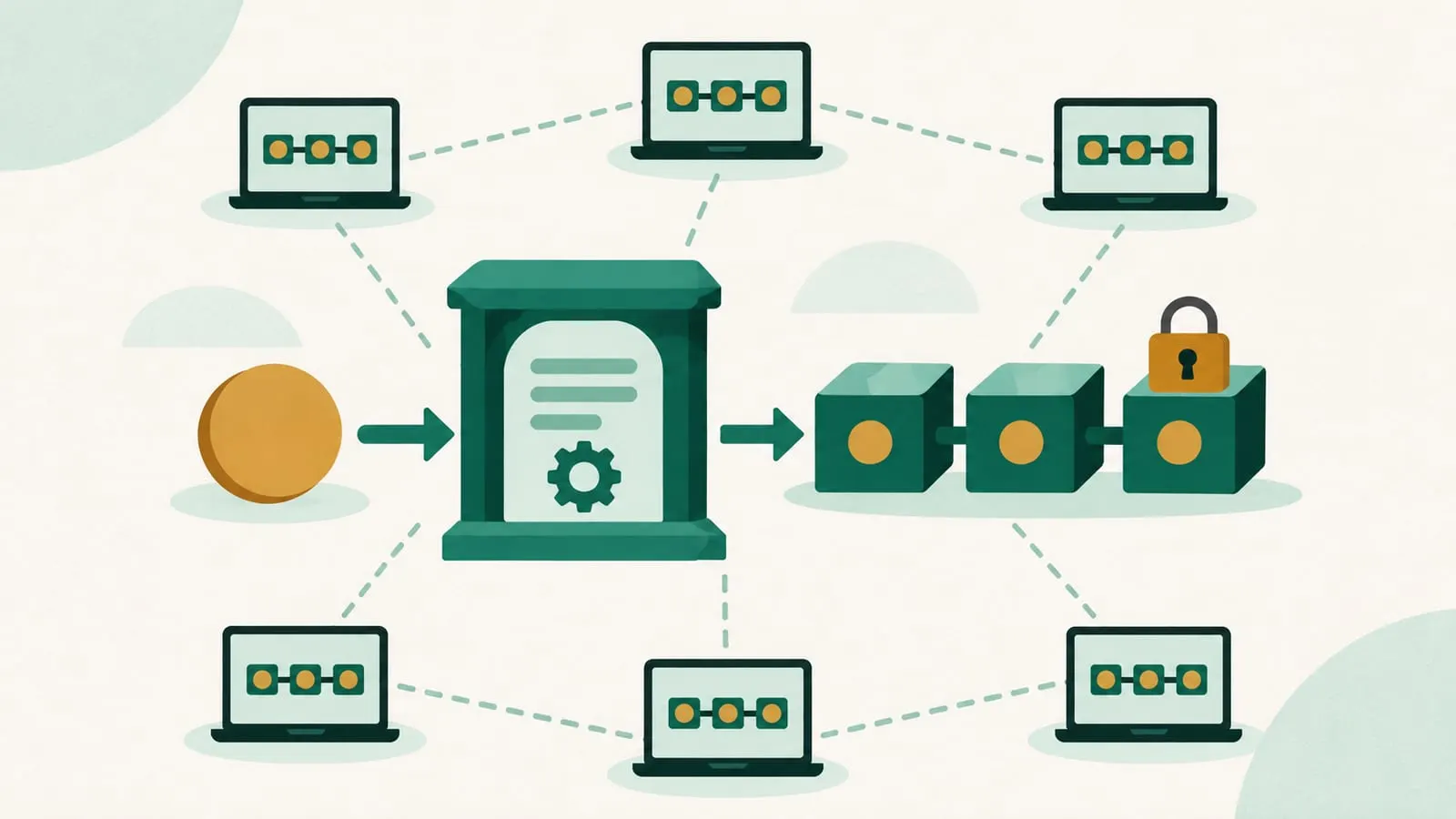
Smart contract and blockchain transactions are irreversible because no single party controls the ledger. When your transaction is confirmed in a block, thousands of independent computers record and verify it. There is no bank or administrator who can edit that record, and the smart contract you interacted with simply runs its code. If that code has no refund function, nobody can pull your funds back out.
So if you send the wrong amount in a peer-to-peer transaction, you usually cannot reverse it yourself. Your realistic options are asking the recipient to send it back or, if a centralized platform was involved, asking that platform for help.
Why blockchains are built this way
Irreversibility is not a bug; it is the main thing a blockchain provides. Bitcoin’s white paper describes the goal as a payment system where transactions are “computationally impractical to reverse”, so that sellers are protected from fraud and no trusted third party is needed.
Three properties make that work:
- Shared, append-only history. Every node keeps a copy of the ledger and checks every new block against the rules. You can add new blocks, but changing old ones would require everyone to accept a different history. This is what blockchain immutability means.
- Economic finality. Rewriting history costs real money. On Bitcoin, an attacker would need to out-mine the rest of the network. On Ethereum, according to ethereum.org, reverting a finalized block would require an attacker to lose at least one-third of all staked ETH.
- Code as the rulebook. A smart contract does exactly what it was programmed to do. If you send tokens into it, the only way out is a function the developers wrote. There is no customer service desk behind it.
The trade-off is clear. Card payments can be charged back because a bank sits in the middle and can reverse entries. Crypto removes that middleman, and with it the undo button.
When does a transaction become final?
A transaction goes through stages, and the window to act closes quickly:
| Stage | Can it be changed? |
|---|---|
| Signed but not broadcast | Yes, just don’t send it |
| Pending in the mempool | Sometimes. On Ethereum-style chains you can submit a replacement with the same nonce and a higher fee, either to cancel it (sending 0 to yourself) or to speed it up. Many wallets have “Speed up” and “Cancel” buttons for this. |
| Included in a block | Very unlikely to change; on proof-of-work chains a block can occasionally be replaced by a competing one |
| Final | No. Bitcoin users conventionally wait about six confirmations (roughly an hour); Ethereum finalizes after about two epochs, roughly 13 minutes |
Once confirmed, even gas fees paid for failed transactions are gone. For a related question about trades, see whether you can cancel a smart contract trade once initiated.
The exceptions, and why they are rare
The old answer on this page said irreversibility “can be overturned”. That is true only in narrow cases, none of which an ordinary user can trigger:
- Centralized stablecoins and tokens. Issuers such as Tether (USDT) and Circle (USDC) can freeze tokens at specific addresses, usually at the request of law enforcement. They do not reverse your transfer for you.
- Exchanges and custodial apps. If you sent funds to an exchange account, the exchange can sometimes credit or return a mistaken deposit, because it controls that wallet.
- Contracts with built-in controls. Some protocols have admin keys, pause functions or time-locks. These can stop a hack in progress but are also a centralization risk.
- Community-level intervention after huge hacks. In July 2016, after The DAO was drained of over 3.6 million ETH, the Ethereum community adopted a hard fork that moved the funds to a recovery contract. It was not unanimous: those who rejected the fork kept running the original chain, which became Ethereum Classic. More recently, in May 2025, about $162 million of the roughly $223 million taken in the Cetus exploit on Sui was frozen in the attacker’s addresses, and validators representing about 91% of stake then voted for a protocol upgrade that moved those funds to a trust wallet for return to users. Critics called it a soft rollback that undermined censorship resistance.
- Dispute-resolution protocols. Services such as Kleros let parties settle disputes through crowdsourced jurors, but only for contracts and escrows that integrated Kleros before the transaction.
Each of these exceptions shows the same principle: funds can only be clawed back where someone kept the power to do so. The more decentralized the asset and the contract, the less likely that is.
What to do if you sent the wrong amount or to the wrong address
- Check the status. Look up the transaction hash on a block explorer. If it is still pending, try your wallet’s cancel or speed-up option.
- Contact the recipient if you know who they are. On-chain records make it easy to prove what happened, and DeFi transactions are traceable.
- Contact the platform if you sent to an exchange or custodial wallet. Give them the transaction hash, amount and time.
- Report theft or fraud to the police and the platform involved. Stablecoin issuers may freeze stolen funds when law enforcement asks.
- Accept the loss if no one controls the address. Funds sent to a typo’d address, a burn address or a token contract with no withdrawal function are generally gone for good. See can you recover lost Bitcoin?
Red flags: recovery scams
People who have just lost crypto are prime targets. Be suspicious of anyone who:
- Contacts you first after you post about a loss online.
- Claims they can “reverse” a blockchain transaction or “hack back” your funds.
- Asks for an upfront fee, your seed phrase, or remote access to your device.
- Uses official-sounding names such as “blockchain recovery bureau”.
No one can reverse a final transaction on a public blockchain. Our guide to crypto scams and recovering coins has more red flags.
How to avoid irreversible mistakes
- Send a small test transaction first for large or first-time transfers.
- Double-check the address, especially the first and last characters, and watch for address-poisoning lookalikes in your history.
- Confirm the network. Sending a token on the wrong chain is a common way to lose funds.
- Read what you sign. Use wallets that simulate transactions and show what will leave your account.
- Use escrow or multisig for large deals. A multisig wallet or an escrow contract adds a layer of approval before funds move.
For more on keeping funds safe, see the wallets and security guide.
Frequently asked questions
Can a blockchain transaction be reversed?
Not once it is final. A pending transaction can sometimes be replaced or cancelled before it is confirmed, but after confirmation the only way to get funds back is for the recipient to send them back voluntarily or for a platform that controls the asset to intervene.
Can I get my money back if I sent crypto to the wrong address?
Only if someone controls that address and agrees to return it, or if you sent it to an exchange that can identify the deposit. Funds sent to an address nobody controls, or to a token contract by mistake, are usually lost permanently.
Didn't Ethereum reverse the DAO hack?
Not by reversing transactions. In July 2016 the Ethereum community adopted a hard fork that moved the drained funds to a recovery contract. It was contentious, not unanimous: a minority kept the original chain, which became Ethereum Classic.
How long until a transaction is irreversible?
It depends on the chain. Bitcoin users traditionally wait for about six confirmations, roughly an hour. Under normal conditions Ethereum finalizes blocks after about two epochs of 6.4 minutes each, so roughly 13 minutes; finality can take longer if many validators are offline.
Can a smart contract have a refund function?
Yes. Developers can build escrow, time-locks, cancellation windows or dispute resolution into a contract. Those features have to be written in before you use it; they cannot be added to a transaction after the fact.
Sources
Educational content, not financial advice. DeFi carries risk, including total loss of funds.