How Do Deflationary Tokens Work? Burns, Buybacks and the Risks
On this page
I have a very limited understanding of deflationary tokens. How do they work?
Short answer
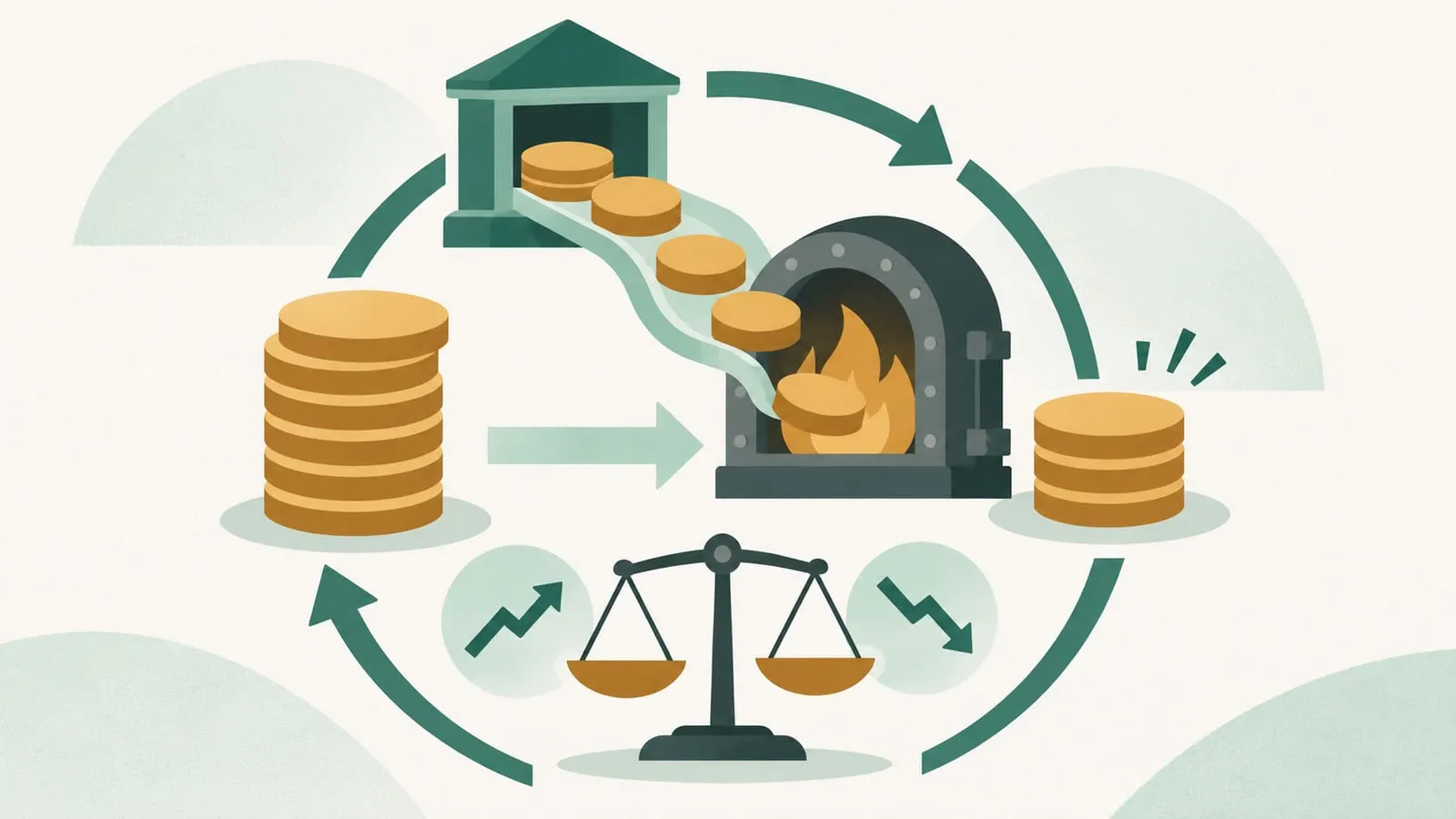
A deflationary token is a cryptocurrency whose total supply is designed to shrink over time. Most do it by burning tokens: sending them to an address nobody controls, or destroying them in a smart contract, so they can never be used again. The burns can be triggered on every transfer, funded by a project’s revenue (buyback-and-burn), taken from network fees, or done in one-off events.
The idea is that if demand stays the same while supply falls, each remaining token represents a bigger share. That “if” matters: burns don’t create demand, and a token can lose value however much of it is burned.
Deflationary vs fixed supply vs inflationary
People often mix these up, including the old answers that used to appear on this page.
| Supply model | What happens to supply | Example |
|---|---|---|
| Inflationary | Grows indefinitely through new issuance | Many proof-of-stake tokens that pay staking rewards with new tokens |
| Fixed cap (disinflationary) | Grows towards a hard maximum, more slowly over time | Bitcoin: capped at 21 million, with new issuance halving roughly every four years |
| Deflationary | Falls over time as tokens are destroyed | BNB, which burns towards a 100 million target |
| Variable | Can rise or fall depending on usage | ETH: new issuance to validators, minus fees burned |
| Elastic (rebasing) | Every holder’s balance expands or contracts to target a price | Ampleforth; see how Ampleforth’s supply changes work |
A capped supply is not deflationary on its own: Bitcoin’s supply still increases with every block until issuance stops at the cap. For the details, see the maximum usable supply of Bitcoin.
The four main ways tokens become deflationary
1. Burn on every transfer
The token contract takes a percentage of each transfer (say 1 to 5%) and burns it. Some variants, called “reflection” tokens, also redistribute part of the fee to existing holders. This was the model behind many 2021-era tokens, SafeMoon among them.
It sounds simple, but it causes problems: transfers deliver less than was sent, which breaks some DeFi apps, and trading on a DEX usually needs a higher slippage setting.
2. Buyback-and-burn
A project uses revenue to buy its own token on the market and burn it, similar to a company buying back shares. The buy pressure and the reduced supply both depend on real revenue, so it’s only as strong as the business behind it.
A recent example: Uniswap’s governance approved switching on protocol fees in December 2025, with the proceeds used to burn UNI. Our DeFi token guide covers how fee switches and burns affect token value.
3. Burning part of network fees
Some blockchains destroy part of every transaction fee.
- Ethereum has burned the “base fee” of every transaction since the London upgrade in August 2021 (EIP-1559). New ETH is issued to validators at the same time, so supply only falls when burns exceed issuance. That happened during busy periods, but since the Dencun upgrade in March 2024 moved most layer 2 data to cheaper “blob” space, burns have usually been lower than issuance. ETH supply has grown slowly in 2025 and 2026, at well under 1% a year by most estimates. You can track it live on ultrasound.money. Learn more about gas fees.
- BNB Smart Chain burns a share of the gas fees in every block in real time (BEP-95), with the share set by validator governance.
4. Scheduled or one-off burns
Some projects burn tokens on a schedule or as a one-off event. BNB’s quarterly Auto-Burn is the best-known example: the amount burned depends on BNB’s price and the number of blocks produced that quarter, and it continues until total supply reaches 100 million BNB. The 37th burn, announced on 19 October 2026, destroyed about 1.65 million BNB (around $1.2 billion at the time), leaving about 131.5 million BNB. See the evolution of BNB Chain for background.
One-off burns of team or treasury tokens are common in marketing. Check what was actually burned: destroying tokens that were never going to circulate has little effect on the tokens that do.
Do burns make a token’s price go up?
Not on their own. Price is set by supply and demand:
- If people stop wanting a token, a falling supply doesn’t stop the price dropping.
- A burn that’s small relative to new issuance or token unlocks still leaves supply growing.
- Burns funded by real revenue (fees, profits) say more about a token than burns funded by transaction taxes on the holders themselves.
For a deeper look at this question, see do deflationary tokens increase in value? and the advantages of deflationary crypto assets.
How to check a deflationary token’s claims
- Read the contract or docs. Where do burned tokens go, and who can change the burn rate or fees?
- Verify burns on-chain. Look up the burn address on a block explorer and compare the burned amount with total and circulating supply.
- Compare burns with issuance and unlocks. Net supply change is what matters. Check emission schedules and vesting.
- Look for a real revenue source. Is the burn funded by fees from actual users or by taxes on traders?
- Check holder concentration and liquidity. Can a few wallets dump? Is the liquidity locked, and by whom? See how liquidity locks work.
Risks of deflationary tokens
- Scams and rug pulls. “Deflationary” and “reflection” branding has been widely used to sell low-quality or fraudulent tokens. SafeMoon, one of the best-known reflection tokens, ended in a US fraud case: its former CEO, Braden Karony, was convicted in May 2025 and sentenced in February 2026 to 100 months in prison for, among other things, diverting tokens from SafeMoon’s liquidity pool. Read how to spot a liquidity mining scam and our crypto scams guide.
- Honeypots and hidden controls. Some contracts let the owner raise the transfer tax to 100% or block selling. Check for owner-only functions before buying.
- DeFi incompatibility. Fee-on-transfer tokens can break lending pools, staking contracts and bridges that assume the amount sent equals the amount received. See the risks of staking deflationary tokens.
- Higher trading costs. Transfer taxes plus high slippage settings make every trade more expensive and expose you to front-running and sandwich attacks.
- Volatility. Small, burn-focused tokens are often thinly traded and can fall sharply.
Nothing on this page is investment advice. A token’s burn mechanism is one input among many; you can learn more on our deflationary tokens topic page.
Frequently asked questions
What does it mean to burn a token?
Burning sends tokens to an address no one controls (often one ending in dEaD) or calls a function that destroys them, so they can never be spent again. The burn is recorded on-chain and anyone can verify it.
Is Bitcoin a deflationary token?
Not strictly. Bitcoin has a fixed cap of 21 million coins, but new coins are still being mined, so its supply grows each year, at a rate that halves roughly every four years. That makes it disinflationary. Coins lost forever reduce the usable supply, but nobody can count them precisely.
Is ETH deflationary?
Sometimes. Since 2021 Ethereum burns part of every transaction fee, so supply falls when the network is busy. Since the March 2024 Dencun upgrade moved most layer 2 data to cheaper blobs, burns have usually been smaller than new issuance, and ETH supply has grown slowly, by well under 1% a year in 2025 and 2026.
Do deflationary tokens always go up in value?
No. A shrinking supply only helps the price if demand holds up. Many tokens with heavy burns have fallen sharply. Supply is one factor among many, alongside usage, revenue and holder concentration.
Why does my swap fail when I trade a deflationary token?
Tokens that burn or tax a percentage on every transfer deliver less than the swap expected, so the trade can fail. DEXs usually require raising the slippage tolerance, which also exposes you to worse prices and to front-running bots.
Sources
- BNB Chain: 37th BNB burn (October 2026), Auto-Burn and BEP-95
- EIP-1559: Fee market change for ETH 1.0 chain
- ethereum.org: Gas and fees (base fee burn)
- ultrasound.money: live ETH supply, issuance and burn
- The Block: Former SafeMoon CEO sentenced to 8 years in prison (February 2026)
- Bitcoin.org: Frequently asked questions (21 million supply)
Educational content, not financial advice. DeFi carries risk, including total loss of funds.