What Is a Blockchain? A Simple Explanation
On this page
Hello. Blockchains are just so complicated to understand. Please simplify this for me as I'd like to understand the world of crypto much more. TA!
A blockchain in one sentence
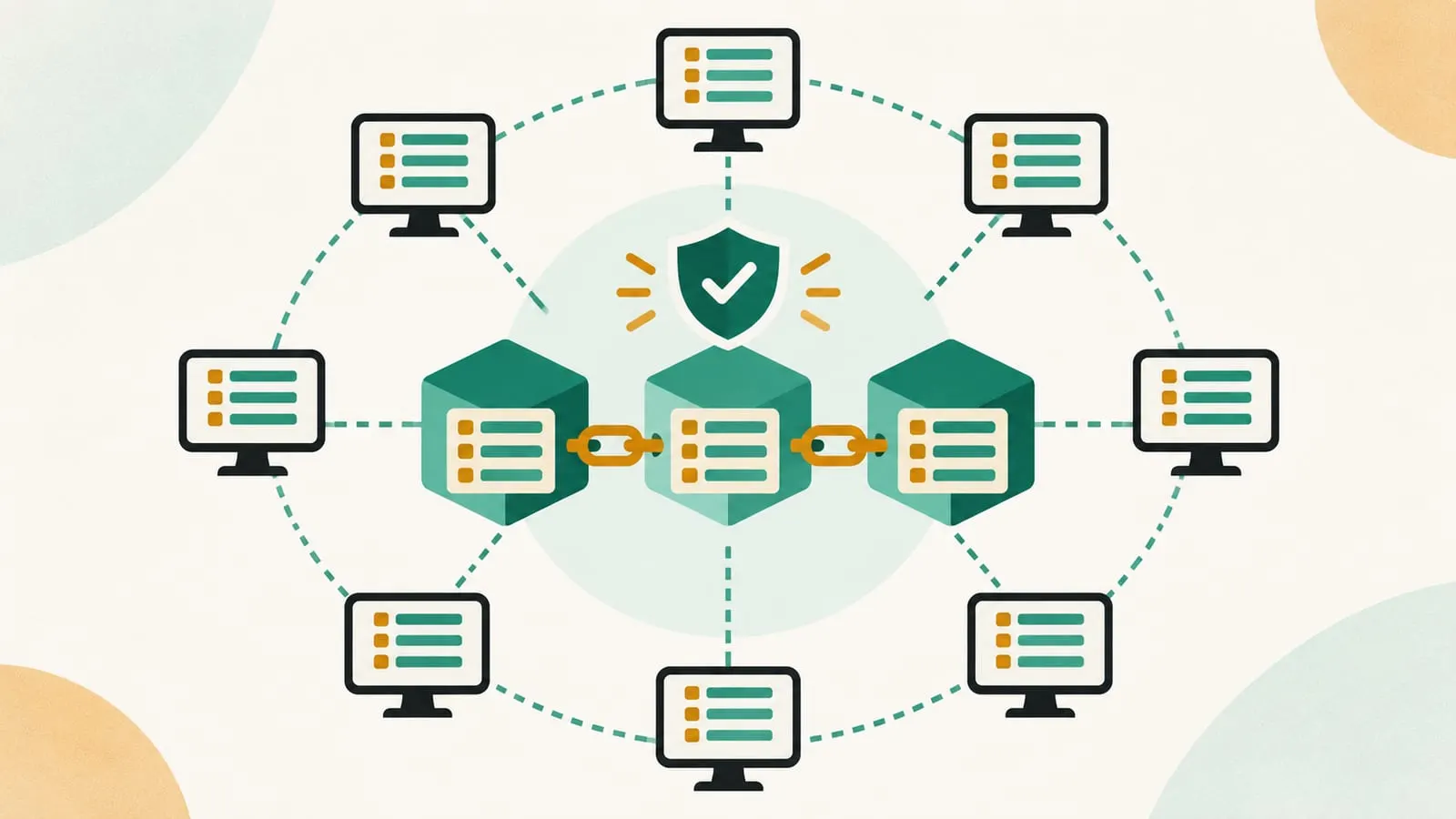
A blockchain is a shared digital ledger that many computers keep identical copies of, where transactions are grouped into blocks and each block is linked to the one before it, so the history is very hard to change. Instead of one bank or company keeping the books, a whole network keeps them together and agrees on every new entry.
A simple way to picture it: imagine a notebook that thousands of people each have a copy of. Every few seconds or minutes, a new page of transactions is added. Everyone checks that the page follows the rules before adding it to their copy, and each page carries a fingerprint of the previous page, so nobody can secretly tear out or rewrite an old one.
How a blockchain works, step by step
- You make a transaction. For example, you send some bitcoin from your crypto wallet. Your wallet signs it with your private key, which proves you own the funds without revealing the key.
- The transaction is broadcast. It spreads across the network’s nodes, the computers that store the ledger and check the rules.
- Transactions are bundled into a block. A miner or validator collects pending transactions into a new block.
- The network agrees on the block. A consensus mechanism decides whose block is accepted (more on this below).
- The block is chained on. The new block includes a cryptographic hash of the previous block, linking them together. Every node adds it to its copy.
- The transaction becomes final. As more blocks are added on top, reversing it becomes practically impossible. On Ethereum, new blocks arrive every 12 seconds and are normally finalized after two epochs, about 13 minutes; on Bitcoin, people traditionally wait for about six blocks, roughly an hour.
What’s inside a block?
| Part | What it does |
|---|---|
| Transactions | The payments or contract calls being recorded |
| Hash of the previous block | Links the block to the chain; changing an old block breaks every link after it |
| Merkle root | A single hash summarizing all the block’s transactions, so changing any one of them changes the block |
| Timestamp | Records roughly when the block was created |
| Consensus data | Proof of the work done (Bitcoin) or validator signatures (Ethereum) |
How do strangers agree? Consensus mechanisms
The hard problem a blockchain solves is getting thousands of computers that don’t trust each other to agree on one history, and to stop anyone spending the same coins twice. That is the job of the consensus mechanism.
- Proof of work, used by Bitcoin, makes miners compete to solve a computing puzzle. The winner adds the next block, roughly every 10 minutes, and earns newly issued bitcoin plus fees. Rewriting history would require redoing that work faster than the rest of the network combined.
- Proof of stake, used by Ethereum since September 2022, has validators lock up ETH as collateral. They propose and vote on blocks, and lose part of their stake if they break the rules.
Our comparison of proof of work vs. proof of stake covers the trade-offs in detail.
Key properties of a public blockchain
- Decentralized. No single company can shut it down or rewrite the rules alone (see decentralization).
- Transparent. Anyone can read every transaction. Addresses are pseudonymous, not anonymous. See blockchain transparency.
- Immutable. Confirmed records are practically impossible to change. See blockchain immutability.
- Permissionless. Anyone can use it or run a node without asking.
Private or permissioned blockchains, often used by companies, keep the chained-block structure but restrict who can read and write, so they trade openness for control.
What blockchains are used for
- Cryptocurrencies. Bitcoin, launched in January 2009, was the first widely used blockchain and is designed for peer-to-peer digital money. The idea of hash-linked, timestamped records is older: the Bitcoin white paper cites Stuart Haber and W. Scott Stornetta’s work on time-stamping documents from the early 1990s.
- Smart contracts and DeFi. Ethereum, launched in 2015, added programmable smart contracts: code that runs on the blockchain exactly as written. These power decentralized finance, such as exchanges, lending markets and stablecoins, without a bank in the middle.
- Tokens and ownership records. NFTs, tokenized assets and on-chain voting all rely on a shared, verifiable record of who owns what.
- Traceability. Some supply-chain systems record a product’s handoffs on a shared ledger.
Limitations and risks
- Speed and cost. Every node processes every transaction, so base layers are slower than card networks, and fees rise when demand is high. Layer 2 scaling networks and the scalability trilemma explain how blockchains try to grow.
- No undo button. If you send funds to the wrong address or approve a malicious contract, nobody can reverse it.
- Privacy. Your transaction history is public to anyone who links an address to you.
- Security depends on size. Small proof-of-work chains, such as Ethereum Classic in 2020, have been rewritten by attackers who rented enough computing power.
- Applications can fail even if the chain doesn’t. Most losses come from hacked exchanges, phishing and buggy smart contracts, not from breaking the blockchain itself.
Try it yourself
The easiest way to understand a blockchain is to look at one. Open a block explorer, search for a recent block, and click into a transaction to see the sender, recipient, amount and fee. Our guide on where to see your transactions on a blockchain walks through it. For more, browse the Blockchains & Scaling hub or the blockchain glossary entry.
About the original community answer
The older answer on this page gave a reasonable analogy but described proof of work and spending rules inaccurately, so it has been replaced by this explanation.
Frequently asked questions
What is a blockchain in simple terms?
It is a shared record book that thousands of computers keep identical copies of. New pages (blocks) are added only when the network agrees they are valid, and old pages can't be quietly rewritten.
Is blockchain the same as Bitcoin?
No. Bitcoin is a cryptocurrency, and the Bitcoin blockchain is the ledger that records its transactions. Many other blockchains exist, such as Ethereum and Solana, each with its own rules and uses.
Who controls a blockchain?
On a public blockchain, no single party. Independent node operators, miners or validators follow shared rules, and changing those rules requires broad agreement. Private or permissioned blockchains are controlled by an approved group.
Can a blockchain be hacked?
Large blockchains like Bitcoin and Ethereum have proven very hard to attack directly, but smaller networks have been rewritten in 51% attacks. Most crypto losses come from hacked wallets, exchanges and buggy smart contracts rather than the blockchain itself.
Where can I see blockchain transactions?
In a block explorer for that network, such as a Bitcoin explorer or Etherscan for Ethereum. Paste in a transaction hash or address to see its details.
Sources
Educational content, not financial advice. DeFi carries risk, including total loss of funds.