DexGuru Review (2026): Trading Terminal, Fees, Chains and Alternatives
On this page
DexGuru status in 2026
DexGuru is still live. As of November 16, 2026, dex.guru loads real-time token charts, an on-chain activity feed and a swap panel, and you can browse it without connecting a wallet. The site footer labels the app a beta.
What has changed is the company around it. The team now operates as Guru Network, which describes itself as a multi-chain Web3 automation and AI compute layer with its own GURU token, and says DexGuru “has transformed” into it. In practice the dex.guru terminal still runs alongside Guru Network’s other products, and Guru Network says its framework powers the new iteration of DexGuru. Expect the interface and feature set to keep changing.
What is DexGuru?
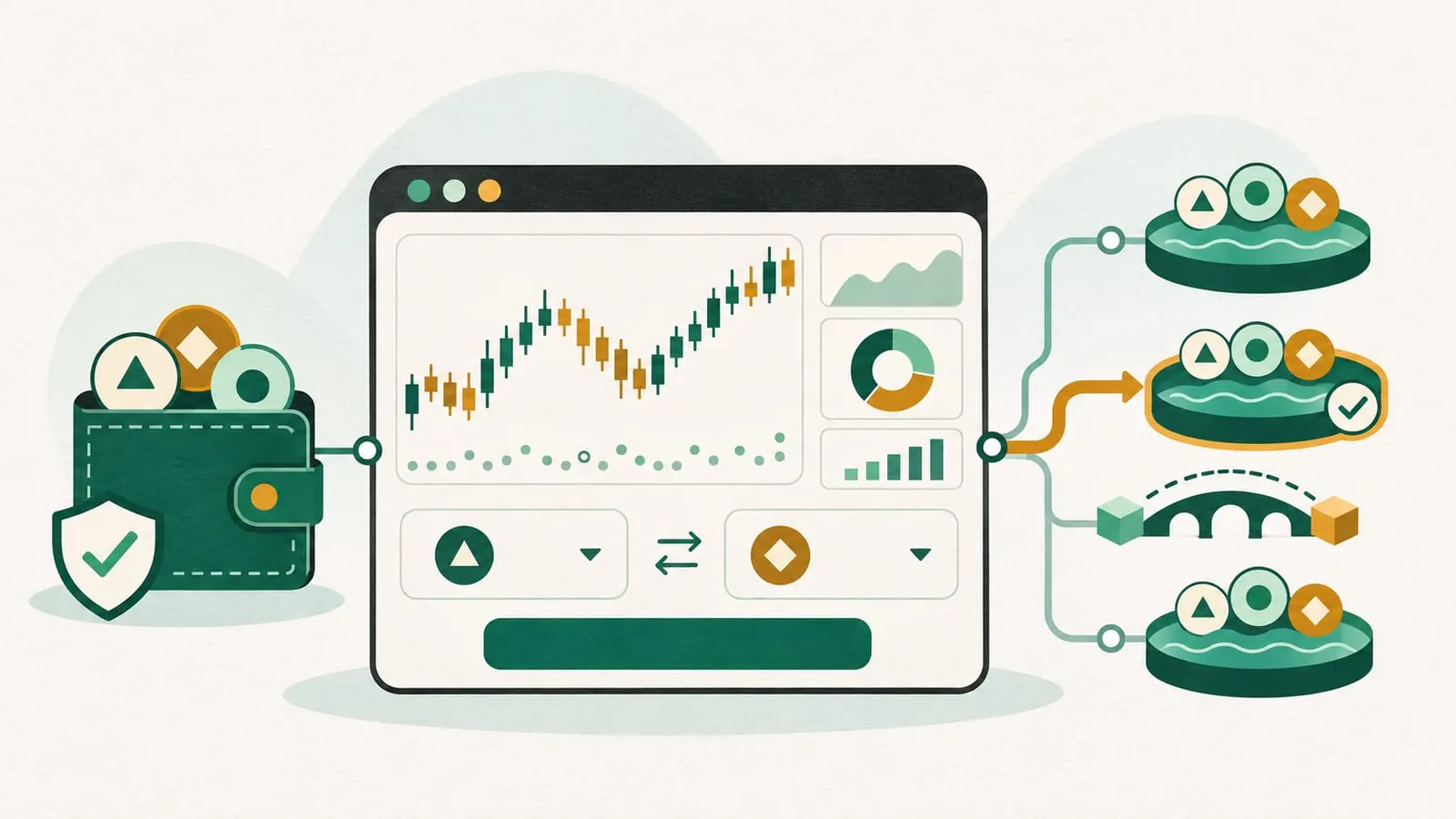
DexGuru is a non-custodial trading terminal for decentralized exchanges. It pulls trade data from on-chain DEX pools and presents it the way a centralized exchange would: candlestick charts, recent trades, liquidity and holder data, all on one screen. You connect your own wallet and swap directly from it, so DexGuru never takes custody of your funds.
It is not an exchange with its own order book or liquidity, and its docs say DexGuru has no smart contract of its own. When you trade, it requests quotes from third-party DEX aggregators and suggests the best one, a process it calls meta-aggregation. Its docs name 0x and 1inch on the meta-aggregation page and also list KyberSwap and Paraswap (which rebranded as Velora in April 2025) as routing protocols. We could not confirm which of these routers the live app currently queries, so check the router named in your quote. You can override the suggested router. Limit orders go through the 1inch Limit Order Protocol, and cross-chain swaps through the LI.FI bridge aggregator.
Ethereum and BNB Chain were its first networks, added in April 2021 according to the docs.
Key features
- TradingView-style charts for DEX-traded tokens, with drawing tools and indicators, built from on-chain trade data.
- Market, limit and cross-chain order tabs in the swap panel (all three were visible in November 2026).
- Meta-aggregation: compares aggregator quotes and shows whether a token approval is needed before a swap.
- On-chain token data: liquidity, volume, trade history, holder and top-holder views for a token.
- Trader profiles: click any wallet in the activity feed to see its trading history and holdings.
- Token explorer and multichart: browse tokens by chain, liquidity, volume and market-cap bands, or watch several charts at once.
- Favorites and alerts (wallet connection required): price alerts for favorite tokens, activity alerts for favorite wallets, with optional delivery to Telegram.
- GURU AI chat panel: an AI assistant for token prices, market overviews and trending tokens. It is labelled beta, warns that its answers may be inaccurate, and in November 2026 asked for 50 AIGURU (a Guru Network token) to start a session. It’s optional; treat its output as unverified.
- Developer API and B2B services: an on-chain trading data API with a free personal tier and paid commercial plans (see pricing below), plus a white-label “block explorer as a service” offering for businesses.
Supported chains
DexGuru focuses on EVM chains, but its chain lists don’t agree with each other:
| Source | Chains listed |
|---|---|
| Docs “Supported chains” page (last updated November 2022) and API docs | Ethereum, BNB Chain, Polygon, Avalanche, Arbitrum, Fantom, Celo, Optimism, Gnosis, Arbitrum Nova, Canto |
| Live token explorer tags (November 2026) | Ethereum, BNB Chain, Arbitrum, Avalanche, Base, Solana, Sonic, plus a few test and niche networks |
| Meta-aggregated market orders (docs) | Ethereum, BNB Chain, Polygon, Avalanche, Fantom, Arbitrum, Optimism, Celo |
| Limit orders (docs) | Ethereum, BNB Chain, Polygon, Optimism, Arbitrum, Avalanche |
Because coverage is in flux, check the chain selector on the site before relying on DexGuru for a particular network. Ordinary swaps happen on one chain; moving assets between networks needs the cross-chain tab or a separate bridge, which carry their own fees and risks. DexGuru’s docs warn that cross-chain swaps can take from 20–30 minutes to a few hours, and that you may sometimes receive a stablecoin instead of the requested token.
Fees and pricing
| What | Cost |
|---|---|
| Charts, token data, explorer | Free |
| Swaps through DexGuru | 0.5% fee per trade, according to DexGuru’s FAQ, plus gas fees |
| Aggregator and pool fees | Built into the quoted price, as on any DEX |
| Limit orders | No gas when filled or expired, per the docs; approvals and cancellations cost gas |
| API, personal use | Free: 200,000 calls/month, 5 requests/second, data delayed 300 seconds |
| API, commercial | $199/month for 1 million calls, $25 per extra million |
Fee and API details are as published in DexGuru’s docs as of November 2026. The docs are not consistently maintained, so confirm the fee in the swap confirmation window before you sign.
Older reviews (including a previous version of this page) said DexGuru charged no trading fees; its current FAQ says otherwise. If you only need to swap, going straight to an aggregator such as 1inch avoids DexGuru’s added fee, although the aggregator may charge its own: 1inch’s interfaces can add an infrastructure fee of up to 0.30% on some pairs.
How to use DexGuru
- Go to dex.guru by typing the address yourself. Search results include unofficial “DexGuru” pages on other domains; the official links are listed in DexGuru’s docs.
- Search for a token or browse the token explorer, and confirm the contract address matches the project’s official one.
- Connect a wallet such as MetaMask or a WalletConnect-compatible wallet, on the right network. The first time, you’ll be asked to sign a message to prove you own the address; this is not a transaction and costs no gas.
- In the swap panel, choose the token you’re paying with and the amount. Review the quote, the router and slippage tolerance.
- Approve the token if prompted (an on-chain approval transaction to the router’s contract), then confirm the swap in your wallet.
Pros and cons
Pros
- Free charts and on-chain data for DEX-traded tokens, no account needed to browse
- Non-custodial: you trade from your own wallet
- Compares aggregator quotes instead of relying on a single DEX, and lets you pick the router
- Charts, holder data, trader profiles and trading on one screen
- Public API with a free tier for personal use
Cons
- 0.5% swap fee (per its FAQ) on top of gas, more than trading directly on an aggregator
- Documentation is partly out of date, so it’s hard to know exactly which chains and features are current
- Product is labelled beta, and the AI and token features tied to Guru Network add complexity many traders don’t need
- Busy interface that can overwhelm beginners
- Thinner coverage of non-EVM ecosystems than Solana-focused tools
Who is DexGuru for?
DexGuru suits on-chain traders who want charts and a swap button in one place, and developers who want a simple DEX data API with a free tier. If you mainly want to scan new pairs, track memecoins on Solana, or swap at the lowest possible cost, a dedicated screener plus an aggregator is usually the better combination. Beginners should start with our guide to choosing a decentralized exchange and understand slippage before trading illiquid tokens.
DexGuru alternatives
All of the following were live when we checked in November 2026.
| Tool | Best for | Notes |
|---|---|---|
| DEX Screener | Scanning pairs across many chains | Free charts, trending and new-pair lists across dozens of chains |
| DEXTools | Pair explorer and token audit scores | Long-running; paid tiers for advanced features are tied to its DEXT token |
| GeckoTerminal | Neutral DEX data | Built by the CoinGecko team; free charts, pool data and a free API |
| Birdeye | Solana and multi-chain trading data | Strong Solana coverage and a data API; its trading app is now branded Birdeye Terminal |
| 1inch / CoW Swap | Swapping without a terminal fee | Aggregators that route across DEXs; CoW Swap uses batch auctions and markets MEV protection |
| Jupiter | Swapping on Solana | Solana’s main swap aggregator, now also offering perps and other products |
For more on how these tools fit together, see our trading tools hub and the broader DEXs category.
Risks to keep in mind
- Token risk: A token appearing on DexGuru (or any screener) is not an endorsement. DexGuru indexes tokens automatically, with no listing review, and many DEX-listed tokens are scams, honeypots or rug pulls. Check contract addresses, liquidity and holder concentration before buying.
- Approval risk: Token approvals let the aggregator’s contracts move your tokens. Approve only what you need and revoke old approvals periodically.
- Phishing: DexGuru will never ask for your seed phrase or private key. Anything that does is a scam.
- MEV and slippage: Swaps on public mempools can be front-run; loose slippage settings make this worse.
- Third-party dependencies: Routing, limit orders and cross-chain swaps rely on outside protocols (0x, 1inch, LI.FI and others), so problems there affect your trade.
- Platform changes: DexGuru’s team is focused on Guru Network. Features, fees and supported chains may change without much notice.
Verdict
DexGuru is a legitimate, still-working DEX trading terminal with solid free charts and a useful API, but it’s no longer the “no-fee” tool it was once described as, and its documentation lags behind the product. It’s a reasonable choice if you like its all-in-one layout; otherwise, a free screener for research plus a direct aggregator for execution covers the same ground. You don’t need any token to use it, and nothing on this page is a recommendation to buy GURU, AIGURU or any other token.
Frequently asked questions
Is DexGuru still working in 2026?
Yes. As of November 16, 2026, dex.guru loads live token charts, an on-chain activity feed and a swap panel, and the footer labels it a beta version. Its team now focuses on Guru Network, so features and layout keep changing.
Is DexGuru a DEX?
Not exactly. It's a trading terminal: it shows on-chain market data and lets you swap from your own wallet, but trades are executed through third-party DEX aggregators and the underlying exchanges' liquidity pools. DexGuru says it has no smart contract of its own.
Does DexGuru charge fees?
Viewing charts and analytics is free. DexGuru's FAQ states that trades include a 0.5% fee, plus the blockchain's gas fee. Always check the fee shown in the swap confirmation before signing.
Is DexGuru safe?
It's non-custodial, so it never holds your funds, but every swap requires you to sign token approvals and transactions in your wallet. Use a reputable wallet, type dex.guru yourself (unofficial look-alike sites exist), and never enter a seed phrase: DexGuru says it will never ask for one.
What is the GURU token, and do I need it?
GURU is the token of Guru Network, the project DexGuru's team evolved into. You don't need GURU or any other token to use DexGuru's charts or swaps; only the optional GURU AI chat panel asks for AIGURU, a separate Guru Network token, to start a session.
Sources
- DexGuru (live app, checked November 16, 2026)
- DexGuru docs: FAQ (fees, wallet connection)
- DexGuru docs: Swapping tokens (routing protocols)
- DexGuru docs: Meta-aggregation
- DexGuru docs: Limit orders
- DexGuru API: Getting started (plans and chains)
- GURU Network official site
- Guru Network blog: Insider updates, Aug 8 2025 AMA (GURU staking and AIGURU)
Educational content, not financial advice. DeFi carries risk, including total loss of funds.