Can You Get Instant Access to Staked Coins? Liquid Staking, Unstaking Times and the Trade-Offs
On this page
Say the market falls, and I want to withdraw my staked assets before I can lose them, or I am in dire need of cashing in my investment for whichever reason. Are there any platforms that will allow me to break the smart contract?
The short answer
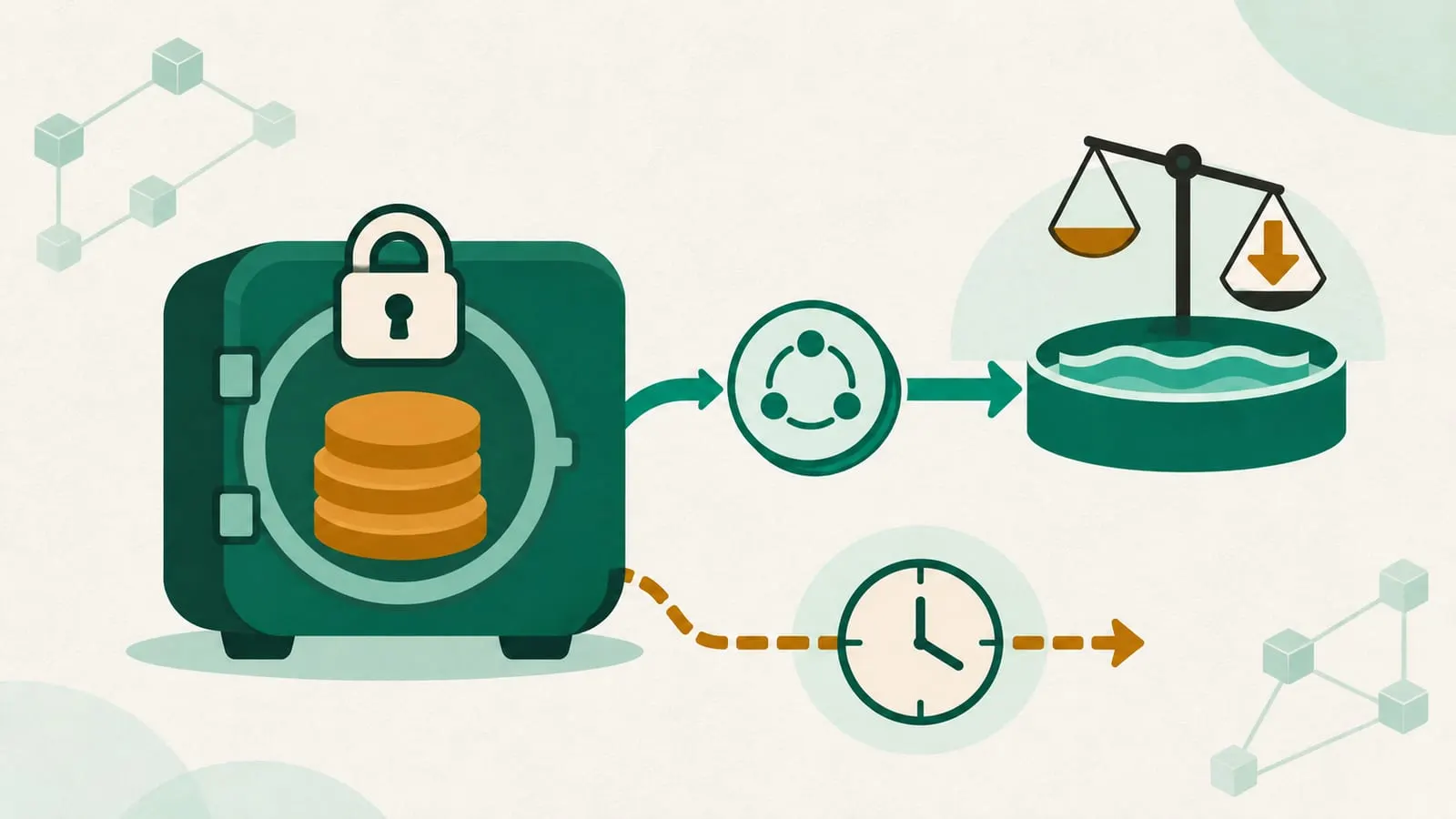
Yes, in a practical sense, but not by breaking the staking rules. No DeFi platform can make a blockchain release natively staked coins before its exit or unbonding period ends. What you can do is stake through a liquid staking protocol, which gives you a token representing your stake. That token can be sold on a decentralized exchange or used as loan collateral at any time, so you can get out in minutes instead of days or weeks.
The catch is price. Selling a liquid staking token means accepting the market rate, and in a crash that rate can be below the value of the stake it represents. Exactly when people most want to exit, the discount tends to be widest.
Why staked coins are locked in the first place
On a proof-of-stake network, validators put up stake as a security deposit. If they misbehave, part of it can be destroyed (slashing). An exit or unbonding delay gives the network time to catch and punish misbehaviour before the stake walks out of the door. That is why no app can simply “break the smart contract”: the wait is part of how the chain stays secure.
Typical waits for native staking, as of November 2026:
| Network | How unstaking works | Typical wait |
|---|---|---|
| Ethereum | Validator joins the exit queue, then funds are paid out by the withdrawal sweep | Varies with demand; mid-November 2026 the exit queue was about 4 days, plus a sweep delay of about a week (live figures on Validator Queue) |
| Solana | Stake deactivates at the end of the current epoch | Up to about 2 days |
| Cosmos Hub | Fixed unbonding period set on-chain | 21 days |
Rewards generally stop while you are exiting. Our page on lock-up periods in crypto covers these rules and vesting locks in more depth.
How liquid staking gives you faster access
With liquid staking, you deposit into a protocol that stakes on your behalf and mints you a token:
- Lido gives you stETH (or wrapped wstETH) for ETH. It is the largest liquid staking protocol, with roughly $17–18 billion in total value locked according to DefiLlama in mid-November 2026.
- Rocket Pool gives you rETH for ETH. rETH can be burned for ETH directly through Rocket Pool only when its deposit pool has spare ETH; otherwise holders usually sell it on a DEX.
- Jito gives you JitoSOL for SOL on Solana.
The token’s value tracks the staked asset plus rewards. Major ETH liquid staking tokens (stETH, rETH, cbETH, WBETH) showed base yields of roughly 1.8–2.4% a year on DefiLlama in mid-November 2026, and JitoSOL about 4.9%; these rates change constantly. Our Lido liquid staking explainer and Lido staking guide go deeper.
You then have three ways out:
| Exit route | Speed | What you get | Cost |
|---|---|---|---|
| Sell the token on a DEX (e.g. a stETH/ETH pool, or JitoSOL via an aggregator) | Minutes | Whatever the market pays | Swap fee, slippage, any discount to the underlying value |
| Redeem through the protocol | Lido: 1–5 days normally (longer under stress); Jito: up to one epoch, about 2 days | Close to full underlying value | Gas; Jito charges a 0.1% fee on delayed unstake |
| Borrow against it on a lending market | Minutes | A loan in ETH or stablecoins; you keep the stake | Interest, plus liquidation risk |
Lido notes that its withdrawals can take longer than 1–5 days when the queue is large, when many validators are exiting at once, or when the protocol switches to a slower “bunker mode” in extreme conditions such as mass slashing.
What about “flexible” staking on exchanges?
Centralized exchanges often advertise flexible or instant-redemption staking. They can do this because they pay you from their own liquidity while their validators wait in the queue. The convenience is real, but you are trusting the exchange: it holds your coins, sets the terms, and can pause redemptions. When lenders such as Celsius froze withdrawals in 2022, customers could not get their assets out at all. See Binance DeFi staking: is it safe? and staking vs lending for that trade-off.
Will unstaking protect you in a crash?
Often not, and this is the most common misunderstanding behind the question. Staked ETH is still ETH. If the price falls 30%, your staked position falls 30% too, and unstaking simply gives you back the same ETH, now worth less. Exiting only protects you from a price fall if you sell the asset, and the fastest way to do that from a liquid staking position is to sell the liquid token, which may itself trade at a discount during the same sell-off.
What staking does add is extra risk on top of price risk: slashing, smart contract bugs, and the possibility that your liquid token trades below its backing.
Risks of “instant” access
- Depeg and discount risk. In June 2022, as Celsius and other firms came under pressure, stETH traded around 0.94 ETH, roughly a 6% discount; reported figures varied by day and outlet. Holders who needed to exit immediately took the loss; those who waited did not.
- Thin liquidity. The DEX pools behind instant exits can become lopsided. A large sale moves the price against you.
- Smart contract risk. Liquid staking adds the protocol’s contracts, and any DEX or lending market you use, to your risk stack. See smart contract vulnerabilities.
- Liquidation risk. If you borrow against a liquid staking token and its price falls, your collateral can be sold at a penalty. See forced liquidation.
- Custody risk. Exchange “flexible staking” depends on the exchange staying solvent and honouring withdrawals.
- Scams. Be wary of any platform promising instant unstaking with no cost and a high fixed yield. Legitimate options either make you wait or make you accept a market price.
How to choose
- Decide how quickly you might need the money. If the answer is “possibly today”, stake only what you could leave untouched through a full exit, or use a liquid staking token with deep DEX liquidity.
- Check the token’s market. Look at the size of its DEX pools and how far it has traded from its backing in past stress.
- Know the protocol’s redemption path and its normal and worst-case timing.
- Avoid layering leverage on top of staking unless you understand liquidation.
- Size positions so a temporary discount would not force you to sell.
For broader context, see whether DeFi staking is a good idea and the staking in DeFi hub. This page explains mechanisms and is not investment advice.
Frequently asked questions
Can I unstake ETH instantly?
Not through the protocol itself. A solo or pooled validator must pass through Ethereum's exit queue and the withdrawal sweep. If you hold a liquid staking token such as stETH or rETH, you can swap it for ETH on a DEX within minutes, at whatever price the market offers.
How long does it take to withdraw from Lido?
Lido says stETH and wstETH withdrawal requests normally take between 1 and 5 days, and can take longer if the queue is large, many validators are exiting, or the protocol enters its 'bunker mode' during extreme events.
What is the difference between liquid staking and flexible staking on an exchange?
Liquid staking gives you an on-chain token you hold in your own wallet. Flexible staking on a centralized exchange lets you redeem from the exchange's own liquidity, but the exchange holds your coins and can change or pause redemptions under its terms.
Can I borrow against staked coins instead of unstaking?
Yes. Major lending markets accept liquid staking tokens such as wstETH as collateral. You get cash or stablecoins without selling, but you pay interest and can be liquidated if the token's value falls.
Do I keep earning rewards while unstaking?
Generally no. On most networks staking rewards stop once you start exiting or unbonding, and liquid staking withdrawal requests stop accruing rewards once submitted.
Sources
- Lido Help Center: How long does it take to withdraw?
- ethereum.org: Staking withdrawals
- ethereum.org: Pooled staking
- Jito: JitoSOL FAQs (instant vs delayed unstake)
- Validator Queue: Ethereum entry and exit queues
- CoinShares: Is the decoupling of Lido's staked ETH another stablecoin collapse?
- Decrypt (June 2022): How the Celsius liquidity crunch is linked to Lido's staked ETH
- DefiLlama Yields: liquid staking pools (base APY)
- DefiLlama: Liquid staking protocols
Educational content, not financial advice. DeFi carries risk, including total loss of funds.