What Is Blockchain Immutability? Meaning, How It Works and Its Limits
On this page
What does blockchain immutability mean?
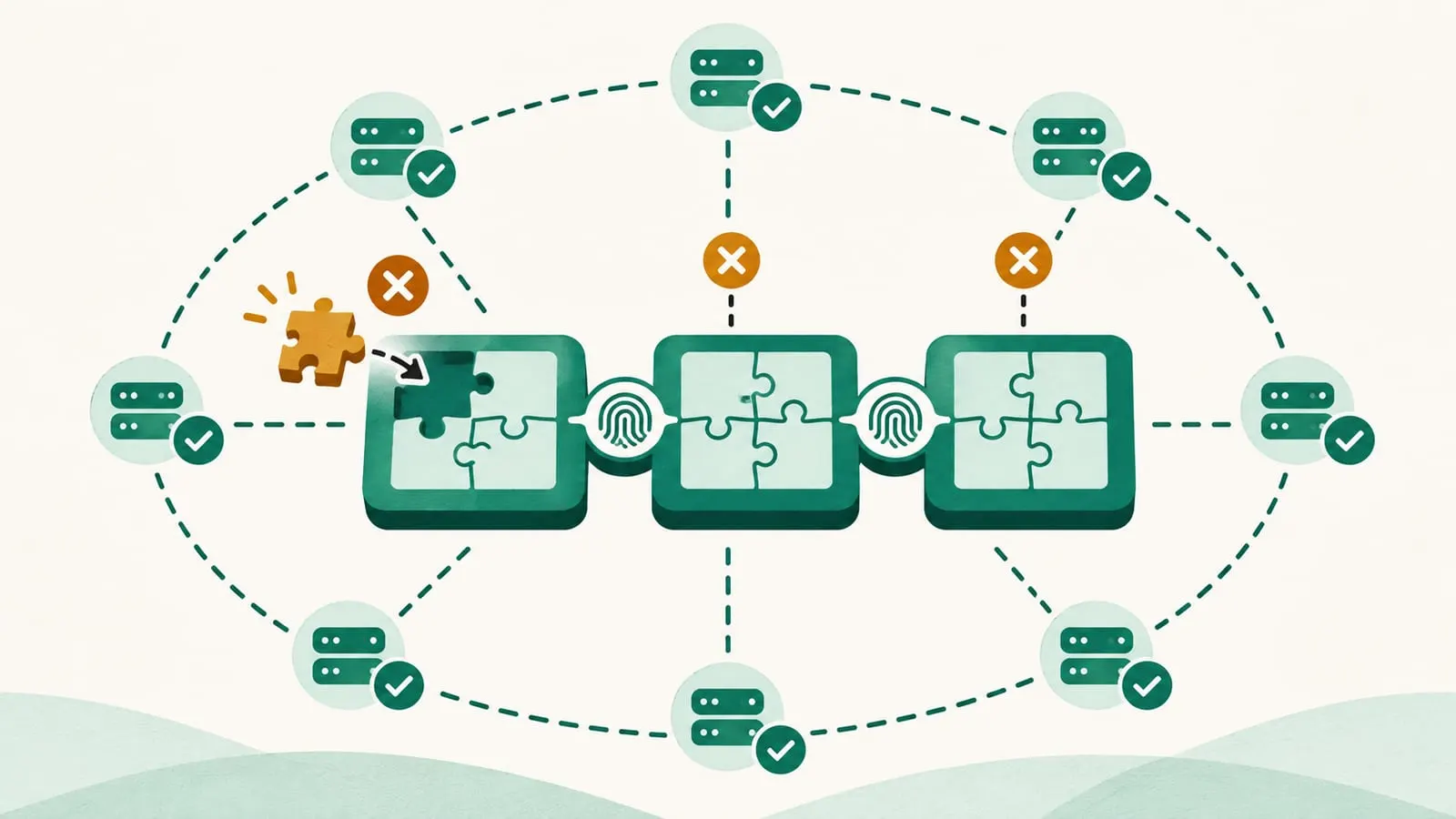
Blockchain immutability is the property that, once data is confirmed on a blockchain and enough later blocks are built on top of it, it cannot practically be altered or deleted by anyone, including the person who created it. There is no administrator who can edit a past entry. The only way to “change” something is to add a new transaction that corrects or reverses its effect, while the original stays in the record forever.
That is the key difference from an ordinary database, where whoever controls the server can update or delete rows. On a public blockchain, thousands of independent nodes each hold a copy of the full history and reject any version that doesn’t follow the rules.
How immutability works
Two mechanisms make a blockchain’s history hard to change.
1. Hash-linked blocks make edits obvious
Each block contains a cryptographic hash (a fixed-length digital fingerprint) of its own contents and of the previous block. Change a single character in an old transaction and that block’s hash changes, which breaks the link to the next block, and the next, all the way to the present. Any node can detect the tampering instantly. This makes the chain tamper-evident, and is the same property that underpins blockchain transparency: anyone can verify that the public record is the original.
2. Consensus makes rewriting expensive
Tamper-evidence alone isn’t enough, because an attacker could try to recompute every block after the one they altered. Consensus rules stop this:
- Proof of work (Bitcoin). Each block requires a large amount of computing work. As the Bitcoin white paper explains, rewriting an old block means redoing its work and every block after it, then overtaking the honest network. The probability of an attacker catching up falls rapidly with each additional block, which is why people wait for confirmations (traditionally about six, roughly an hour).
- Proof of stake (Ethereum). Validators lock up ETH and vote on blocks. Under normal conditions a block becomes finalized after two epochs, about 13 minutes (an epoch is 32 slots of 12 seconds). According to ethereum.org, reverting a finalized block would require an attacker to lose at least one-third of all staked ETH.
The deeper a transaction is buried and the larger the network, the more immutable it effectively becomes.
Why immutability matters
- Trust without a middleman. You don’t need to trust a bank or company to keep honest books; the rules and the math do it.
- Settlement finality. A confirmed payment can’t be clawed back by the sender, which protects merchants from chargebacks. Our page on why smart contract transactions are irreversible explains what this means in practice.
- Auditability. Lenders, DAOs and stablecoin issuers keep funds in smart contracts whose full history anyone can audit.
- Provenance. Token ownership, NFTs and certificates rely on a history no one can quietly rewrite (see proof of ownership in crypto).
The limits: when “immutable” chains have changed
Immutability is a strong practical guarantee, not an absolute law. History shows three ways it can bend.
| Event | What happened | Lesson |
|---|---|---|
| Bitcoin value overflow (August 15, 2010) | A bug let a transaction in block 74638 create about 184 billion BTC. Developers released a fixed client within about five hours, and the corrected chain overtook the bad one the next day (at block 74691). | Early, small networks could coordinate to replace a chain. |
| The DAO fork (July 2016) | After a hack drained The DAO, Ethereum adopted a hard fork that moved the funds to a recovery contract. A minority kept the original chain, which became Ethereum Classic. | Social consensus can override code, but it is contentious. |
| Ethereum Classic 51% attacks (August 2020) | Attackers, reportedly using rented hash power, reorganized thousands of blocks in three separate attacks that month (more than 7,000 blocks in the last one), enabling double spends worth millions of dollars. | Smaller proof-of-work chains are much easier to rewrite. |
Two other points are worth knowing:
- Forks don’t edit the old chain. A hard fork creates a new set of rules going forward. The original history still exists on any chain that rejected the fork. The story of why Ethereum split into ETH and ETC shows how that plays out.
- Upgradeable smart contracts. Contract code at an address cannot be edited, but many protocols use proxy patterns so an admin key or governance vote can point the contract to new logic. That is useful for fixing bugs, but it means the protocol is only as immutable as whoever holds the upgrade key. Check this before depositing funds; see smart contract vulnerabilities.
The downsides of an immutable ledger
Mistakes and theft are permanent
If you send funds to the wrong address or sign a malicious transaction, nobody can reverse it. Hacks are recorded just as permanently as legitimate payments. Some centrally issued assets, such as major stablecoins, can be frozen by their issuer, but the underlying ledger entries remain. Be wary of anyone offering to “reverse” a blockchain transaction for a fee; this is a common scam.
Bad data stays bad
A blockchain guarantees that a record hasn’t been changed since it was written, not that it was true when written. “Garbage in, garbage out” applies to supply-chain and identity records too.
Privacy and GDPR
The EU’s General Data Protection Regulation gives people a right to erasure, which clashes with a ledger designed never to delete anything. The European Data Protection Board’s Guidelines 02/2025 on blockchain (version 2.0, adopted July 7, 2026) say it is generally not advisable to store personal data on a blockchain. Where a record is needed, they suggest storing only a proof on-chain, such as a cryptographic commitment or a keyed or salted hash, with the underlying data and key kept off-chain so they can be deleted. Even a keyed hash is still treated as personal data, and unsalted or unkeyed hashes are generally not enough protection on a public chain. Our blockchain transparency page covers the privacy side in more depth.
Immutability vs. related properties
- Transparency: anyone can read the record.
- Immutability: nobody can change the record.
- Decentralization: no single party controls the record, which is what makes the first two credible.
Explore more in the Blockchains & Scaling hub.
Frequently asked questions
Is blockchain really immutable?
On large public blockchains such as Bitcoin and Ethereum, changing a confirmed, final transaction is not practically possible. It is not mathematically impossible, though: smaller networks have been rewritten by attackers who controlled most of their mining power.
What is the difference between immutability and transparency?
Transparency means anyone can read and verify the ledger. Immutability means the recorded history cannot be quietly changed. Together they let people trust a public record without trusting whoever runs it.
Can immutable smart contracts be changed?
The code deployed at an address cannot be edited, but developers can build in upgrade mechanisms, such as proxy contracts that point to new code. Whether a protocol is upgradeable, and who controls the upgrade key, is an important risk to check.
Does immutability make blockchains secure?
It makes the record tamper-resistant, not the users. Wallets can still be hacked, smart contracts can contain bugs, and wrong data entered on-chain stays wrong forever.
How does GDPR apply to immutable blockchains?
The EU's GDPR gives people a right to have personal data erased, which conflicts with a ledger that never deletes anything. European regulators advise keeping personal data off-chain and storing only proofs on-chain.
Sources
- Satoshi Nakamoto: Bitcoin, A Peer-to-Peer Electronic Cash System
- ethereum.org: Proof-of-stake and finality
- ethereum.org: Ethereum history (DAO fork)
- ethereum.org: Upgrading smart contracts
- Bitcoin Wiki: Value overflow incident (2010)
- Decrypt: Hackers launch third 51% attack on Ethereum Classic this month (Aug 2020)
- EDPB Guidelines 02/2025 on processing of personal data through blockchain technologies (v2.0)
Educational content, not financial advice. DeFi carries risk, including total loss of funds.