Are DeFi Transactions Traceable?
On this page
If DeFi uses blockchains and smart contracts, then I suppose this means that if something had to go wrong, then all P2P transactions are traceable? I'm making an assumption and I thought it would be best to check it up within a DeFi community.
Thanks in advance!
Short answer
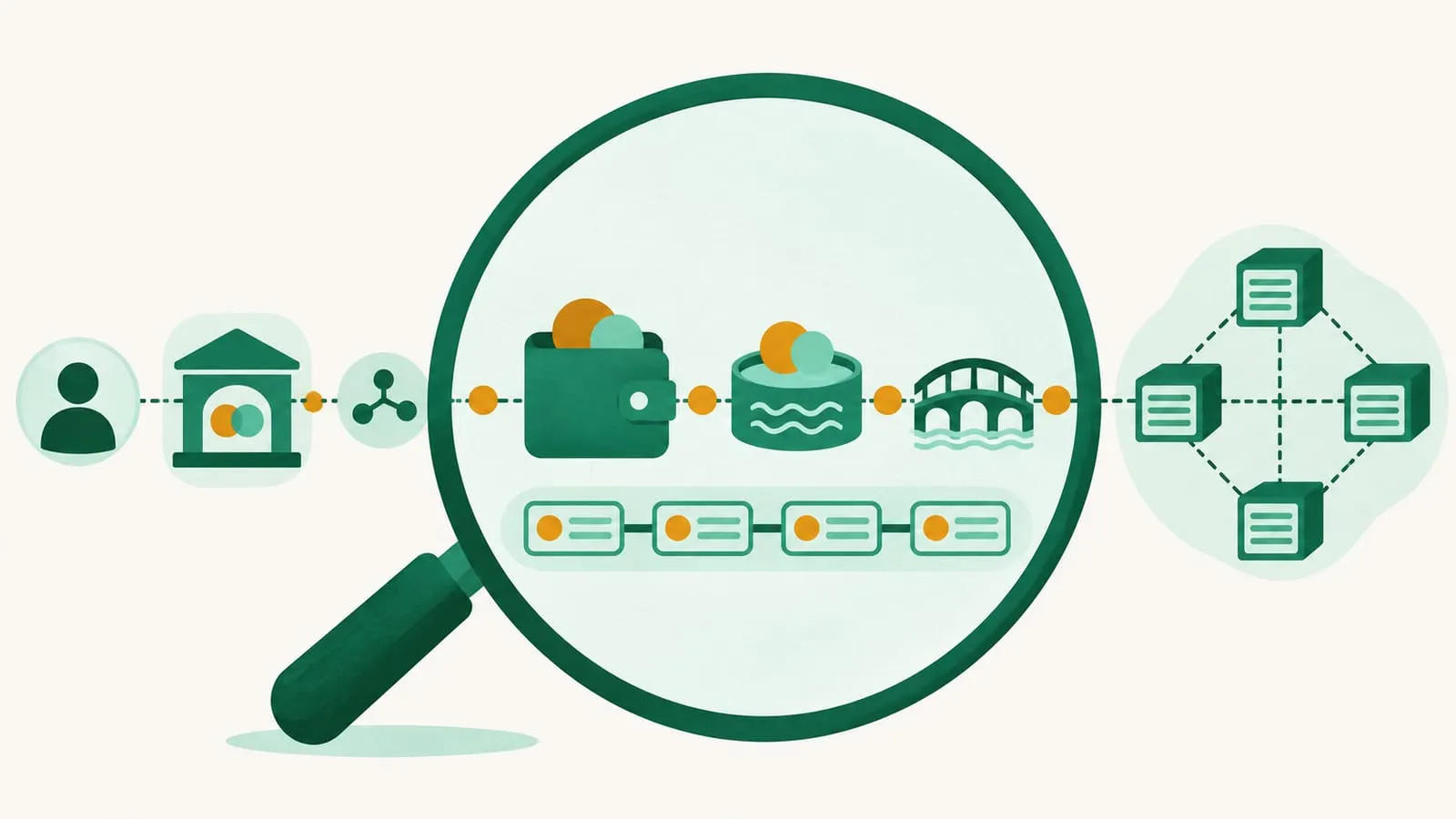
Yes. DeFi transactions are traceable. DeFi apps run as smart contracts on public blockchains such as Ethereum, so every swap, deposit, loan and transfer is recorded permanently on a ledger that anyone can read. You don’t give your name to a DEX, but your wallet address and its entire history are public, and that address can often be linked to you.
The accurate description is transparent and pseudonymous, not anonymous. Our page on blockchain transparency explains the underlying design in more depth.
What anyone can see
With nothing more than a block explorer such as Etherscan, anyone can see for any address:
- Every transaction it sent or received, with amounts, time and fees.
- Its token and NFT balances.
- Which smart contracts it used: which DEX it swapped on, which lending protocol it borrowed from, which bridge it used.
- Any short messages someone attached to a transaction’s input data.
That’s what the original question on this page assumed, and it’s right: if something goes wrong, the trail is there. The more difficult question is who is behind an address.
How addresses get linked to people
The Bitcoin white paper described the privacy model as keeping public keys anonymous while transactions stay public. In practice that anonymity is fragile:
- Exchange records. Regulated exchanges require KYC verification. When you withdraw from an exchange to your wallet, or deposit to one to cash out, the exchange can link that address to your identity, and it can be required to share those records with authorities.
- Chain analysis. Firms such as Chainalysis, TRM Labs and Elliptic cluster addresses using patterns like shared funding sources, timing and repeated interactions, and label addresses that belong to exchanges, protocols, hackers or sanctioned entities. Law enforcement and compliance teams use these tools daily.
- Your own links. An ENS name, a public NFT, a donation, a social media post or an airdrop claim can tie an address to you. Once one link exists, all past and future activity at that address is visible.
- Cross-chain trails. Bridges and DEX aggregators don’t break the trail. A bridge transaction is recorded on both chains, and analysts follow funds across them.
Tracing in practice: hacks and stolen funds
Large thefts show how visible DeFi flows are. In February 2025 attackers stole about $1.5 billion in crypto from the exchange Bybit. On 26 February 2025 the FBI attributed the theft to North Korean hackers it calls TraderTraitor and published 51 Ethereum addresses holding or laundering the stolen funds, asking exchanges, bridges, DeFi services and node operators to block transactions linked to them. Tracing didn’t stop the laundering, but it made the funds harder to cash out and gave exchanges a list to freeze.
Earlier incidents follow the same pattern. In the 2021 Poly Network exploit, the attacker embedded messages in transactions and ultimately returned the funds; even then, the movements were visible to everyone in real time. Stablecoin issuers can also freeze tokens at flagged addresses, which only works because the flows are traceable.
What makes tracing harder (and the legal risk)
Some tools reduce what outside observers can see. We explain them so you understand the limits of tracing, not as a way to avoid it.
- Mixers pool deposits from many users and let them withdraw to new addresses, breaking the obvious link. Tornado Cash is the best-known example. The US Treasury sanctioned it in August 2022, citing its use by hackers including North Korea’s Lazarus Group. In November 2024 a federal appeals court (the Fifth Circuit, in Van Loon v. Treasury) ruled that its immutable smart contracts were not sanctionable “property”, and Treasury removed the sanctions on March 21, 2025. Delisting did not end the legal risk: in August 2025 a US jury convicted developer Roman Storm on an unlicensed money-transmitting charge and deadlocked on the laundering and sanctions charges. In August 2026, with his motion for acquittal still undecided, the judge postponed a retrial on the deadlocked counts to April 26, 2027; he remains presumed innocent of those charges.
- Privacy-focused chains such as Zcash (optional shielded transactions) and Monero (private by default) hide amounts and parties from public view. Some exchanges restrict or have delisted them.
- Zero-knowledge systems can prove a transaction is valid without revealing its details.
None of these make funds untouchable. Mixers have well-known statistical weaknesses, deposits and withdrawals can still be correlated, and exchanges often refuse or freeze funds that come from mixers or flagged addresses. Using them to hide criminal proceeds is a crime in most jurisdictions.
Why traceability matters to ordinary users
- Your privacy. Anyone who learns your address can see your balance and activity, which can make you a target for scams or worse. Some people use separate addresses for public activity and savings, which is ordinary account hygiene, not evasion.
- Your safety net. If you’re hacked or scammed, the trail is the starting point for reports to exchanges and police. Be wary of “fund recovery” services that promise to trace and retrieve crypto for an upfront fee; they are a common scam. See our scams guide.
- Your taxes. On-chain records are permanent, and tax authorities increasingly receive data from exchanges. See our crypto tax hub.
- Irreversibility. Tracing can show where funds went, but it can’t reverse a transaction; see why smart contract transactions are irreversible.
For more on how regulation treats DEXs and exchanges, read DEX vs CEX privacy and regulation and is DeFi completely anonymous?, or browse the Regulation, Tax and Risk section.
Frequently asked questions
Can the police trace DeFi transactions?
Yes. Law enforcement agencies use block explorers and commercial chain-analysis tools to follow funds between addresses, and can request records from exchanges where funds are converted to cash. Tracing isn't always complete, but the record never disappears.
Is DeFi anonymous?
No. It is pseudonymous: you don't need to give your name to a smart contract, but your address and its full history are public, and one link between that address and your identity can expose all of it.
Can I see someone else's DeFi transactions?
If you know their address, yes. A block explorer such as Etherscan shows every transaction, token balance and contract interaction for any public address.
Are transactions on a DEX traced the same way as on an exchange?
A centralized exchange records your identity and trades in its own database. A DEX has no account records, but every trade is on-chain, so it is traceable by address rather than by name.
Is using a crypto mixer illegal?
It depends on the country and the circumstances, and the law is unsettled. In the US, Tornado Cash was sanctioned in 2022 and delisted in March 2025, and developer Roman Storm faces a retrial, postponed to April 2027, on the laundering and sanctions charges on which a jury deadlocked. Mixers are also a red flag for exchanges, which may freeze funds that pass through them.
Sources
- Satoshi Nakamoto: Bitcoin, A Peer-to-Peer Electronic Cash System (Section 10, Privacy)
- FBI / IC3: North Korea responsible for $1.5 billion Bybit hack (PSA, February 26, 2025)
- US Treasury: Tornado Cash Delisting (March 21, 2025)
- The Block: Roman Storm's retrial pushed back to April 2027 (August 2026)
- Chainalysis: Crypto mixers explained
Educational content, not financial advice. DeFi carries risk, including total loss of funds.