What Is a dApp? Decentralized Applications Explained for Beginners
On this page
I'm new to the concept of decentralized finance and want to know what a dApp is? Do I need it?
The short answer
A dApp, short for decentralized application, is an app whose core logic runs as smart contracts on a public blockchain rather than on servers controlled by one company. You usually reach it through a normal-looking website or mobile app, but instead of logging in with a username and password you connect a crypto wallet and approve each action with a digital signature.
If you are new to decentralized finance, dApps are simply the “apps” of DeFi: the places where you swap tokens, lend, borrow or stake. You do not need one unless you want to do those things with crypto held in your own wallet.
How does a dApp work?
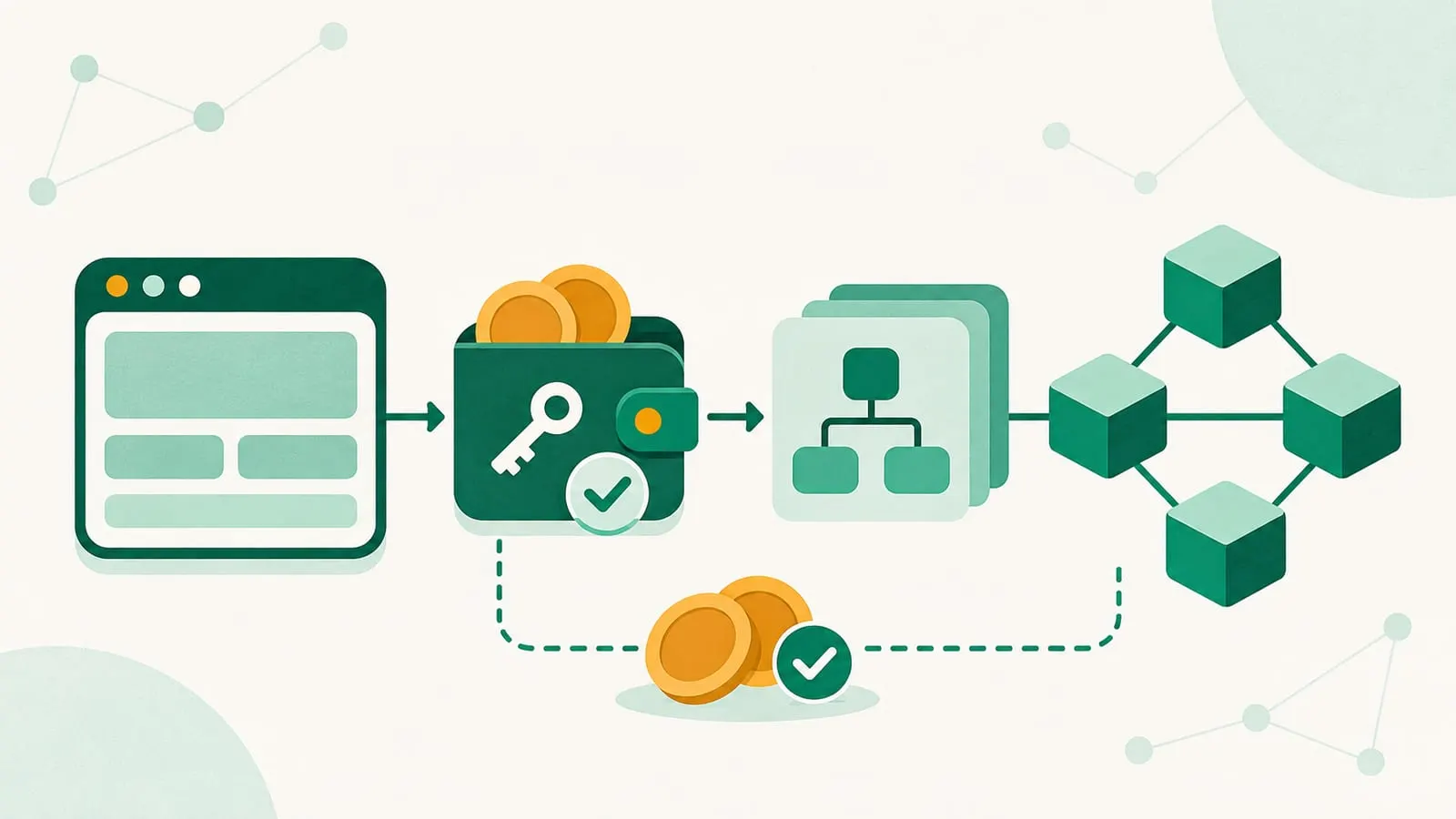
ethereum.org’s developer docs describe a dApp as an application built on a decentralized network that combines a smart contract with a user-facing front end. In practice, most dApps have three layers:
| Layer | What it is | Who controls it |
|---|---|---|
| Smart contracts | The rules and the money: code deployed on the blockchain that holds funds and executes trades, loans or votes | Nobody can change deployed code unless it was built to be upgradeable, usually via governance or an admin key |
| Front end | A website or app that shows balances and builds transactions | Usually the team behind the project; anyone can build another one |
| Wallet | The user’s own software (MetaMask, Rabby, Phantom and others) that holds keys and signs | The user |
When you click “Swap” on a decentralized exchange, the front end prepares a transaction, your wallet asks you to sign it, and the network’s validators execute the contract code. The result is recorded on-chain, where anyone can check it with a block explorer. The app’s operators never hold your funds in an account; the contract does exactly what its code says.
For the technical difference between the two pieces, see dApp vs. smart contract.
dApps vs. traditional apps
| Traditional app | dApp | |
|---|---|---|
| Backend | Company servers and databases | Smart contracts on a public blockchain |
| Account | Email and password, held by the company | Your wallet address; no sign-up |
| Who holds funds | The company | You, or the contract you deposit into |
| Can the operator reverse or freeze a transaction? | Usually yes | Usually no |
| Code visibility | Private | Contract code is typically public and verifiable |
| Costs | Often free, paid by ads or fees | Gas fees for every on-chain action, plus any protocol fee |
The trade-off is control versus convenience. A dApp cannot lock your account or lend out your deposit without your signature, but there is also no help desk that can undo a mistaken transfer. Blockchain transactions are final; see why smart contract transactions are irreversible.
Examples of dApps
Most activity is in finance, but dApps cover several categories. These are illustrations, not recommendations:
- Decentralized exchanges (DEXs) such as Uniswap or Curve let you swap tokens from your wallet. See DEX vs. dApp and how to access a decentralized exchange.
- Lending markets such as Aave and Compound let you supply assets to earn interest or borrow against collateral. Our Aave vs Compound comparison explains both.
- Liquid staking protocols such as Lido stake ETH for you and return a tradable token. See liquid staking.
- NFT marketplaces for buying and selling NFTs, and minting tools; see how to mint an NFT.
- DAOs and governance apps, where token holders vote on proposals.
- Name services such as ENS, which map readable names to wallet addresses.
- Games and social apps, where in-game items or social profiles live on-chain; these are a smaller share of activity than finance.
Do you need a dApp?
Only if you want to use crypto on-chain yourself. If you simply buy and hold crypto on a centralized exchange, you never touch a dApp. You will need one if you want to:
- swap tokens without an exchange account,
- earn interest by lending or providing liquidity,
- stake through a protocol rather than an exchange,
- buy or mint NFTs, or
- vote in a DAO.
To use one you need a self-custody wallet and a little of the network’s native token for gas. Our step-by-step guide on how to interact with dApps covers setup, connecting and signing, and the DeFi wallet guide explains wallet choice and security.
Are dApps safe?
Older descriptions often claim dApps “never go offline” and are “more secure” than normal apps. That is only partly true:
- The contracts keep running as long as the blockchain runs, but they can contain bugs. Many DeFi hacks have come from flawed code; see smart contract vulnerabilities.
- Admin keys and upgrades mean some “decentralized” apps can still be paused or changed by a small group.
- The front end is an ordinary website. It can go down, be blocked in some countries, or be hijacked to serve malicious transactions.
- Phishing copies of popular dApps are common, especially through search ads and social media links.
- Token approvals you grant can be abused later if a contract is malicious or compromised. ethereum.org recommends reviewing and revoking approvals you no longer need.
Risks to keep in mind
- No undo button. A wrong address, a malicious signature or a scam token approval usually cannot be reversed.
- Smart contract risk. Audits reduce but do not remove the chance of an exploit.
- Fees. Gas can make small transactions uneconomic on Ethereum mainnet; layer 2 networks are much cheaper.
- Privacy is limited. You do not need to give a name or email, but every on-chain transaction is public and tied to your wallet address, so activity can often be traced. dApp websites may also collect your IP address and wallet address like any other site.
- Usability and congestion. ethereum.org itself lists maintenance difficulty, network congestion and user experience as drawbacks of dApps.
- Regulatory uncertainty. Access to some front ends is restricted by location, and rules for DeFi are still developing.
Start with small amounts, bookmark the official site of any dApp you use, and read every wallet prompt before you sign. For the wider picture, see the dApp hub and our introduction to what DeFi is.
Frequently asked questions
What does dApp stand for?
dApp stands for decentralized application. The lower-case d is a convention; you will also see it written DApp or dapp.
Is a dApp the same as a smart contract?
No. A smart contract is a program deployed on a blockchain. A dApp usually combines one or more smart contracts with a user interface, such as a website, that makes them easy to use.
Do dApps cost money to use?
Reading data is usually free, but any action that changes the blockchain, such as a swap or deposit, costs a network gas fee paid in the chain's native token. Some dApps also charge their own protocol fee, and some wallets sponsor gas for you.
Can a dApp be shut down?
The smart contracts generally keep running as long as the blockchain does, unless they were written with admin controls that allow pausing or upgrades. The website front end, however, can be taken offline or blocked, which is why some protocols have several independent interfaces.
Are dApps only on Ethereum?
No. Ethereum and its layer 2 networks host the most, but dApps also run on Solana, BNB Chain, Avalanche and many other smart contract platforms.
Sources
Educational content, not financial advice. DeFi carries risk, including total loss of funds.