Crypto Savings Accounts: How to Earn Interest on Stablecoins (and How They Differ From a Bank)
On this page
What is a crypto savings account?
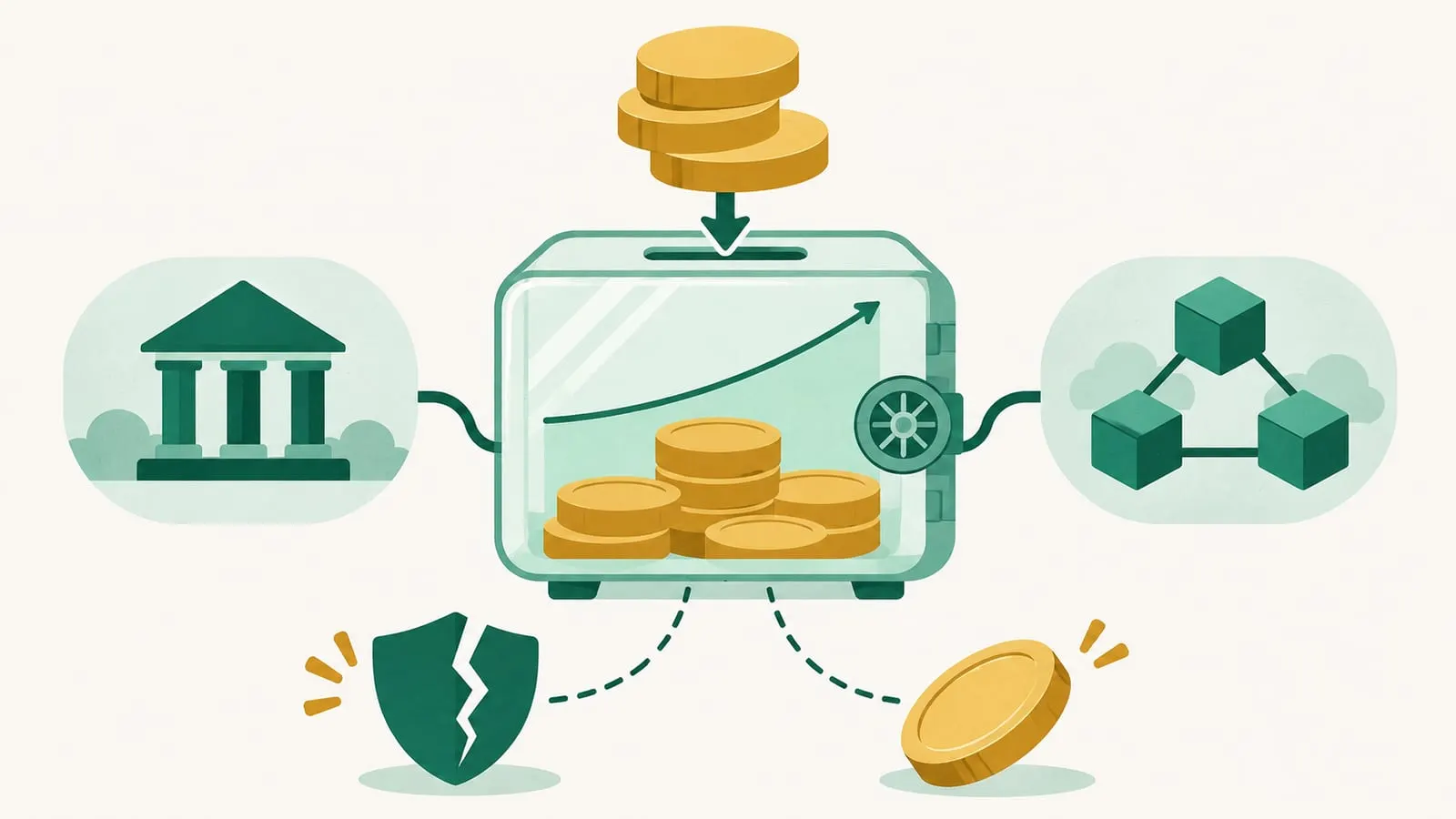
A crypto savings account is a way to earn interest on crypto you hold, most often on stablecoins such as USDC or USDT that track the US dollar. You either deposit them with a company (an exchange or crypto lender) that pays you a rate, or you supply them yourself to a DeFi protocol that pays interest from borrowers.
The name is borrowed from banking, but the product is not a bank account. There is no deposit insurance, the rate is variable, and your money is exposed to risks that a bank deposit is not. Used with that in mind, it can be a way to earn on dollars you already keep in crypto. This guide explains how it works, what it pays compared with a bank or Treasury bills, how to start and what can go wrong. It is not financial advice.
How crypto savings accounts work
Every stablecoin interest rate is paid by someone. The main sources are:
- Borrowers. Traders and institutions borrow stablecoins, usually against crypto collateral, and pay interest. This funds DeFi lending markets and many centralized “earn” products.
- Reserve income. Some stablecoin systems hold Treasury bills and pass part of the income to savers, for example through savings tokens. Exchanges may also share interest that stablecoin issuers pay them.
- Trading fees and incentives. Liquidity pools and reward tokens add yield, at the cost of more complexity. That is closer to yield farming than to saving.
Our explainer on how stablecoins earn interest goes further into each source.
The three ways to “save” stablecoins
| CeFi earn program | DeFi lending market | DeFi savings token | |
|---|---|---|---|
| Examples | Exchange or crypto-lender earn accounts | Aave, Compound | sUSDS (Sky Savings Rate) |
| Who holds your coins | The company | A smart contract; you keep the receipt token | A smart contract; you hold the token |
| Rate set by | The company, at its discretion | Utilization: borrowing demand vs supply | Protocol governance |
| Ease of use | Very easy | Needs a self-custody wallet | Needs a self-custody wallet |
| Main risk | Company failure or frozen withdrawals | Hacks, bad debt, liquidity shortfalls | Governance rate cuts, contract risk, stablecoin risk |
CeFi earn programs are the closest to a bank experience: you deposit through an app and see interest accrue. But you become an unsecured creditor of that company. In 2022, Celsius, Voyager and BlockFi froze withdrawals and filed for bankruptcy, and customers waited a year or more for partial or court-supervised recoveries. Read the terms to see whether the platform lends out your coins.
DeFi lending markets let you supply stablecoins to a pool that over-collateralized borrowers draw from. On Aave you receive aTokens whose balance grows as interest accrues. Rates rise and fall with utilization. See how lending works on Aave.
Savings tokens wrap a stablecoin in a token that grows in value. sUSDS, from Sky (formerly MakerDAO), accrues the Sky Savings Rate set by governance and can be redeemed for USDS.
How much do stablecoin savings pay? (November 2026)
| Option | Approximate rate, mid-November 2026 | Protection |
|---|---|---|
| US bank savings, national average (FDIC) | 0.38% | FDIC insured up to limits |
| 3-month US Treasury bill | About 4.2% | Backed by the US government |
| Aave V3 USDC (Ethereum), base | About 4.5% | None |
| Aave V3 USDT (Ethereum), base | About 3.1% | None |
| Compound III USDC (Ethereum) | About 3.6% | None |
| sUSDS (Sky Savings Rate) | About 3.8% | None |
DeFi rates from DefiLlama, Treasury yield from the US Treasury (13-week bill, coupon-equivalent, 13 November 2026), bank rate from the FDIC’s October 2026 national rate. All are variable.
Two things stand out. First, stablecoin savings do pay far more than the average bank savings account. Second, in late 2026 the leading DeFi rates were roughly in line with what short-term government debt paid, which is available through a brokerage or money market fund with much less risk. Some markets add a percentage point or two in token rewards, and riskier products advertise much more; a yield far above the benchmark is compensation for extra risk, not free money. See is stablecoin yield farming a good investment for how to judge high advertised rates, and what APY means in crypto for the maths.
How to earn interest on stablecoins in DeFi: step by step
- Choose the stablecoin. Understand how it is backed and who can freeze it. Our page on the safest stablecoins compares the main ones.
- Set up a self-custody wallet and back up the recovery phrase offline. See DeFi wallets.
- Pick the network. Ethereum mainnet has the deepest markets but higher gas; layer 2 networks are cheaper but add bridge and liquidity considerations.
- Go to the protocol’s official site by typing the address or using a bookmark, never from an ad or a direct message.
- Approve and supply. Approve the stablecoin for the protocol, then deposit. Check you received the receipt token (for example aUSDC) or savings token.
- Monitor. Check the rate, pool utilization and protocol news periodically. Rates can halve in weeks.
- Withdraw by redeeming the receipt token. If a pool is heavily borrowed, you may have to wait for liquidity to return.
Our full walkthrough of how to lend your crypto on DeFi covers each step in more detail.
Does it make sense for a small balance?
Do the arithmetic first. At 4% APY, $1,000 earns about $40 a year. On Ethereum mainnet, the gas to approve, deposit and later withdraw can eat a meaningful share of that when the network is busy; on a layer 2 it is usually cents. CeFi apps avoid gas but add counterparty risk. And a single loss event can wipe out years of interest on any balance size.
Risks of crypto savings accounts
- No deposit insurance. Regulators such as the DC Department of Insurance, Securities and Banking warn that crypto interest-bearing accounts are not insured like bank deposits.
- Platform failure (CeFi). The company can freeze withdrawals, change terms or go bankrupt.
- Smart contract risk (DeFi). Bugs and exploits can drain funds. See smart contract vulnerabilities.
- Depeg risk. A stablecoin can trade below $1; USDC briefly fell to about $0.87–0.88 in March 2023 during the Silicon Valley Bank failure, and algorithmic stablecoins such as TerraUSD collapsed entirely. See can stablecoins crash.
- Liquidity risk. Fully borrowed pools, cooldowns and withdrawal queues can delay access.
- Rate risk. Variable rates can fall sharply, and governance can cut savings rates.
- Regulatory risk. The US GENIUS Act, signed in July 2025, bars permitted payment stablecoin issuers from paying holders interest just for holding their coins. Whether exchanges and other third parties may pay rewards has been fought over in the Senate’s market-structure bill (the CLARITY Act), whose 2026 Senate draft would bar rewards that work like deposit interest. A Senate procedural vote to take up that bill failed 49–50 on 15 September 2026, and as of November 2026 it had not become law; check the current status, because CeFi products may change.
- Scams. Fixed, high “guaranteed” rates, referral pressure and unregistered platforms are classic red flags.
For a full catalogue, see the risks of yield farming.
Taxes
In most countries, stablecoin interest is taxable, typically as income when received. Keep a record of every payout. See whether you can make money from stablecoins for more on taxes and on how issuers themselves earn.
Bottom line
A crypto savings account can be a sensible tool if you already hold stablecoins, understand where the yield comes from and are comfortable with the absence of deposit insurance. It is not a substitute for an emergency fund in an insured bank account. A total loss on any one platform is possible, so the useful comparison is always the rate against what Treasury bills pay with far less risk. Browse more in the stablecoins hub.
Frequently asked questions
Are crypto savings accounts safe?
They are not safe in the way an insured bank account is. Neither the FDIC nor any other government agency insures crypto interest accounts, and in 2022 several large crypto lenders froze withdrawals and went bankrupt. DeFi protocols can be hacked or suffer bad debt.
What interest rate can I get on stablecoins?
As of mid-November 2026, DefiLlama showed Aave V3 USDC on Ethereum at about 4.5% base APY, USDT about 3.1%, Compound III USDC about 3.6% and the Sky Savings Rate on sUSDS about 3.8%. Rates change daily, so check live data before depositing.
Is a crypto savings account better than a high-yield savings account?
It can pay more than an average bank savings account, but in late 2026 the leading DeFi stablecoin rates were close to what Treasury bills and many money market funds paid, without their protections. The extra yield over those benchmarks is small relative to the extra risk.
How much would $10,000 in stablecoins earn?
At a 4% APY held for a year, about $400 before fees and taxes. Rates float, and a single hack, depeg or platform failure could cost far more than that.
Can I withdraw my stablecoins at any time?
Usually, but not always. A DeFi lending pool can run short of withdrawable funds when most of it is borrowed, some savings tokens have cooldowns, and centralized platforms can pause withdrawals under their terms.
Is stablecoin interest taxable?
In most countries, yes, typically as income when you receive it. Keep records and check local rules.
Sources
- DefiLlama Yields (live stablecoin rates)
- DLA Piper: Senate fails to advance the CLARITY Act (September 2026)
- FDIC: National rates and rate caps (savings national rate, October 2026)
- US Treasury: Daily Treasury bill rates
- DC Department of Insurance, Securities and Banking: Cryptocurrency interest-bearing accounts
- Aave V3 documentation: Overview
- Sky developer docs: sUSDS (Savings USDS)
- Congressional Research Service: The Stablecoin Yield Debate (IF13174)
- CNBC: How the fall of Celsius dragged down crypto investors (2022)
Educational content, not financial advice. DeFi carries risk, including total loss of funds.