What Is a Lock-Up Period in Crypto? Token Vesting, Staking Locks and Unlocks
On this page
What does it mean when tokens are locked-up? Is this a bad thing?
The short answer
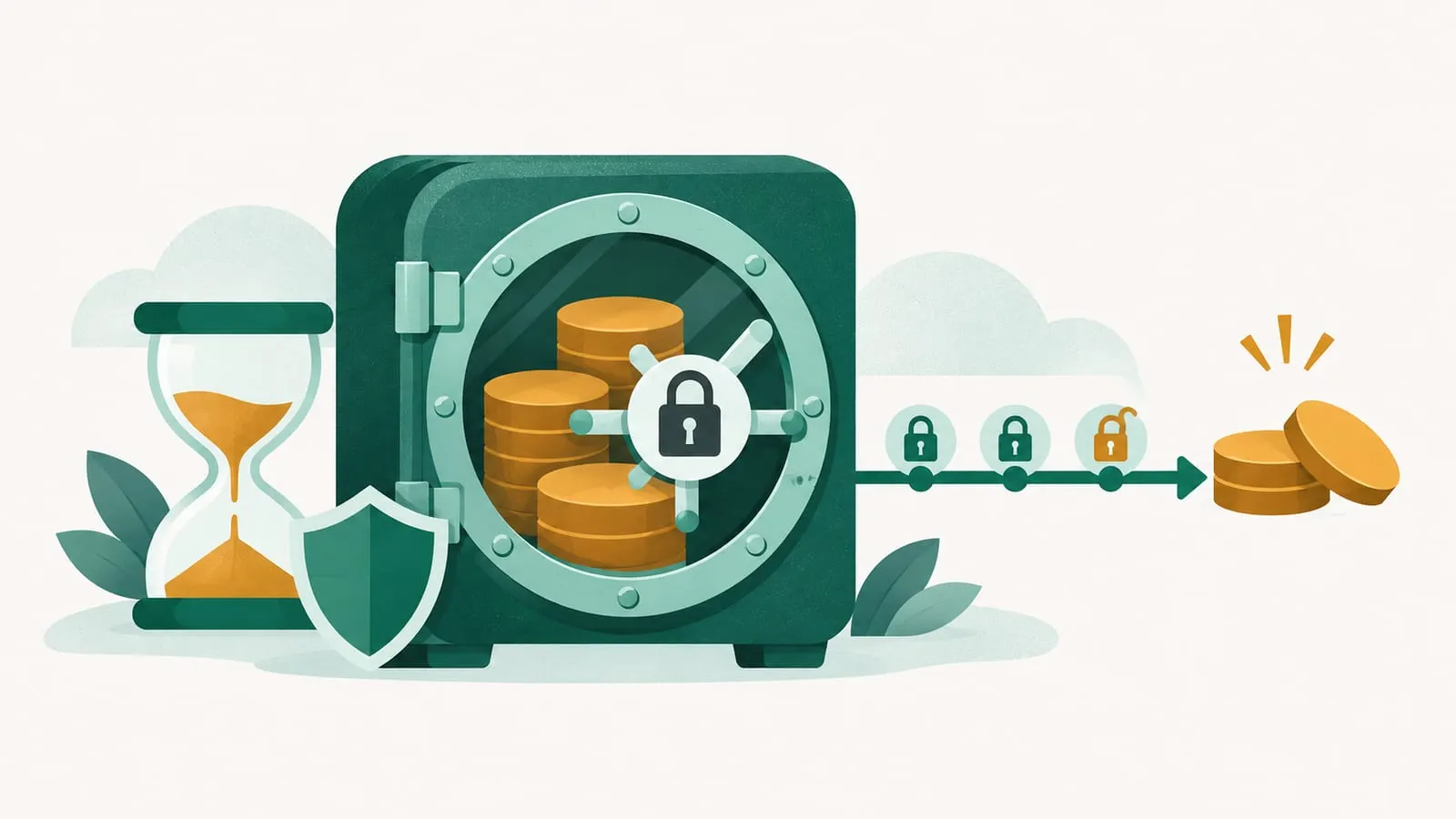
A lock-up period in cryptocurrency is a fixed stretch of time during which certain tokens cannot be sold, transferred or withdrawn. The lock is enforced by a smart contract, by the rules of a blockchain, or by the terms of a platform.
You will meet lock-ups in two main situations:
- Token launches. A project’s founders, team and early investors usually receive tokens that are locked for months or years, so they cannot sell immediately after launch.
- Staking and DeFi. When you stake tokens, lock them for governance power, or put them in a fixed-term earn product, you may have to wait before you can get them back.
A lock-up is not a bad thing in itself. It can protect a new token from insiders dumping it, and it is how many networks keep staking secure. But it also means you cannot sell when you want to, and large scheduled unlocks can hit a token’s price.
Where the idea comes from: IPO lock-ups
Crypto borrowed the concept from stock markets. Before a company goes public, insiders typically sign lock-up agreements that stop them selling their shares for a set time after the IPO; the SEC’s Investor.gov notes that terms vary but most last 180 days. The aim is to avoid a flood of insider shares right after the offering.
Token sales, whether an initial coin offering (ICO), an initial DEX offering (IDO) or a private round, use lock-ups for the same reason. They are usually written into a vesting contract rather than a legal agreement, so in principle anyone can verify them on-chain.
Token lock-ups and vesting schedules
How a typical schedule works
Most team and investor allocations combine three pieces:
| Term | Meaning |
|---|---|
| Lock-up | A period during which none of the allocation can be sold |
| Cliff | The date when the first block of tokens unlocks, often at the end of the lock-up |
| Vesting | The gradual release of the remaining tokens, usually monthly or block by block |
Example: Arbitrum (ARB). According to the Arbitrum Foundation’s documentation, all team and investor tokens were subject to four-year lock-ups. The first unlock came one year after the token’s launch on March 16, 2023, with the rest released monthly over the following three years, so the last of these monthly unlocks is due in March 2027.
Schedules vary widely. Some projects lock insiders for several years; others release a large share within months. Community and ecosystem allocations may follow a different schedule from the team’s, and the treasury may be controlled by governance rather than a fixed timetable.
Why projects use lock-ups
- Aligning incentives. Insiders benefit only if the project does well over years, not weeks.
- Avoiding a crash at launch. Without a lock, early buyers who paid far less than the market price could sell immediately.
- Building trust. A visible, contract-enforced schedule shows buyers what supply will hit the market and when.
What happens at a token unlock?
When tokens unlock, the people who receive them can sell, so the circulating supply rises. If they sell more than buyers want, the price can drop around the unlock date. That is why traders follow unlock calendars on sites such as Tokenomist, which track cliffs, vesting and how much of each token’s supply is still locked. Large unlocks do not always lead to selling, and well-known schedules are often priced in, but they are a real factor in a token’s supply picture. For more on supply and value, see what a DeFi token is.
Staking and DeFi lock-ups
Lock-ups also apply to your own tokens when you stake or deposit them.
Staking unbonding periods
Many proof-of-stake networks make you wait before staked tokens can be withdrawn. This unbonding delay gives the network time to penalize (slash) validators for misbehaviour that is discovered after they ask to leave. You typically earn no staking rewards while unbonding.
| Network | How exiting works (as of November 2026) |
|---|---|
| Cosmos Hub (ATOM) | Fixed unbonding period of 21 days, set as a chain parameter |
| Ethereum (ETH) | Validators join an exit queue whose length depends on demand. In mid-November 2026 the queue was a few days long, plus a sweep delay of about a week before funds are withdrawn |
| Solana (SOL) | Stake deactivates at the end of an epoch; an epoch is 432,000 slots, roughly two days |
| Polkadot (DOT) | Tokens are locked for an unbonding period set on-chain and earn no rewards meanwhile. Since Referendum 1910 was enacted in July 2026, nominators unbond in about 2 days (2 eras), down from 28 days; validators keep the longer validator unbonding period |
Liquid staking offers a way around this: protocols like Lido give you a tradable token (such as stETH) in exchange for your stake. You can sell it any time, but it can trade below the value of the staked asset in a market panic. See liquid staking and what liquid staking is and how it works.
Vote-escrow locks
Some DeFi protocols reward you for locking their governance token for a long time. On Curve, locking CRV gives you veCRV, which carries voting power and boosted rewards. The maximum lock is four years, the tokens cannot be withdrawn until the lock expires, and voting power declines as the unlock date approaches. Longer locks mean more influence but less flexibility.
Fixed-term earn products
Centralized exchanges and some DeFi platforms offer “locked” or “fixed-term” savings in which you commit tokens for, say, 30, 60 or 90 days in return for a higher advertised rate. Read the terms: early withdrawal may be impossible or may forfeit rewards, and the platform holds your funds throughout. Compare these with flexible options in staking vs lending and is DeFi staking a good idea?
Liquidity locks
A third kind of lock applies to a token’s trading pool: a project locks its DEX liquidity-pool tokens so it cannot pull the liquidity. That is covered in detail in how to lock liquidity for tokens and the lock-liquidity glossary entry.
How to check a token’s lock-up and unlock schedule
- Read the official tokenomics in the project’s docs or whitepaper: allocations, lock-up lengths, cliffs and vesting.
- Check an unlock tracker such as Tokenomist for upcoming cliffs and the share of supply still locked.
- Compare circulating and total supply. A token with a small float and a large locked supply faces more future dilution.
- Verify on-chain where possible: look up the vesting contract in a block explorer and confirm who can change it.
- Watch for changes. Governance votes can alter treasury and ecosystem releases even when team vesting is fixed.
Risks and red flags
- Unlock overhang. Big unlocks for investors who paid a fraction of the current price can put pressure on the price.
- Illiquidity. Your own staked or locked tokens cannot be sold during a crash; the price can fall a long way while you wait.
- Unverifiable “locks”. A promise that team tokens are locked means little if they sit in an ordinary wallet or a contract the team can change.
- No lock-up at all. Insiders who can sell immediately are a classic warning sign, especially in new tokens with anonymous teams. See crypto scams.
- Fake lock-up schemes. Platforms that demand you lock funds for a period in exchange for very high “fixed” returns, then add withdrawal fees or delays, are a common fraud pattern. Legitimate staking does not promise a fixed high return.
- Platform risk. Locked funds held by an exchange or lender are exposed if that platform fails, as many users learned in 2022.
For more on how the lock-up period concept fits into staking and DeFi, browse the staking hub.
Frequently asked questions
Is a token lock-up a good or bad sign?
A long, transparent lock-up for the team and investors is usually a positive sign, because it aligns insiders with the project's long-term success. It becomes a concern when insiders hold a large share of supply that unlocks soon, when the schedule is not enforced by a verifiable contract, or when there is no lock-up at all.
What is the difference between a lock-up and vesting?
A lock-up is a period when tokens can't be sold. Vesting is the schedule by which tokens are gradually released or earned. Most token schedules combine both: a lock-up or 'cliff' first, then vesting in monthly or continuous instalments.
What happens when crypto tokens unlock?
Newly unlocked tokens can be sold, so circulating supply rises. If recipients sell more than the market can absorb, the price can fall, which is why traders watch unlock calendars. Not every unlock leads to selling, and markets often price in well-known schedules in advance.
Can I withdraw staked crypto during a lock-up period?
Usually not directly. Native staking on many networks requires an unbonding or exit period before you can withdraw. Liquid staking tokens such as stETH can often be sold on the market instead, but they can trade below the value of the underlying asset in stressed markets.
How long are typical crypto lock-up periods?
There is no standard. Team and investor vesting commonly lasts several years with a cliff of around a year; staking unbonding ranges from days to weeks depending on the network; and DeFi vote-escrow locks can run up to four years on Curve.
Sources
- Investor.gov (SEC): Initial public offerings, lockup agreements
- Arbitrum Foundation docs: Airdrop eligibility and token distribution
- Cosmos Hub staking parameters (live chain data: unbonding_time 1,814,400 seconds)
- Validator Queue: Ethereum validator entry and exit queues
- Curve DAO: VotingEscrow contract source (4-year maximum lock)
- Polkadot Forum: Staking updates, nominators no longer slashable and 2-day unbonding (Jul 6, 2026)
- Polkadot Wiki: Staking
- Tokenomist: Token unlock schedules
Educational content, not financial advice. DeFi carries risk, including total loss of funds.