Crypto Loans Without Collateral: The Platforms That Offer Uncollateralized Loans in 2026
On this page
The short answer
You can’t walk into DeFi and get a normal loan without collateral. The big lending protocols, including Aave, Compound and Morpho, are over-collateralized: you must deposit more value than you borrow, because the protocol has no way to chase you if you don’t repay.
There are three real exceptions, and each fits a specific user:
- Flash loans: borrow any amount the pool holds with no collateral, but repay it within the same transaction. A tool for developers and bots.
- Credit delegation: someone who has collateral on Aave lets you borrow against it. Works between parties who already trust each other.
- On-chain credit lines: platforms such as Wildcat and 3Jane where vetted borrowers, mostly trading firms and businesses, borrow undercollateralized from lenders who accept that credit risk.
If you were hoping for an unsecured personal loan in crypto, none of these will help, and anyone advertising one to the public should be treated with suspicion (see red flags below). For background, read can you borrow crypto without collateral.
Comparison: ways to borrow crypto without collateral
| Option | Collateral | Who can use it | Duration | Typical use |
|---|---|---|---|---|
| Aave flash loans | None | Anyone who can deploy a smart contract | One transaction | Arbitrage, liquidations, collateral swaps |
| Uniswap flash swaps | None | Developers | One transaction | Arbitrage across pools |
| Morpho flash loans | None | Developers | One transaction | Refinancing, liquidations |
| Aave credit delegation | Delegator’s collateral | Anyone a delegator approves | Open-ended | Private lending between known parties |
| Wildcat | Partial or none (reserve ratio) | Borrowers who set up a market; lenders judge credit risk themselves | Borrower-set terms | Institutional credit lines |
| 3Jane | None for approved credit lines | Approved borrowers | Credit line | USDC credit for traders, businesses, agents |
Figures and features as of November 2026. These are examples of how each mechanism works, not recommendations.
1. Flash loans: the truly uncollateralized loan
A flash loan is borrowed and repaid inside one blockchain transaction. Your smart contract receives the funds, does something with them, and must return the amount plus any fee before the transaction ends. If it doesn’t, the entire transaction reverts and nothing happened, so the lender never takes credit risk.
The popular pitch, “turn $1,000 into a $100,000 trade”, leaves out the hard part. Flash loans only pay off if you’ve already found a profitable opportunity that completes in one transaction, such as:
- Arbitrage between two exchanges with different prices.
- Liquidations: repaying an unhealthy loan on a lending protocol, collecting the discounted collateral, and repaying the flash loan.
- Collateral swaps and refinancing: moving a position from one protocol to another without first closing it.
You compete with professional bots for these opportunities, still pay gas when a transaction reverts, and need to write and audit your own smart contract code.
Aave
Aave V3 is the best-known flash-loan source. Its documentation says the fee is 0.05% at deployment and changeable by governance (addresses that governance approves as flash borrowers pay none). flashLoanSimple() borrows one asset; flashLoan() can borrow several and can even convert the loan into a normal variable-rate debt position if the borrower has collateral or a credit delegation. Liquidity is whatever sits unborrowed in Aave’s pools across its networks. See how lending works on Aave and Aave vs Compound.
Uniswap flash swaps
Uniswap’s docs explain that every v2 swap is technically a flash swap: the pool sends you tokens before checking that it has been paid. You can take tokens out, use them, and then either return them or pay for them with the pool’s other token, plus the swap fee. Uniswap v3 pools also have a dedicated flash function that charges the pool’s fee. Uniswap is a DEX, not a lender: its liquidity providers earn trading fees, not interest.
Morpho
Morpho’s core contract has a flashLoan function that lends any token the contract holds and pulls it back at the end of the same transaction. The Morpho Blue contract charges no flash-loan fee, which makes it a common choice for liquidation and refinancing bots.
What happened to dYdX and Balancer flash loans?
dYdX’s Ethereum margin protocol, known as Solo, was once a favorite free flash-loan source, which is why “dYdX flash loan” is still a common search (see our older explainer, what is a flash loan in dYdX). Solo entered close-only mode on November 1, 2021, with new borrows disabled. dYdX then ran its StarkEx-based V3 exchange, which it sunset in late 2024 (DefiLlama shows about $6 million still sitting in V3), and now runs dYdX Chain, a Cosmos SDK blockchain for perpetual futures. None of these offers flash loans today. Balancer’s V2 vault was another popular source until a rounding-error exploit on November 3, 2025 cost about $128 million, according to DefiLlama’s hacks database (Balancer’s own post-mortem put the theft of user funds at about $94.8 million); its V2 TVL is now a small fraction of what it was.
Flash loans and exploits
Because they deliver enormous capital for a single transaction, flash loans are a common ingredient in DeFi hacks: an attacker borrows, manipulates a price or exploits a bug, and repays. DefiLlama records the March 2023 Euler V1 exploit at about $197 million, for example. The bug lies in the exploited protocol, but this is why protocols that rely on spot-price oracles are dangerous.
2. Aave credit delegation
Credit delegation lets an Aave depositor (the delegator) give another address permission to borrow against the delegator’s collateral. The delegator calls approveDelegation for a specific asset and amount; the borrower then borrows with the delegator as onBehalfOf. Aave’s docs note that the terms are agreed between the two parties, off-chain through legal agreements or on-chain through a contract.
The debt sits on the delegator’s position. If the borrower never repays, the delegator is still liable, and Aave’s safeguards only stop a delegated borrow that would push the delegator’s health factor below 1. So it’s uncollateralized for the borrower but fully collateralized from Aave’s point of view, and it only makes sense between people or institutions with a real relationship.
3. On-chain credit lines for vetted borrowers
Wildcat
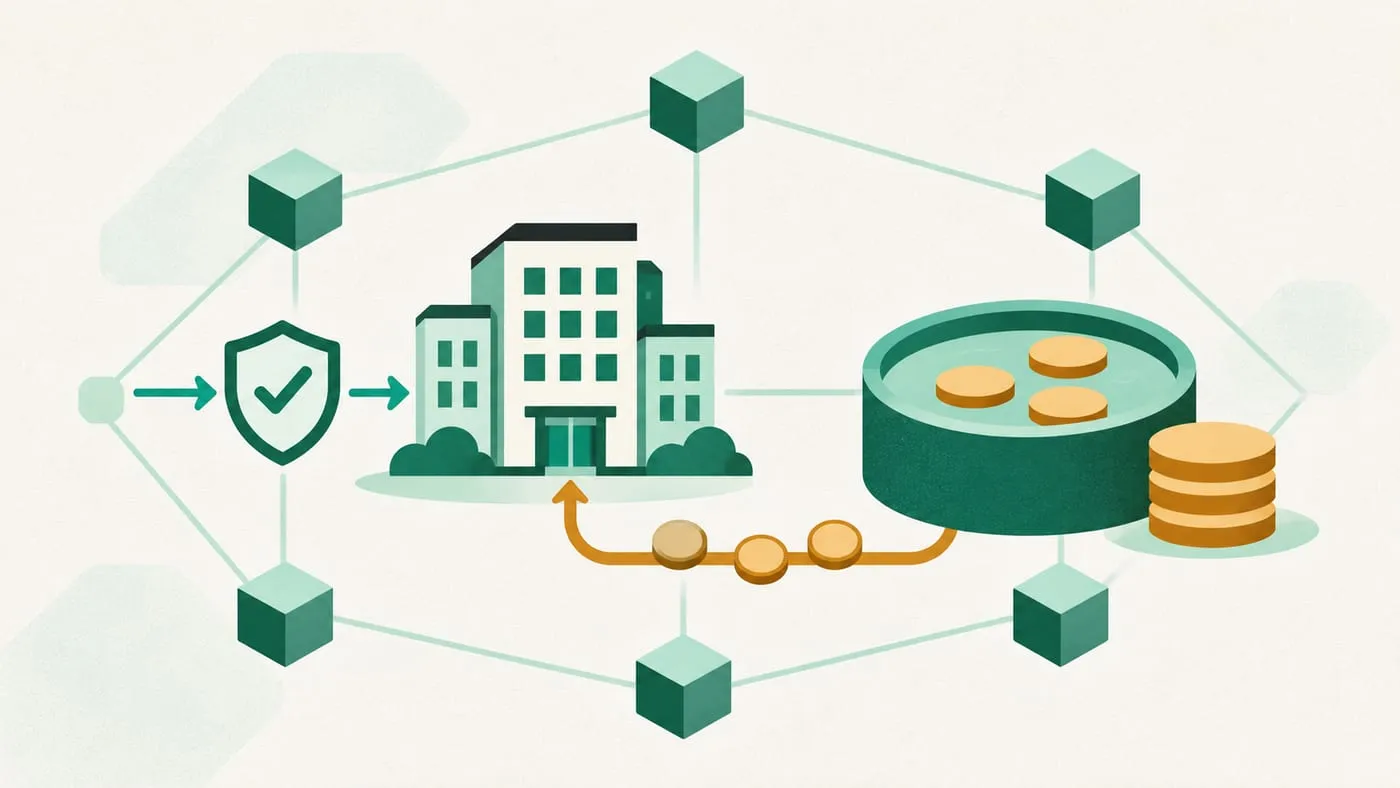
Wildcat lets borrowers create their own credit markets, setting the size, a fixed interest rate, a reserve ratio (a share of deposits that must stay available for withdrawals), withdrawal notice periods and penalties for missed payments. Vetting is limited to identity: before deploying a market, a borrower must be a registered legal entity that passes a one-time automated KYB check (legal existence, ownership, control, and AML and sanctions screening) run through a compliance provider, after which Wildcat adds its address to an on-chain registry, the “archcontroller”. Each borrower then decides which lenders can join, either through self-onboarding or an allowlist. Its docs are blunt that the KYB check is not a credit assessment and that Wildcat does not underwrite borrowers or insure against defaults, so lenders “assume full counterparty risk.” DefiLlama showed about $150 million borrowed through Wildcat in November 2026.
3Jane
3Jane offers uncollateralized USDC credit lines to crypto-native borrowers, underwritten against verifiable proofs of on-chain, off-chain and future assets rather than posted collateral. Lenders fund it through a senior token (USD3) and a junior, first-loss token (sUSD3). DefiLlama showed about $116 million borrowed on Ethereum in November 2026.
Older names: Maple, Goldfinch, TrueFi
Several earlier “undercollateralized DeFi” platforms have changed course or faded:
- Maple, one of the largest, now says its yield comes primarily from fixed-rate, overcollateralized loans to institutional borrowers, so it’s no longer an unsecured option.
- Goldfinch token holders backed a June 2026 proposal (GIP-87) to put the protocol into maintenance mode: its Prime product is being shut down and a trust is pursuing recoveries from legacy borrower pools. DefiLlama shows about $2 million TVL.
- TrueFi passed a 2026 governance proposal (TFIP-41) to reconstitute as a new organization called Brila with a new token; legacy loans and defaults remain under administration.
Check a platform’s current status before relying on an old list.
What about centralized crypto loans?
Exchanges and crypto lending companies also offer loans, but crypto-backed loans from them are collateralized too, and some unsecured “credit” products are only available to institutions after due diligence. Our guide to getting a crypto-backed loan covers that route, and DeFi loans explained for beginners covers the basics.
Red flags: “crypto loans without collateral” scams
Searches for no-collateral crypto loans attract scammers. Walk away if you see:
- An upfront fee, “insurance” or “activation deposit” required before the loan is released. This is the classic advance-fee scam.
- Guaranteed approval with no credit check and no collateral.
- Contact through social media, Telegram or WhatsApp rather than an established platform.
- Requests for your seed phrase, a wallet “verification” transaction, or remote access to your device.
- A website you can’t find independently, or one that copies a known brand’s name.
Legitimate flash loans never send money to your wallet to spend, and legitimate credit platforms don’t ask retail strangers for fees in advance.
Risks to understand
- Flash loans: smart contract bugs in your own code, failed transactions that still cost gas, and competition from faster bots.
- Credit delegation: the delegator carries the full default risk.
- Credit platforms (as a lender): borrowers can default, and there may be no collateral to recover. Withdrawals depend on reserves and notice periods.
- All of DeFi: smart contract, oracle and front-end risk. See DeFi lending risks and the risks to the DeFi borrower.
This page explains how these mechanisms work and is not financial advice. For collateralized options, see the best crypto lending platforms and the Lending & Borrowing hub.
Frequently asked questions
Can you borrow crypto without collateral?
Only in narrow forms. Flash loans need no collateral but must be repaid in the same transaction. Credit delegation lets someone with collateral on Aave extend borrowing power to you. A few permissioned platforms extend unsecured credit lines to vetted businesses or traders. Public, no-collateral loans for spending are not something mainstream DeFi offers.
What is a flash loan?
A loan taken and repaid inside a single blockchain transaction. If the borrower's code doesn't repay the amount plus any fee by the end of the transaction, the whole transaction reverts as if it never happened, so the lender takes no credit risk.
Does dYdX still offer flash loans?
Not as a lending feature. dYdX's Ethereum margin protocol (Solo), which developers used for flash loans, entered close-only mode on November 1, 2021, with new borrows disabled. dYdX later moved to dYdX Chain, its own Cosmos-based blockchain for perpetual futures. Developers today mostly use Aave, Uniswap or Morpho for flash liquidity.
What is the fee for an Aave flash loan?
Aave's documentation says the flash loan fee is set to 0.05% at deployment and can be changed by governance, so check the current parameter on the market you use.
Can I get a crypto loan without collateral or a credit check?
Not a conventional loan. Unsecured lenders, on-chain or off, assess creditworthiness somehow. Offers of guaranteed no-collateral, no-check crypto loans, especially ones asking for a fee first, are typical of scams.
Are flash loans used in hacks?
Often. Flash loans let an attacker borrow huge sums for one transaction to exploit a bug or manipulate a price oracle, as in the 2023 Euler Finance exploit. The flaw is in the exploited protocol; the flash loan just supplies the capital.
Is Maple Finance an uncollateralized lender?
Not today. Maple's documentation says its yield comes primarily from fixed-rate, overcollateralized loans to institutional borrowers. It was known for undercollateralized institutional loans before the 2022 credit crisis, which is why it still appears on older lists.
Sources
- Balancer: Nov 3 exploit post-mortem (November 2025)
- Euler Labs: War & Peace, behind the scenes of Euler's $240M exploit recovery
- Wildcat documentation: How borrowers are onboarded
- Aave documentation: Flash loans
- Aave documentation: Credit delegation
- Uniswap developer docs: Flash swaps (v2)
- Morpho documentation: Flash loans
- Wildcat documentation: Introduction
- 3Jane documentation
- Maple documentation
- dYdX: Layer 1 (Solo) wind-down announcement
- The Block: Goldfinch set to shutter Prime after community vote backs wind-down proposal (June 2026)
- DefiLlama: hacks database
Educational content, not financial advice. DeFi carries risk, including total loss of funds.