How Do DAOs Work? Structure, Voting, Money and Incentives Explained
On this page
Hi, I don't know much about DAOs at all. I understand that it's an organization of people that comes together to make the company work. However, I don't understand the structure, how it makes its money, and what motivates the team of people to govern the workings.
TIA!
The short answer
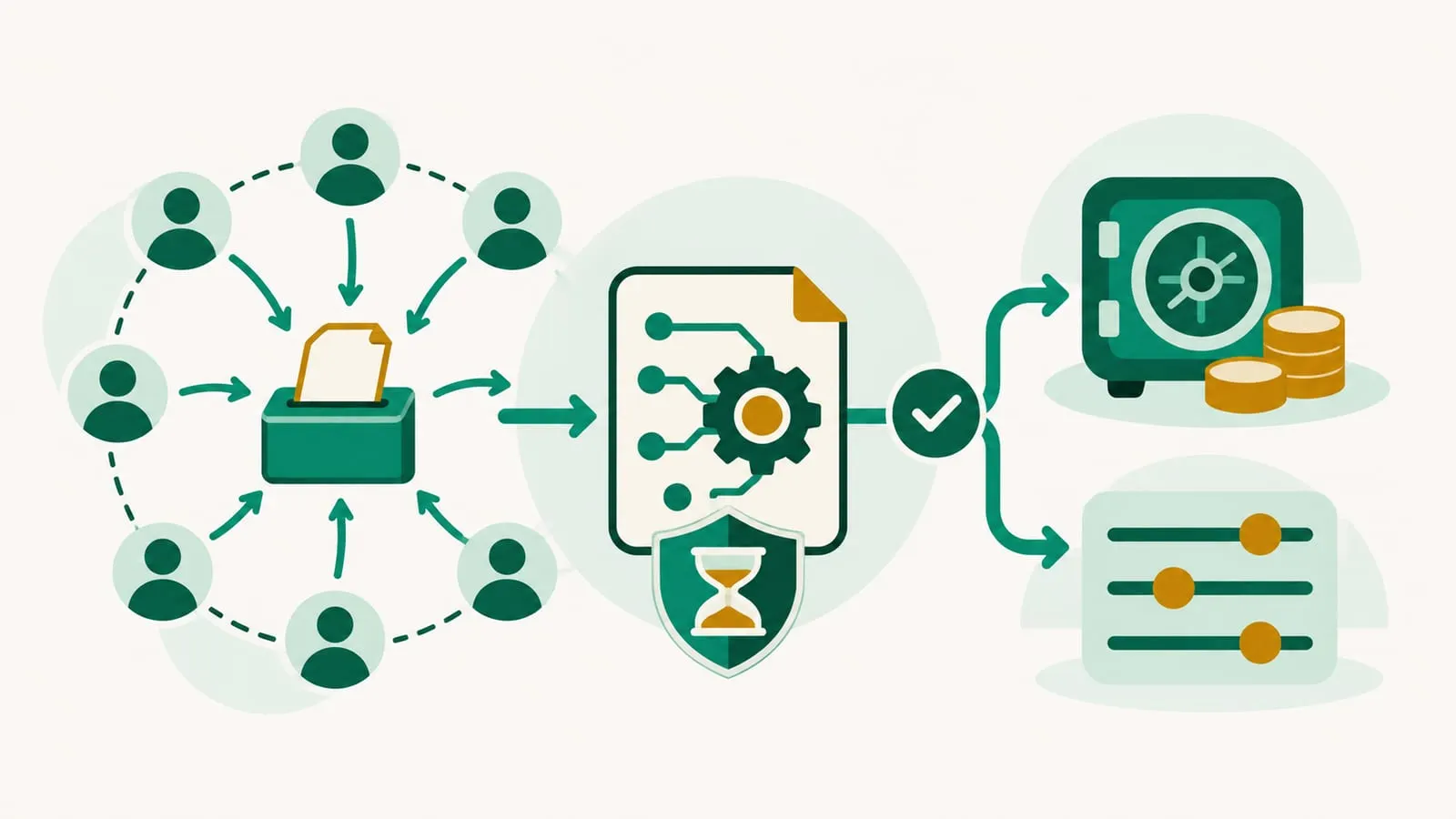
A DAO (decentralized autonomous organization) is a group that runs its shared money and rules through smart contracts on a blockchain. Members, usually holders of a governance token, propose and vote on decisions. When a proposal passes, the smart contract can carry it out on its own, for example by sending funds from the treasury or changing a protocol setting.
So there’s no CEO with the final say. The “board” is whoever holds voting power, the “bank account” is a treasury contract, and the “bylaws” are a mix of code and written community rules.
The building blocks of a DAO
| Part | What it does | Common tools |
|---|---|---|
| Membership and voting power | Decides who can vote and how much each vote weighs | ERC-20 governance tokens, NFTs, membership shares, multisig signer lists |
| Governance contract | Records proposals, counts votes, enforces quorum and thresholds | OpenZeppelin Governor, Aragon OSx plugins |
| Treasury | Holds the DAO’s funds and only releases them when rules are met | A treasury contract or a multisig wallet such as Safe |
| Timelock | Delays execution so people can react to a bad proposal | Timelock contracts |
| Off-chain coordination | Discussion, polls, working groups | Forums, Discord, Snapshot |
Voting power is usually “one token, one vote”. Holders who don’t want to research every proposal can delegate their votes to someone else, which is how most large DAOs get enough turnout to function.
How a decision gets made
Most established DAOs follow a version of the same pipeline. Uniswap’s published process (checked November 2026) is a good real example:
- Discussion. Someone posts a request for comment on the governance forum. Uniswap asks for at least seven days of discussion.
- Temperature check. An off-chain poll, usually on Snapshot, which lets token holders vote by signing a message instead of paying gas. Uniswap’s runs for five days and needs at least 10 million UNI voting in favour to move on.
- On-chain vote. The final proposal, including the exact transactions to run, goes on-chain. At Uniswap the submitter needs 1 million UNI delegated to them, voting lasts seven days after a two-day delay, and a proposal needs 40 million UNI in favour to pass.
- Timelock and execution. A passed proposal waits in a timelock (two days at Uniswap), then anyone can trigger execution and the contract carries it out.
Smaller DAOs often skip steps: a five-person investment club might simply use a 3-of-5 multisig, where any three members can approve a payment. For more on the trade-offs, see our guide to the decentralized governance model.
How DAOs make money
A DAO is not a business model in itself; it’s a way of governing one. Money usually comes from:
- Protocol fees. A lending market, exchange or stablecoin system earns fees that flow, in whole or part, to the DAO treasury. MakerDAO (now Sky) is a long-running example.
- Token sales and reserves. Many DAOs keep a large share of their own token supply in the treasury and sell or grant it over time.
- Treasury management. Holding stablecoins, staking or lending out assets to earn yield.
- Member contributions. Investment, collector and social DAOs are often funded directly by members.
Our page on how DAOs make money goes deeper, and DAO treasuries explains how the funds are held and spent.
Why people take part
The original question asked what motivates people to govern. In practice:
- Financial stake. Token holders want the protocol, and therefore their tokens, to do well.
- Pay. Active contributors are usually paid in stablecoins or tokens through grants, bounties or ongoing roles approved by vote.
- Influence. Delegates, investors and teams building on the protocol vote to protect their interests.
- Belief in the project. Many communities, from open-source funding groups to social clubs, run on shared goals rather than profit.
The weak spot is that most holders don’t vote. Turnout on many proposals is a small fraction of supply, so outcomes are often decided by a handful of large holders and delegates.
How “decentralized” are DAOs really?
Less than the name suggests, often:
- Concentrated tokens. Founders, early investors and the team frequently hold enough to swing votes.
- Admin keys and multisigs. Many protocols still let a small group pause contracts or act in emergencies.
- Off-chain dependence. Anything outside the blockchain, such as paying a law firm, depends on people following the vote.
We cover this debate in are DAOs really decentralized and autonomous? and the advantages and disadvantages of DAOs.
Risks and legal questions
- Smart contract bugs. The first famous DAO, “The DAO” in 2016, was drained through a code flaw, and the SEC later concluded its tokens were securities. See smart contract vulnerabilities.
- Governance attacks. Someone who borrows or buys enough tokens can try to pass a malicious proposal, which is why timelocks and quorums exist.
- Legal liability. In June 2023 a US federal court in California entered a default judgment ordering the Ooki DAO to pay a $643,542 penalty to the CFTC, and holding that the DAO is a “person” under the Commodity Exchange Act that can be held liable. In November 2024, in Samuels v. Lido DAO, a federal judge in California refused to dismiss claims that the Lido DAO is a general partnership whose members can be liable. That was an early-stage ruling that the claim was plausibly alleged, not a final finding, and the case was still pending without a judgment in 2026. Many DAOs now use a legal wrapper; see the legal structure of a DAO.
- Tax. Token rewards, treasury income and contributor pay can all be taxable. See DAO tax.
A note on the old answer
The earlier community answer used Solana as an example of a DAO where each SOL is a vote. That isn’t how Solana works: SOL is a network token used for fees and staking, and the network isn’t run by token-holder governance votes. Real examples of token-governed DAOs include Uniswap, Aave, Lido and Sky (formerly MakerDAO).
Next steps
- How can I invest in a DAO project? explains DAO tokens and their risks.
- How much does it cost to set up a DAO? covers deployment and legal costs.
- Browse the full DAOs category.
Frequently asked questions
Who runs a DAO?
Formally, its token holders or members, who vote on proposals. Day to day, work is usually done by paid contributors, working groups or a foundation, and many DAOs still give a small multisig of trusted signers the power to act quickly in emergencies.
Do you need to own a token to be in a DAO?
For most token-governed DAOs, yes: voting power comes from holding or being delegated the governance token. Some DAOs use NFTs, non-transferable membership shares or a list of multisig signers instead.
Is a DAO a legal company?
Not automatically. Without a legal wrapper, US courts have allowed claims that a DAO is a general partnership to go forward, which could make active members personally liable. Some DAOs register as an LLC or foundation to avoid this.
Are DAO decisions really automatic?
Only the parts written into smart contracts. A passed on-chain proposal can execute code automatically, but off-chain work such as hiring, legal agreements and marketing still depends on people carrying out what was voted.
Sources
- Uniswap: Governance process (forum, Snapshot temperature check, on-chain vote)
- Snapshot documentation
- OpenZeppelin Contracts: Governance (Governor and timelock)
- Aragon OSx documentation
- SEC: Report of Investigation on The DAO (July 2017)
- CFTC: Court orders Ooki DAO to pay $643,542 penalty (June 2023)
- Eric Goldman: Samuels v. Lido DAO motion-to-dismiss ruling (November 2024)
- CourtListener: Samuels v. Lido DAO, 3:23-cv-06492 (N.D. Cal.) docket
Educational content, not financial advice. DeFi carries risk, including total loss of funds.