Liquidity Pool vs. Staking: Which Is Better for You in 2026?
On this page
The short answer
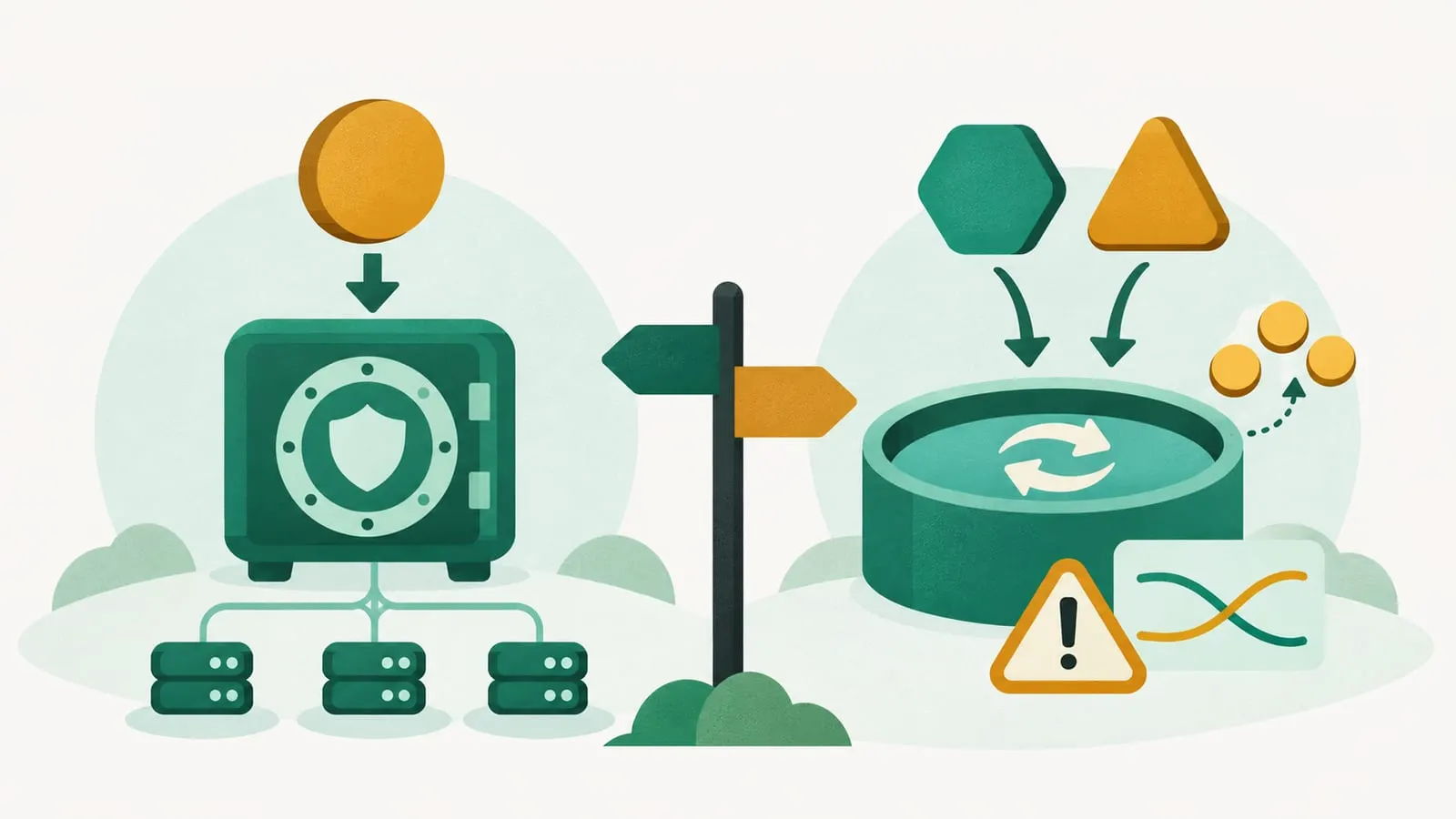
Neither is better in general; they solve different problems. Staking is for people who want to hold one proof-of-stake asset, such as ETH or SOL, and earn the network’s rewards with little effort. Providing liquidity to a DEX pool is for people willing to hold two assets, accept impermanent loss and manage positions in exchange for a share of trading fees.
On 16 November 2026, DefiLlama showed ETH liquid staking at roughly 1.8–2.5% a year and Solana liquid staking at about 5–5.7%. Fee yields on large Uniswap v3 ETH/stablecoin pools ranged from about 11% to over 80%, but those numbers swing daily and don’t account for impermanent loss, which is why the higher figure doesn’t automatically mean a better return.
What is staking?
Staking means locking a proof-of-stake network’s native token so it can be used to run validators that produce and confirm blocks. In return, the network pays rewards from new issuance and transaction fees. You can:
- Run a validator yourself (on Ethereum that takes 32 ETH and your own hardware).
- Stake through a pool or exchange, which runs the validator for you for a fee.
- Use liquid staking, such as Lido, which gives you a token (stETH) that keeps earning rewards and can be used elsewhere in DeFi. See our Lido liquid staking explainer.
Your return is the staking rate, paid in the same asset you staked, minus any operator fee. The main risks are the asset’s price, slashing if a validator misbehaves, withdrawal queues, and smart contract risk if you use a liquid staking protocol.
What is a liquidity pool?
A liquidity pool is a smart contract holding two or more tokens that traders swap against. As a liquidity provider, you deposit both tokens (for example ETH and USDC) and earn a share of the fee charged on every trade, typically 0.01% to 1% per swap on Uniswap v3 depending on the pool (Uniswap v4 pools can also set custom or dynamic fees). Some pools also pay extra token rewards (liquidity mining).
The catch is that the pool constantly rebalances as prices move. If ETH rises, the pool sells your ETH for USDC along the way, so you end up with less ETH than if you had just held it. That shortfall is impermanent loss. On concentrated-liquidity DEXs such as Uniswap v3 and v4, you choose a price range: you earn more fees while the price is in range, nothing when it moves out, and impermanent loss is magnified. Our explainer on how liquidity pool fees work covers the fee side.
Side-by-side comparison
| Staking | Liquidity pool | |
|---|---|---|
| What you deposit | One asset (ETH, SOL, etc.) | Usually two assets in a set ratio |
| Where the yield comes from | Network rewards (issuance and fees) | Trading fees, sometimes token incentives |
| Typical yield (16 Nov 2026, DefiLlama) | ETH liquid staking about 1.8–2.5%; SOL liquid staking about 5–5.7% | Highly variable: about 2% on the main Uniswap USDC/USDT pool, roughly 11–88% in fees on major ETH/stablecoin pools before impermanent loss |
| Impermanent loss | None | Yes, the main risk |
| Slashing | Possible (usually small) | No |
| Lockups | Withdrawal queues; liquid staking tokens can be sold instead | Usually withdraw anytime |
| Effort | Low | Medium to high, especially with price ranges |
| Smart contract risk | If using liquid staking or a pool | Always |
Rates are snapshots from DefiLlama Yields; check live data before acting.
Why LP yields look so high
The yield shown for a pool is usually the fees earned over a recent period divided by the pool’s total value, annualized. Three things make it misleading:
- It ignores impermanent loss. If ETH rises 50%, a full-range ETH/USDC position ends up about 2% behind simply holding; if ETH halves, about 5.7% behind. With a narrow concentrated range, the gap can be far larger.
- It’s an average. Concentrated positions that sit out of range earn nothing, while tight in-range positions earn more than the average and take more impermanent loss.
- Volume moves. A pool’s displayed yield can swing several-fold within weeks. The 0.3% ETH/USDT pool on Ethereum, for example, showed about 23% on 16 November 2026 against a 30-day average of about 54%.
Stablecoin pools (such as USDC/USDT) have almost no impermanent loss while both coins hold their peg, but their fees are correspondingly low, about 2% on the main Uniswap pool in November 2026.
A note on “staking” on DeFi platforms
On many exchanges and DeFi apps, “staking” means depositing the platform’s own token into a rewards pool, for example staking CAKE on PancakeSwap or locking a governance token. That isn’t network staking: rewards come mostly from token emissions or protocol fees, and their value depends on that token’s price. Very high advertised APYs on these pools are usually funded by printing new tokens. The old version of this page noted that some 2021–22 protocols advertised APYs in the thousands or more; those projects largely collapsed.
Which should you choose?
Staking tends to fit you if you:
- already plan to hold ETH, SOL or another proof-of-stake asset long term;
- want low maintenance;
- don’t want to think about price ranges or rebalancing.
Liquidity providing tends to fit you if you:
- understand impermanent loss and can calculate whether fees will cover it;
- are comfortable holding both assets in the pair;
- can monitor and adjust positions, or use a stable pair.
Many people combine both: they stake ETH through a liquid staking token and then pair it in a correlated pool such as stETH/ETH. That stacks yields but also stacks risks, including a depeg of the staking token.
For more detail, compare yield farming vs staking, read which is more profitable: yield farming or staking, and see whether AMM liquidity pools are worth it.
Risks
- Price risk. Both strategies pay you in crypto. A 3% staking yield doesn’t offset a 30% price drop.
- Impermanent loss (pools). Can exceed fees when prices move sharply.
- Smart contract risk. Pools, liquid staking protocols and reward contracts can be exploited.
- Slashing and withdrawal delays (staking). Validator penalties and exit queues can delay or reduce what you get back.
- Reward-token risk. Incentive tokens often lose value faster than they’re paid out.
- Scam pools. New tokens with tiny pools can be rug-pulled; see how to tell if you’ve been a victim of a liquidity mining scam.
None of this is investment advice. For the bigger picture, see the risks of yield farming or browse the yield farming and staking guide.
Frequently asked questions
Is staking safer than a liquidity pool?
Usually it is simpler, because you hold a single asset and avoid impermanent loss. It still carries price risk, smart contract risk if you use a liquid staking protocol, slashing risk and withdrawal delays.
Can you lose money in a liquidity pool?
Yes. If the prices of the pooled tokens diverge, impermanent loss can exceed the fees you earn, and the tokens themselves can fall in value. Pools can also be hacked or drained by scam token creators.
Why are liquidity pool APYs so much higher than staking?
Displayed LP yields are usually recent fees divided by the pool's total value, before impermanent loss. Higher numbers compensate for more risk, and they can drop sharply when trading volume falls.
Can I stake and provide liquidity at the same time?
Yes. Liquid staking tokens such as stETH can be paired in pools (for example stETH/ETH on Curve), earning staking rewards plus pool fees, with added layers of smart contract and depeg risk.
What does 'staking' mean on DEXs like PancakeSwap?
On many DeFi platforms 'staking' means locking the platform's own token to earn more of it or a share of fees. That is different from network staking: the rewards usually come from token emissions and depend on the token's price.
Sources
Educational content, not financial advice. DeFi carries risk, including total loss of funds.