What Is a Flat Hierarchy? Meaning, Pros, Cons and How DAOs Use It
On this page
Flat hierarchy: definition
A flat hierarchy is an organizational structure with few or no levels of middle management between the people at the top and everyone else. It is also called a flat organization or horizontal structure. Instead of passing decisions up a long chain of command, employees or teams have more authority to decide for themselves, and leaders deal with staff more directly.
A “flatter hierarchy” is the relative version: an organization that has removed some management layers without abolishing them.
The idea matters in crypto because decentralized autonomous organizations (DAOs) are, in effect, an attempt to run organizations with a flat structure enforced by code.
Flat vs. hierarchical organizations
| Traditional hierarchy | Flat hierarchy | |
|---|---|---|
| Management layers | Many | Few or none |
| Who decides | Managers, escalating upward | Individuals and teams, with leaders for big calls |
| Communication | Through the chain of command | Direct |
| Roles | Defined job titles and reporting lines | Fluid; people often take several roles |
| Strengths | Clear accountability, predictable at scale | Speed, autonomy, low overhead |
| Weaknesses | Slow, bureaucratic | Unclear responsibility, informal power, hard to scale |
Advantages
- Faster decisions. Fewer approval layers mean less waiting.
- Autonomy and ownership. People choose or shape their work, which many find motivating.
- Lower overhead. Fewer managers means lower salary costs.
- Better information flow. Ideas and problems reach decision-makers without being filtered.
Disadvantages
- Unclear accountability. When nobody is “the boss”, it can be unclear who owns a failure.
- Hidden hierarchies. Influence does not disappear; it moves to people with seniority, relationships or information. Feminist writer Jo Freeman called this the “tyranny of structurelessness” in a widely read 1970s essay.
- Role overload. Generalists may stretch across too many tasks, and specialization suffers.
- Scaling problems. What works for 50 people often breaks at 5,000 without clear processes.
- Career paths. With no ladder of titles, promotion and pay decisions can feel opaque.
Examples of flat organizations
- Valve. The game company’s Handbook for New Employees (first edition, March 2012) welcomes staff to “Flatland”: it says Valve has no management and nobody reports to anybody else, though it does have a founder/president. Employees choose their own projects, and desks have wheels so people can move to join teams.
- Morning Star. Gary Hamel’s December 2011 Harvard Business Review article profiled this California tomato processor, which had about 400 full-time staff (and far more in the harvest season) and no managers. Each year employees negotiate a “Colleague Letter of Understanding” with the colleagues most affected by their work.
- Zappos. The online retailer announced at the end of 2013 that it would move to Holacracy, a formal system of self-managing “circles” and written roles, and in 2015 offered a buyout to staff who did not want to work that way; reports put the share who left at roughly 14–18%. It shows that going flat usually means adding rules, not removing them.
Many startups are flat by default simply because they are small. Larger companies more often adopt hybrid models, such as self-managed teams inside a conventional structure.
What makes a flat structure work?
Organizations that run flat for years tend to replace the manager with something else rather than with nothing:
- Clear, written agreements. Morning Star staff draw up commitments with the colleagues their work affects, so responsibilities are explicit even without a boss.
- Transparent information. People can only decide well if they can see budgets, priorities and results.
- Peer review and feedback in place of a manager’s appraisal, often including peer input on pay.
- Defined decision rules. Who can decide what, and how disagreements are resolved, is written down in advance.
- Small, stable teams in which people know each other’s work.
Without these, a flat structure tends to drift into the problems listed above: decisions stall, and influence collects around a few well-connected people. The same applies on-chain, where the “written agreements” are smart contracts and governance rules.
Flat hierarchies and DAOs
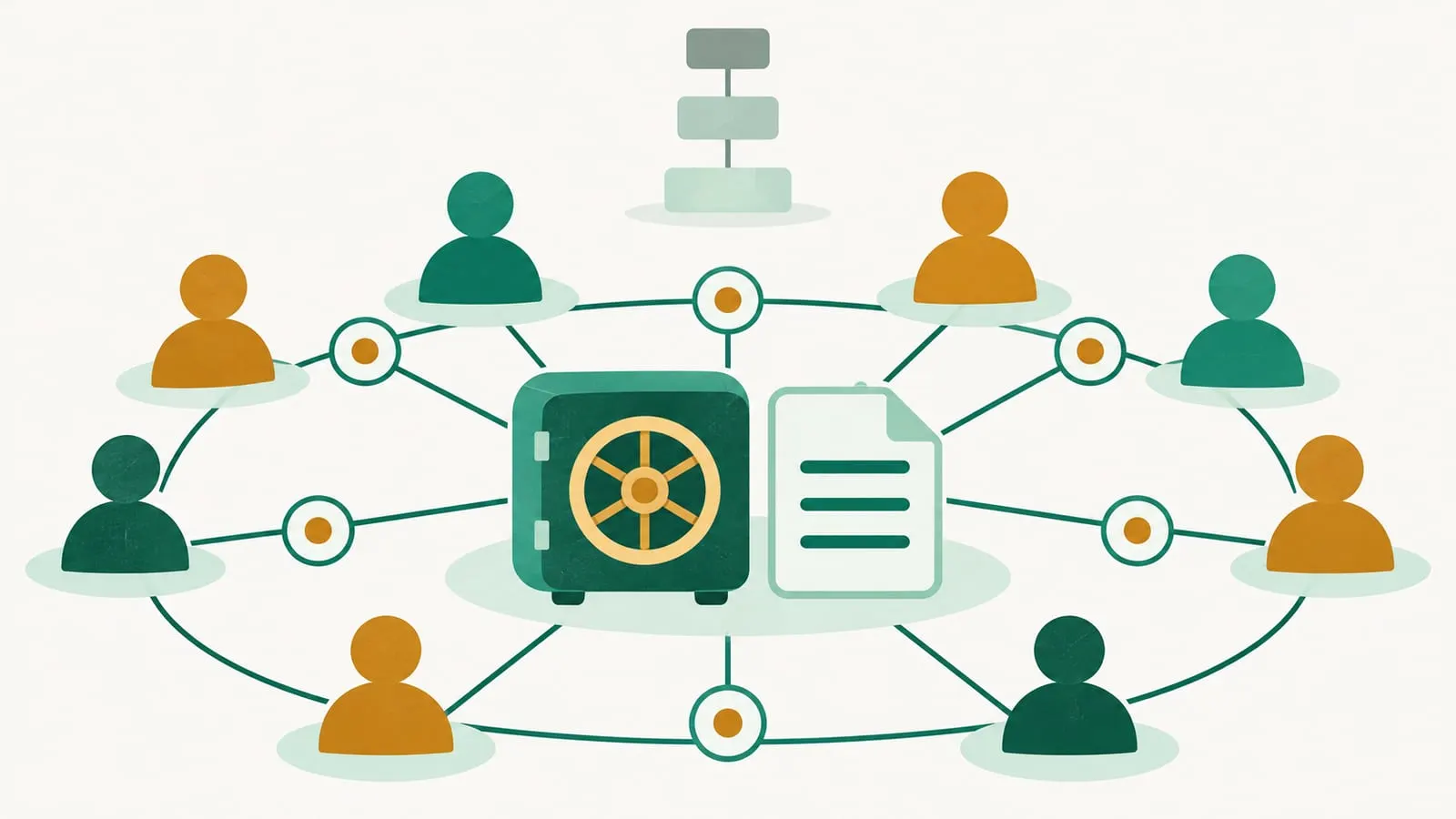
A DAO replaces managers with rules written in smart contracts and decisions made by governance token holders. ethereum.org describes DAOs as member-owned communities without centralized leadership, where funds are held in a shared treasury and spent only with members’ approval. Typical features:
- Anyone holding the token can propose and vote.
- The DAO treasury is controlled by votes rather than a CFO.
- Contributors are often paid per task or role, not hired into a reporting line.
DAOs show both sides of flat organization clearly. They can coordinate thousands of people across borders with no hiring process, but they also struggle with:
- Low voter turnout, which leaves decisions to a small active group.
- Concentrated voting power among large holders, funds or delegates.
- Slow or chaotic decision-making on complex operational questions, which leads many DAOs to recreate committees, working groups and delegated leaders.
For more, see the decentralized governance model, the challenges of decentralized governance and the advantages and disadvantages of DAOs. The broader idea is covered under decentralization and decentralized governance.
Frequently asked questions
What does a flatter hierarchy mean?
A flatter hierarchy has fewer management layers than a traditional one. Companies 'flatten' by removing middle-management levels so that more people report directly to senior leaders or manage their own work.
What is the difference between a flat and a hierarchical structure?
A hierarchical structure has many levels, each reporting to the one above, with authority concentrated at the top. A flat structure has few levels, wider spans of control and more decisions made by teams or individuals.
Are DAOs flat organizations?
Formally many are, because any token holder can propose and vote. In practice, voting power often concentrates among large holders, delegates and core contributors, so DAOs can be less flat than they appear.
Does a flat hierarchy work in large companies?
It is harder. Most fully flat organizations are small or medium-sized; large ones that try it usually add structure such as self-managed teams, clear roles and agreed decision processes.
Sources
Educational content, not financial advice. DeFi carries risk, including total loss of funds.