Is It Safe to Use High Leverage for Crypto Scalping?
On this page
Hi, I want to try out a new trading strategy with my crypto. I'm looking for something that is a little more fast-paced. I'm aware that scalping is a high risk, but if I can get it down, then I'd make significant profits.
Ideally, I want to leverage my trades while focusing on a small number of pips. Would this decrease the risk involved?
The short answer
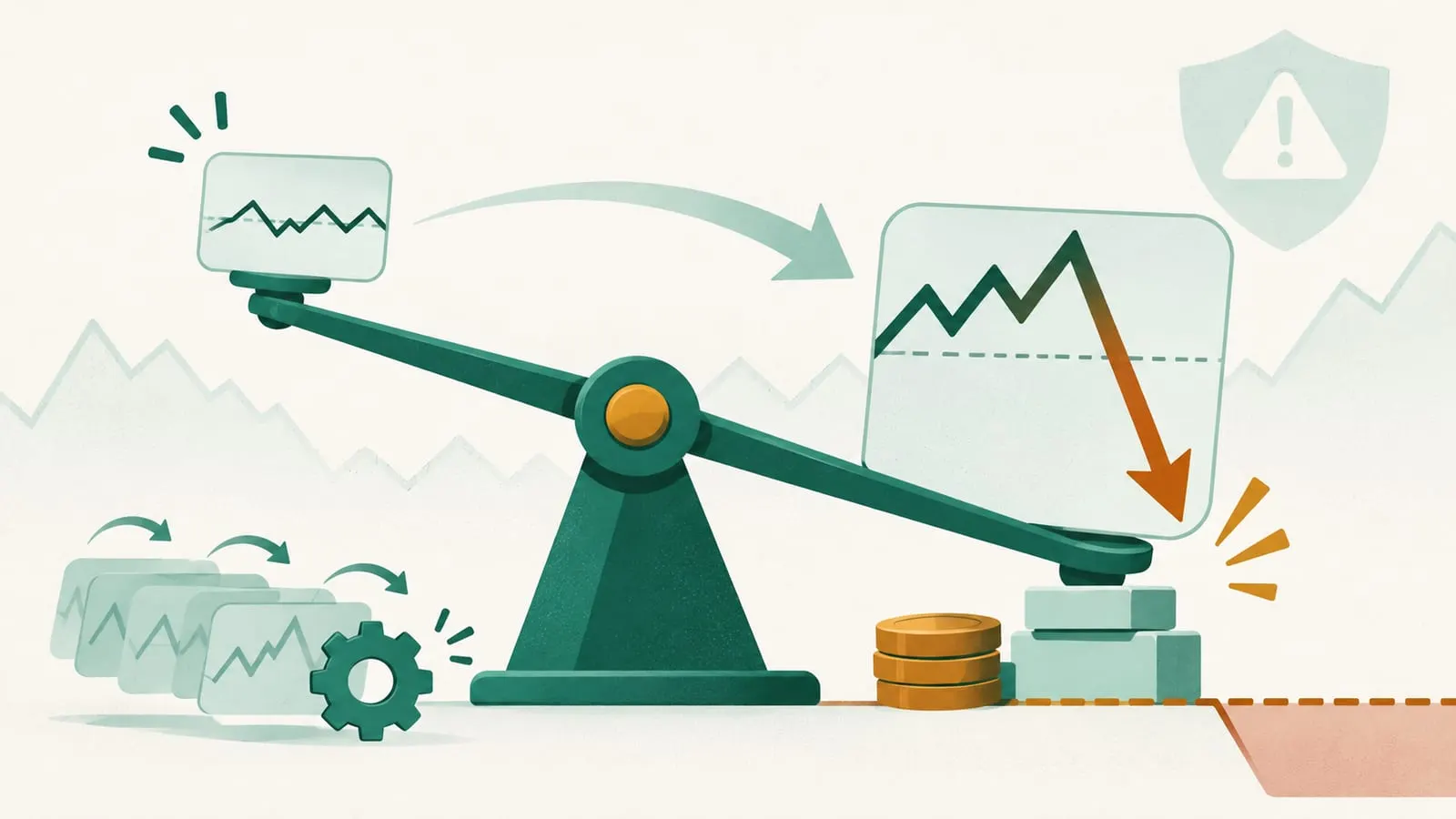
No. Using high leverage does not reduce the risk of scalping; it increases it. Scalping means taking many short trades to capture small price moves. Leverage makes each small move matter more in both directions, so the same tiny move that produces your target profit can, in the other direction, liquidate the whole position. On top of that, trading fees are charged on the full leveraged position, which eats a large share of the small gains scalping depends on.
The original question asked whether leveraging trades while targeting “a small number of pips” would decrease risk. It does the opposite. The old community answer on this page used the example of turning a $10 stake into a $10 profit with 100x leverage on a 1% move. The same 1% move the other way would liquidate that position entirely, which is why we have removed it.
What scalping and leverage actually are
Scalping is a very short-term trading strategy: positions last seconds to minutes and aim for gains of a fraction of a percent. It depends on tight spreads, fast execution and low fees, which is why it overlaps with high-frequency trading done by firms with dedicated infrastructure.
Leverage lets you control a position larger than your deposit. With $1,000 of margin at 20x, you control a $20,000 position. Profit and loss are calculated on the $20,000, but only your $1,000 can be lost before the position is closed.
The math: why small targets and high leverage collide
Liquidation distance
Roughly, the price move that wipes out your margin is 1 divided by your leverage. Venues close you out earlier, when your equity falls below the maintenance margin, so the real distance is a little smaller than this.
| Leverage | Move against you that erases your margin (approx.) |
|---|---|
| 2x | 50% |
| 10x | 10% |
| 20x | 5% |
| 50x | 2% |
| 100x | 1% |
A scalper aiming for a 0.3% gain at 100x has their liquidation price well under 1% away. Ordinary noise, a single large market order or a news headline can cover that distance before you can react. See how liquidation works for the mechanics.
Fees scale with leverage
Exchanges charge fees on position size, not on your margin. Using Hyperliquid’s base-tier taker fee of 0.045% as an example (fees vary by venue and volume tier):
| Leverage | Round-trip taker fees as a share of your margin |
|---|---|
| 1x | 0.09% |
| 10x | 0.9% |
| 20x | 1.8% |
| 50x | 4.5% |
| 100x | 9% |
At 100x, each in-and-out trade costs about 9% of your margin in fees alone, before spreads, slippage and funding. A strategy that trades dozens of times a day has to clear that bar every time.
Win rate needed rises
Scalping usually means a small target and a stop of similar size. When fees take a fixed slice of every trade, you need to win noticeably more than half of your trades just to break even, and at high leverage a single trade that gaps through your stop can undo many wins.
How risk is actually controlled
Risk is measured by how much of your account you can lose on one trade, not by a leverage setting. As an illustration, take a $10,000 account, a limit of risking at most 1% ($100) per trade, and a stop 0.5% from entry: the position can be at most $20,000, about 2x the account, whatever leverage the venue allows. Selecting 100x does not make that trade any bigger or safer; it only means less collateral sits behind the position, so a smaller adverse move triggers liquidation, sometimes before the stop.
Practical points that reduce, but never remove, the risk:
- Lower or no leverage. The lower the leverage, the further away your liquidation price. Trading without leverage removes liquidation risk entirely.
- Isolated margin. It limits a single position’s loss to the collateral assigned to it, instead of the whole account.
- Stop-loss orders. A stop-loss order caps the planned loss but can fill at a worse price in a fast market.
- Know the venue’s rules. Mark price, maintenance margin, liquidation fees and auto-deleveraging differ between exchanges.
- Paper trade first. Many venues offer a demo or testnet, which shows whether a strategy survives fees before real money is involved.
For how leverage should relate to holding period, see should my leverage factor and trading time frame correlate, and for sizing the collateral, how to determine the collateral required to leverage a crypto trade.
What the evidence says
- Most retail leveraged traders lose. Analyses by EU national regulators, cited by ESMA when it agreed its CFD restrictions in 2018, found that 74–89% of retail CFD accounts typically lose money. In response, retail leverage on crypto CFDs was capped at 2:1, a limit EU national regulators have since made permanent. CFDs are not identical to crypto perpetuals, but they are the best-documented retail comparison.
- UK retail access is banned. The FCA has prohibited the sale of crypto derivatives to UK retail consumers since January 2021, citing extreme volatility and consumers’ inability to value the products. When it reopened retail access to crypto exchange-traded notes in October 2025, it said the derivatives ban would remain in place.
- Liquidations are routine, not rare. CoinGlass’s 2026 semi-annual report counted about $73.4 billion of liquidations in the first half of 2026 across the exchanges in its sample, roughly $400 million a day, with long positions making up about 62%.
High-leverage products are also not available everywhere. Most offshore and on-chain perp venues exclude US persons; our guide to trading crypto futures explains what is legal in the US, and the most popular margin platforms covers regional rules elsewhere.
Risks to weigh before any leveraged scalping
- Total loss of margin through liquidation, sometimes within minutes.
- Fee drag that makes a strategy with more wins than losses still lose money.
- Execution risk: latency, slippage, exchange outages and stop orders filling far from their trigger.
- Funding payments on perpetual futures if positions are held across funding intervals.
- Behavioral risk: fast trading invites revenge trades and position sizing that grows after losses.
- Scams: “signal” groups, bots and copy-trading schemes promising consistent scalping profits are a common fraud pattern.
Nothing here is a recommendation to trade with leverage. If you want to improve short-term trading, start with spot trading strategy and a realistic view of what a small account can earn.
Frequently asked questions
What leverage do scalpers use?
There is no safe or standard number. Offshore venues advertise 50x to 100x or more, while regulated venues cap retail leverage far lower, such as 2:1 on crypto CFDs in the EU. The higher the leverage, the closer your liquidation price sits to your entry.
Is 100x leverage good for scalping?
It is the setting most likely to end the account. At 100x, roughly a 1% move against you, minus the maintenance margin, closes the position, and fees on the full position consume a large share of each small win.
Is scalping profitable in crypto?
For most retail traders, no evidence suggests it is. Scalping relies on many small wins, so trading fees, spreads and slippage take a large share of gross profit, and professional firms compete with faster execution and lower fees.
Does a stop-loss make high-leverage scalping safe?
It helps but does not guarantee anything. In fast markets a stop can fill well beyond its trigger price, and at very high leverage the stop and the liquidation price can be so close that the gap between them is meaningless.
What does 'pips' mean in crypto?
Pips are a forex unit for the smallest standard price move. Crypto traders usually talk in ticks or percentages instead, since each market sets its own tick size.
Sources
- ESMA: Restrictions on CFDs to protect retail investors
- Hyperliquid Docs: Fees
- Hyperliquid Docs: Liquidations
- dYdX Docs: Liquidations
- FCA: FCA bans the sale of crypto-derivatives to retail consumers
- CoinGlass: 2026 Semi-Annual Cryptocurrency Derivatives Market Report
- FCA: FCA opens retail access to crypto ETNs (derivatives ban remains)
Educational content, not financial advice. DeFi carries risk, including total loss of funds.