Venture Capital Fund: Definition, How It Works and Crypto VC Funds
On this page
What is a venture capital fund?
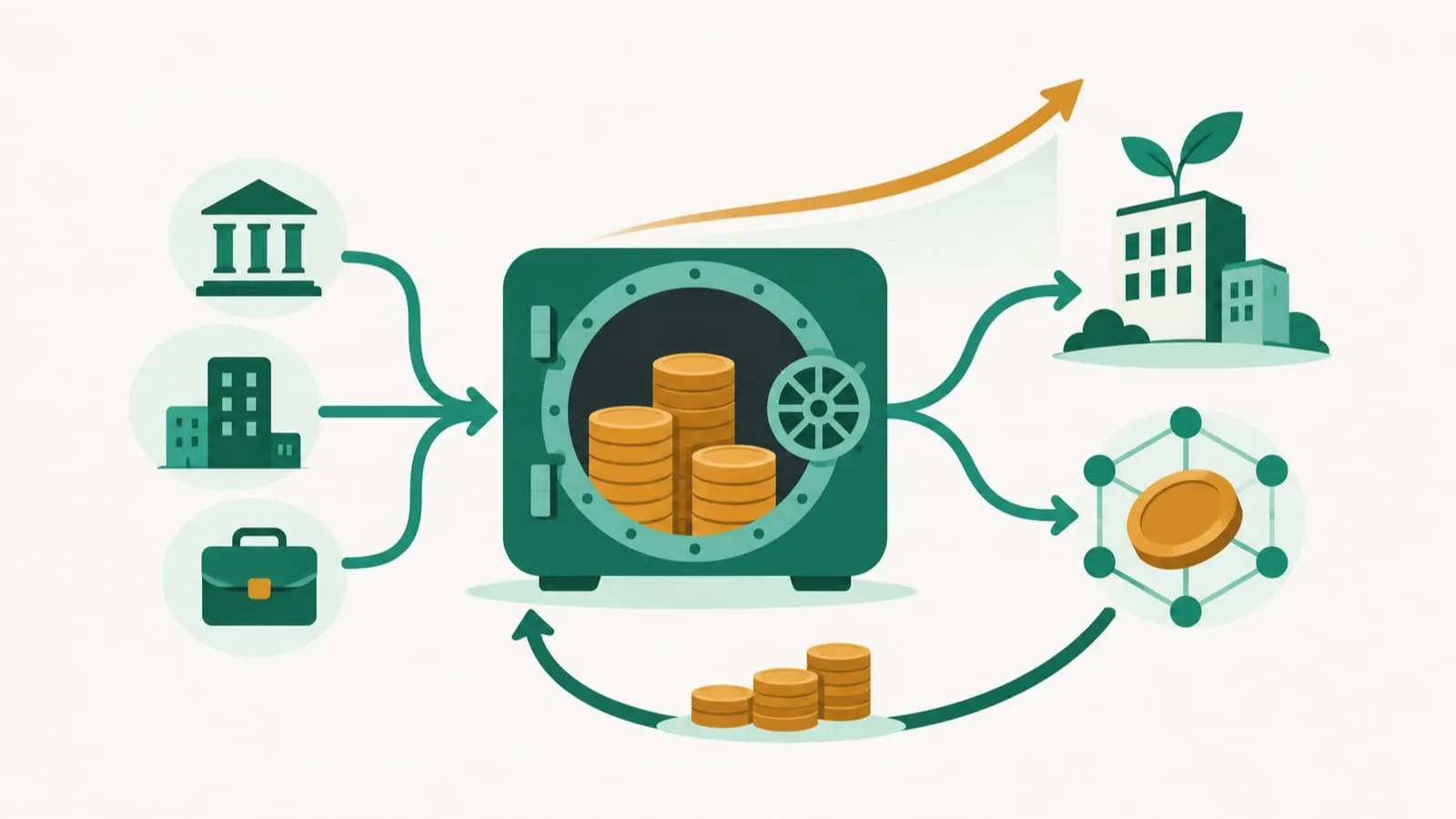
A venture capital (VC) fund is a private investment fund that pools money from outside investors and invests it in young, fast-growing companies in exchange for an ownership stake. The fund’s managers pick the companies, help them grow, and aim to sell those stakes years later for much more than they paid. In crypto, VC funds often buy a project’s tokens as well as, or instead of, shares.
VC is one of the highest-risk forms of investing. Most startups a fund backs fail or return little, so a fund’s results depend on a small number of big successes.
How a VC fund is structured
Most VC funds are set up as limited partnerships:
- Limited partners (LPs) supply almost all of the money. They are typically pension funds, university endowments, foundations, insurance companies, family offices and wealthy individuals. LPs don’t make day-to-day decisions.
- The general partner (GP) is the VC firm (or an entity it controls). It sources deals, decides what to invest in, sits on company boards and decides when to sell.
Investors make a commitment when the fund is raised, and the GP “calls” that capital in stages as it finds investments. One VC firm usually runs several funds over time, each a separate vehicle (Fund I, Fund II and so on).
How long VC funds last and how they’re paid
| Feature | Typical terms |
|---|---|
| Fund life | Usually 10 years by contract, often with extensions |
| Investment period | Often the first 3-5 years, when new companies are added |
| Management fee | Around 2-2.5% of committed capital per year, sometimes stepping down later (for example to a share of invested capital) |
| Carried interest (“carry”) | About 20% of profits, paid to the GP after investors get their capital back |
| Exit routes | IPO, acquisition, secondary sale, or (in crypto) selling unlocked tokens |
The fee-plus-profit-share model is often called “2 and 20”. Terms vary by firm and fund: carry can depend on the manager’s track record, and some funds pay carry only after investors also receive an agreed minimum return (a “hurdle” or preferred return).
Stages of venture funding
Funds usually specialize in a stage:
- Pre-seed and seed: the earliest money, often before a product exists.
- Early stage (Series A): a working product and first users.
- Growth or late stage (Series B, C and later): scaling a proven business.
Some funds also specialize by sector (for example crypto, biotech or fintech) or by region.
Crypto venture capital funds
Crypto VC follows the same basic model, with some important differences:
- Tokens, not just shares. Funds buy tokens in private rounds, through SAFTs (simple agreements for future tokens), or receive “token warrants” alongside equity. Our page on tokens explains the different types.
- Faster liquidity. A token can list on exchanges within a year or two of a funding round, much sooner than a typical startup IPO. Vesting schedules and “cliffs” control when investors can sell.
- Governance power. Large holdings of governance tokens can give funds real influence over a protocol’s DAO.
- Regulatory questions. Since the SEC’s 2017 report on The DAO, token sales have raised securities-law questions in the US that equity rounds largely avoid.
Crypto fund sizes rise and fall with the market. For example, a16z crypto raised $4.5 billion for its fourth fund in 2022 and $2.2 billion for its fifth in May 2026, while Paradigm raised an $850 million fund in June 2024. Mandates are also widening: in October 2026 a16z renamed its crypto arm a16z Frontier and widened its new fund’s scope to other “frontier” technologies such as AI, while saying it will keep investing in crypto, and Paradigm’s $1.2 billion fund of July 2026 covers crypto, AI and robotics. For background on the main firms, see our guide to top crypto venture capital firms.
DAOs and “decentralized” venture capital
Some groups have tried to run venture investing through a DAO, where members pool crypto in a shared DAO treasury and vote on investments. These “investment DAOs” lower the barrier to taking part, but they bring their own issues: unclear legal status, smart-contract risk and governance that can be dominated by a few large holders. Read more in the role of DAOs in decentralizing venture capital and decentralized hedge funds.
Venture capital fund vs other fund types
| Venture capital fund | Mutual fund / ETF | Hedge fund | |
|---|---|---|---|
| What it buys | Stakes in private, early-stage companies (and tokens) | Publicly traded securities | Mostly liquid assets, many strategies |
| Who can invest | Institutions and qualified/accredited investors | The general public | Institutions and qualified investors |
| Access to your money | Locked up for about 10 years or more | Usually daily | Periodic redemptions |
| Typical fees | ~2% plus ~20% carry | Low annual expense ratio | Often a management fee plus performance fee |
Risks of venture capital
- High failure rate. Most portfolio companies fail or return little.
- Illiquidity. Money is locked up for a decade or more with no easy exit.
- Valuation uncertainty. Private holdings are marked by estimates until they’re sold.
- Crypto-specific risks. Token prices are volatile, smart contracts can be exploited, and regulation keeps changing.
- Fees. Management fees are charged whether or not the fund performs.
Retail investors usually can’t buy into VC funds directly. If you’re considering token projects that VCs have backed, see how to invest in a DAO project for what governance tokens do and don’t give you, and our funding glossary entry for related terms.
Frequently asked questions
What is a venture capital fund in simple terms?
It is a pot of money from many investors that a professional firm invests in young companies with big growth potential. If some of those companies become very valuable, the fund's investors share the profits.
How is a venture capital fund different from a mutual fund?
A mutual fund invests in publicly traded securities, is open to the public and lets you redeem shares. A VC fund invests in private companies, is usually open only to institutions and wealthy investors, and locks money up for a decade or more.
What is the 2 and 20 fee model?
It refers to a roughly 2% yearly management fee on committed capital plus 20% of the fund's profits (carried interest) going to the general partner. Exact terms vary by fund.
Can I invest in a venture capital fund?
Usually only if you meet your country's rules for professional, accredited or qualified investors, and minimums are high. Some listed companies, funds and online platforms give indirect or small-scale exposure, with their own fees and risks.
Sources
- AngelList: Management fees (typical fees, step-downs, carry and fund life)
- Cointelegraph: a16z crypto raises $2.2 billion for its fifth fund (May 2026)
- a16z Frontier (Chris Dixon): a16z Frontier, renaming announcement (22 October 2026)
- a16z: Crypto Fund 5, $2.2 billion (5 May 2026)
- Fortune: Andreessen Horowitz renames a16z Crypto as a16z Frontier (October 2026)
- Paradigm: Announcing Paradigm's Third Fund (June 2024)
- SEC: Report of Investigation on The DAO (July 2017)
Educational content, not financial advice. DeFi carries risk, including total loss of funds.
Guides about Venture capital fund
- Top 6 Crypto Venture Capital Firms
Venture capitalism has been growing in crypto, and knowing how to capitalize on this opportunity can make a world of difference for a retail investor.
- The Role of DAOs in Decentralizing Venture Capital
Venture capitalism is profitable, but the barriers for entry are too high for most investors. Read to learn how investment DAOs solve this problem.